








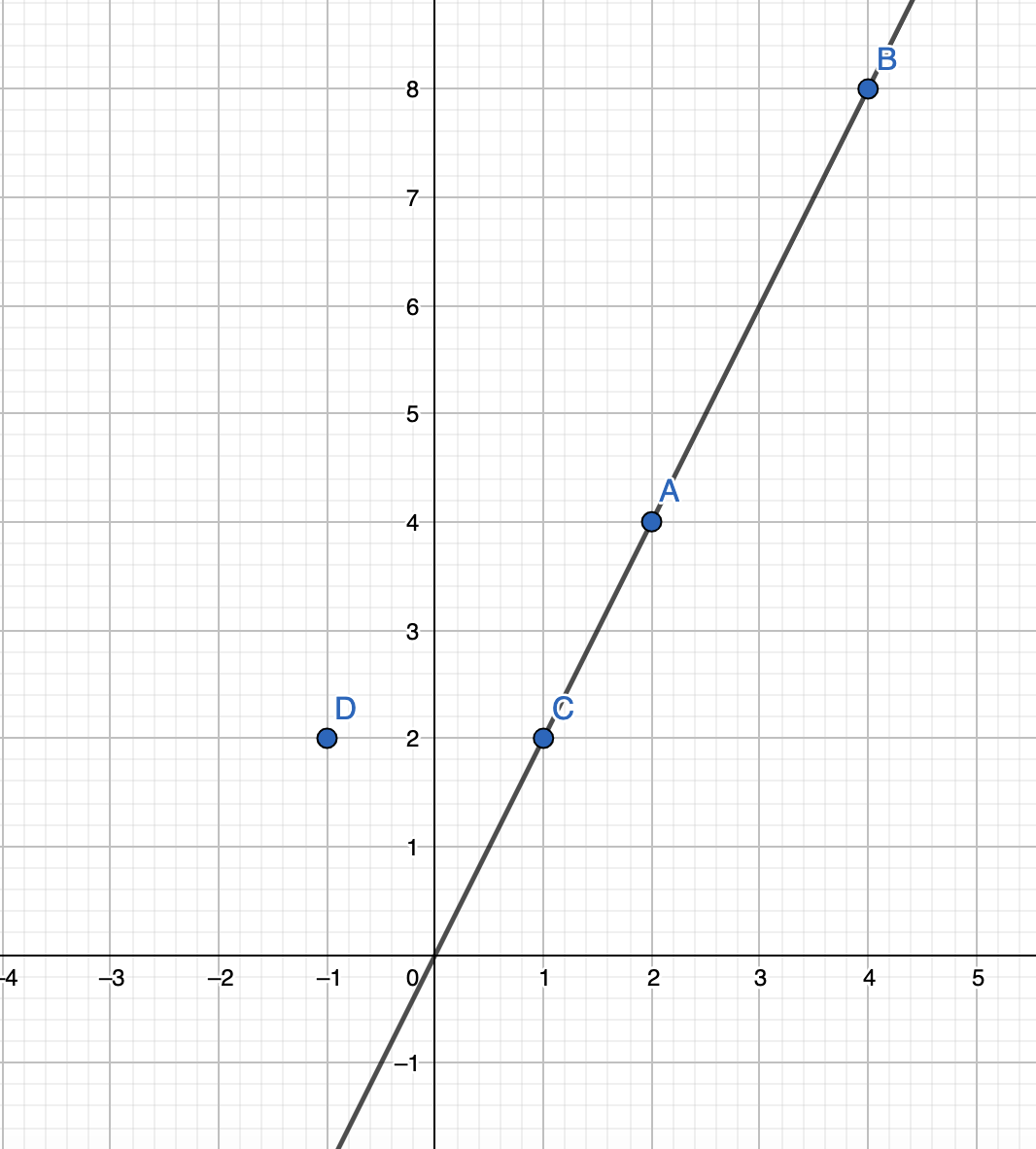
ARR = [ (2,4), (4,8), (-1,2), (1,2) ]
Here answer is 3 as (1,2), (2,4), (4,8) lie on the same line.
The first line of input contains an integer 'T' denoting the number of test cases to run. Then the test case follows.

The first line of each test case contains an integer 'N', the number of points in ARR.

The next 'N' lines of each test case contain two space-separated integers ‘X’ and ‘Y’ denoting the coordinates of the points in ARR.
For each test case print an integer denoting the maximum number of collinear points.

Output for each test case will be printed in a separate line.
You don’t need to print anything. It has already been taken care of. Just implement the given function.
1 <= T <= 5
1 <= N <= 2000
-10^9 <= X[i], Y[i] <= 10^9

All the points in ARR are pairwise distinct.

Time Limit: 1 sec
Approach: The key observation here is that if we will fix two points on a line all other points which are collinear can be uniquely determined. We will fix a certain point and then for all the other points, we can make a counter based on the slope of the segment joining it and the fixed point.
The Algorithm will be:

