










If edges[i][j] = 1, that implies there is a bi-directional edge between ‘i’ and ‘j’, that means there exists both edges from ‘i’ to ‘j’ and to ‘j’ to ‘i’.
Given:
‘N’ = 3
‘edges’ = [[0, 1, 1], [0, 0, 1], [0,0,0]].
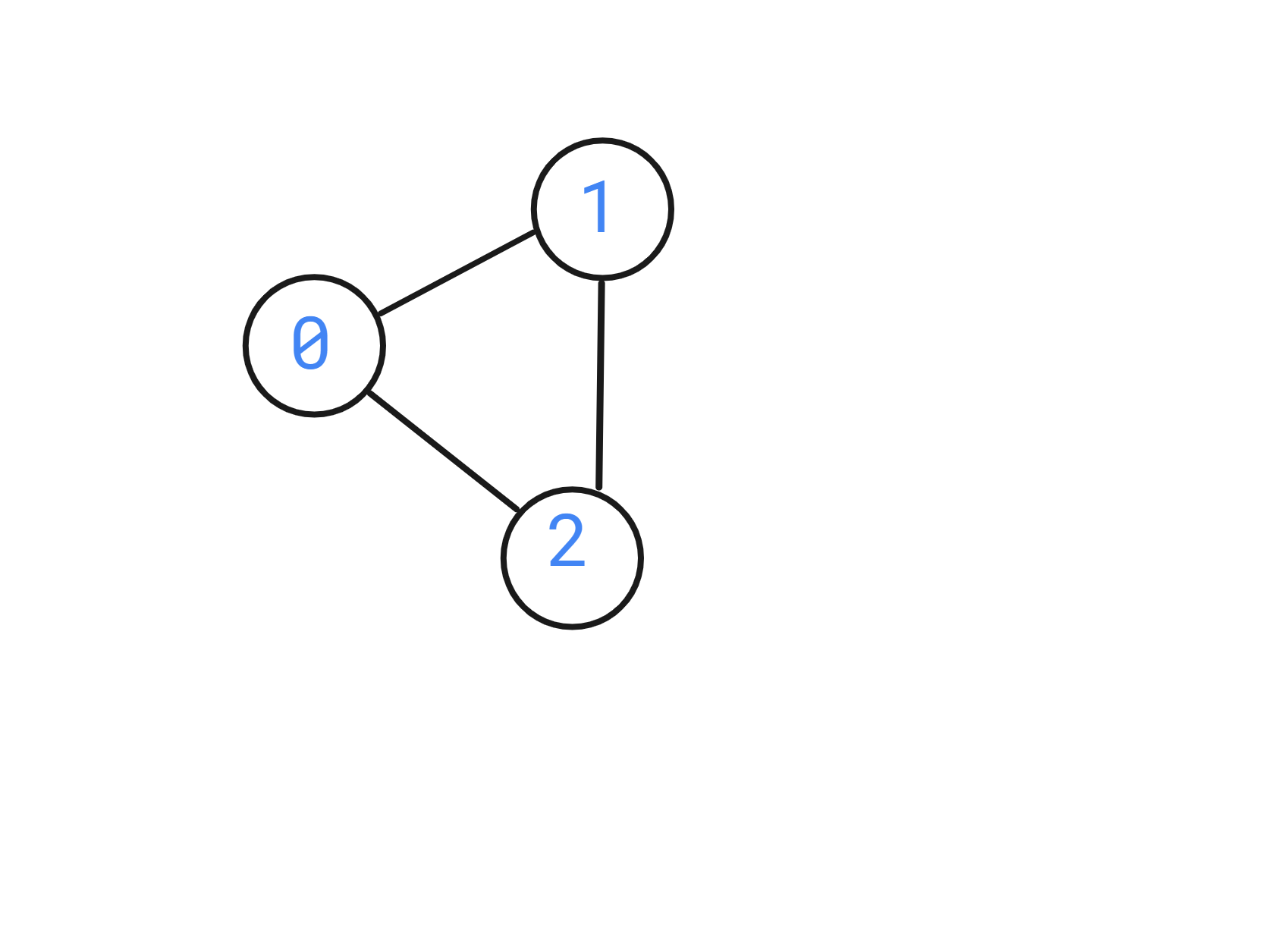
The first line of input contains an integer ‘T’ denoting the number of test cases.

The first line of each test case contains two space-separated integers, ‘N,’ where ‘N’ is the number of rows in ‘edges’ and the number of columns in ‘edges’.

The next ‘N’ line of each test case contains ‘N’ space-separated integers which tell if there is an edge between ‘i’ and ‘j’.
For each test case, You are supposed to return a bool value determining whether the graph is bipartite or not.
You are not required to print the expected output; it has already been taken care of. Just implement the function.
1 <= ‘T’ <= 10
2 <= ‘N’ <= 300
0 <= ‘edges[i][j]’ <= 1.

Time Limit: 1sec.
The idea is that a bipartite can be colored in such a way that only 2 colors in total would be used, where the neighbor nodes have different colors. Therefore we can do a breadth-first search and assign colors to each vertex and if at any point neighboring nodes have the same color we return false.
The steps are as follows:

