










You may assume that duplicates do not exist in the given traversals.
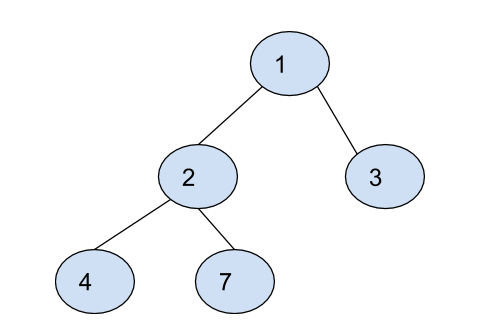
For the preorder sequence = [1, 2, 4, 7, 3] and the inorder sequence = [4, 2, 7, 1, 3], we get the following binary tree.
The first line contains an integer ‘N’ denoting the number of nodes in the binary tree.

The second line case contains ‘N’ integers denoting the preorder traversal of the binary tree.

The third line contains ‘N’ integers denoting the inorder traversal of the binary tree.
Print the level order traversal of the constructed binary tree separated by a single-space.

For example, the output for the tree depicted in the below image would be :
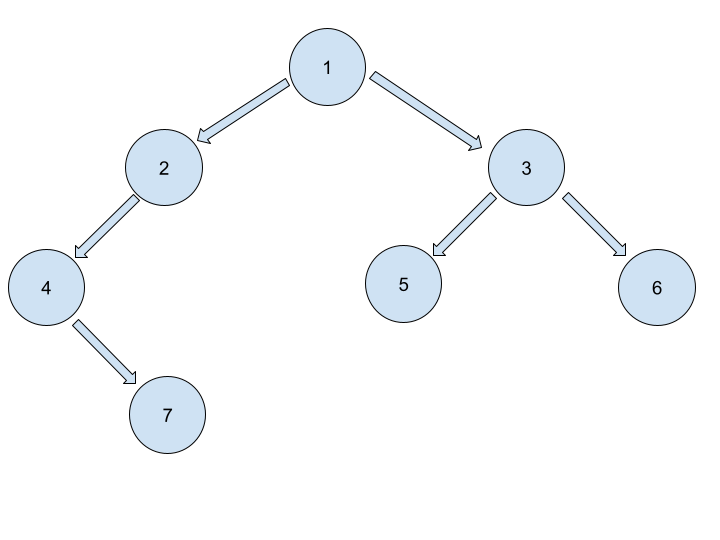
Level Order Traversal:
1
2 3
4 5 6
7


Explanation :
Level 1 :
The root node of the tree is 1

Level 2 :
Left child of 1 = 2
Right child of 1 = 3

Level 3 :
Left child of 2 = 4
Right child of 2 = null
Left child of 3 = 5
Right child of 3 = 6

Level 4 :
Left child of 4 = null
Right child of 4 = 7
Left child of 5 = null
Right child of 5 = null
Left child of 6 = null
Right child of 6 = null

Level 5 :
Left child of 7 = null
Right child of 7 = null
Here, if the node is null, print nothing. The above format was just to provide clarity on how the output is formed for a given tree.
The sequence will be put together in a single line separated by a single space. Hence, for the above-depicted tree, the output will be:

1 2 3 4 5 6 7
You do not need to print anything; it has already been taken care of. You just need to return the root node of the constructed binary tree.
The basic idea of this approach is to build the tree recursively by utilizing the property of preorder and inorder traversal of a binary tree.
Consider a recursive function “constructTree” which takes five arguments: “inStart”, “inEnd”, “pIndex”, “inorder”, “preorder”. Here “inorder” and “preorder” as the inorder sequence and preorder sequence of the binary tree respectively. And, “inStart” and “inEnd” denote the starting and ending index of the inorder sequence of the given subtree and “pIndex” represents the index of the first element of the preorder sequence of the given subtree.
The node at index “pIndex” in the preorder traversal will be the root node of the binary tree. The idea here is to find the index of the root node in the inorder traversal because that index will divide the inorder traversal into two parts. For this, consider “inIndex” is equal to “inStart”. Then iterate over the inorder from “inStart” to “inEnd”. As we find the index of the root node in inorder, store it in “inIndex”. Now, the node from index “inStart” to “inIndex” - 1 are the inorder sequence of the left subtree of the root node and the node from index “inIndex” + 1 to “inEnd” are the inorder sequence of the right subtree.
Now, the problem is reduced to constructing the left and right subtree and then linking it to the root node. We can follow the same procedure and build the left and right subtree recursively.
Algorithm:
The basic idea of this approach is to use HashMap to store a key, value pair of <nodeValue, index> of the inorder sequence. Since we are searching the index of the root node in the inorder sequence in each recursive call, we can optimize it from O(N) to O(1) using HashMap.
Consider a recursive function “constructTree” which takes five arguments: “inStart”, “inEnd”, “pIndex”, “inorderIndex”, “preorder”. Here “inorderIndex” denotes HashMap to store a key, value pair of <nodeValue, index> , “preorder” denotes the preorder sequence of the binary tree respectively. And, “inStart” and “inEnd” represent the starting and ending index of the inorder sequence of the given subtree and “pIndex” denotes the index of the first element of the preorder sequence of the given subtree.
The node at index “pIndex” in the preorder traversal will be the root node of the binary tree. The idea here is to find the index of the root node in the inorder traversal because that index will divide the inorder traversal into two parts. The index of the root node can be found from “inorderIndex” and store in the variable “inIndex”. Now, the node from index “inStart” to “inIndex” - 1 are the inorder sequence of the left subtree of the root node and the node from index “inIndex” + 1 to “inEnd” are the inorder sequence of the right subtree.
Now, the problem is reduced to constructing the left and right subtree and then linking it to the root node. We can follow the same procedure and build the left and right subtree recursively.
Algorithm:

