








1. The size of ‘ARR’ will always be greater than or equal to the ‘K’.
2. Here window refers to a subarray of ‘ARR’. Hence ‘K’ sized window means a subarray of size ‘K’.
3. You are not required to print the output explicitly. It has already been taken care of. Just implement the function and return an array of the count of all distinct elements in the ‘K’ size window.
Consider ARR = [ 1, 2, 1, 3, 4, 2, 3 ] and K = 3.
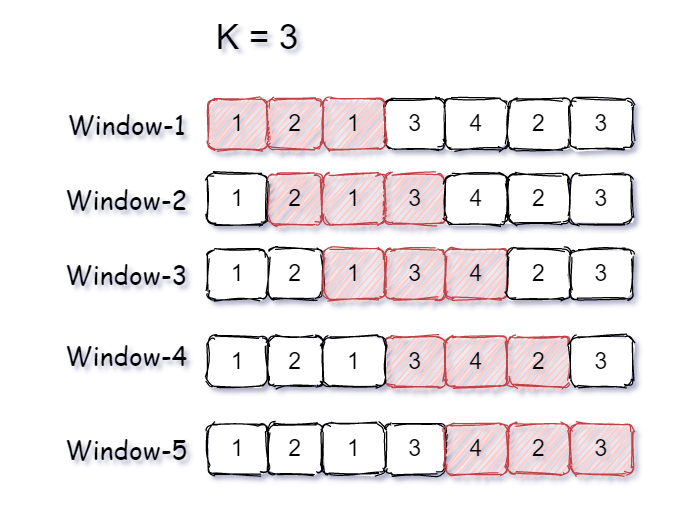
As per the given input, we have a sequence of numbers of length 7, and we need to find the number of distinct elements present in all the windows of size 3.

Window-1 has three elements { 1, 2, 1 } and only two elements { 1, 2 } are distinct because 1 is repeating two times.
Window-2 has three elements { 2, 1, 3 } and all three elements are distinct { 2, 1, 3 }.
Window-3 has three elements { 1, 3, 4 } and all three elements are distinct { 1, 3, 4 }.
Window-4 has three elements { 3, 4, 2 } and all three elements are distinct { 3, 4, 2 }.
Window-5 has three elements { 4, 2, 3 } and all three elements are distinct { 4, 2, 3 }.

Hence, the count of distinct elements in all K sized windows is { 2, 3, 3, 3, 3 }.
The first line of the input contains an integer, 'T,’ denoting the number of test cases.
The first line of each test case contains two space-separated integers, 'N' and ‘K’, denoting the number of elements in the array and the size of the window.
The second line of each test case contains 'N' space-separated integers denoting the elements of the array 'ARR'.
For each test case, print an array that contains the number of distinct elements in all ‘K’ size windows, and the count of distinct elements must be from the left to the right window.

Print the output of each test case in a separate line.
1 <= T <= 10
1 <= N <= 10 ^ 5
1 <= K <= N
1 <=ARR[i] <= 10 ^ 9

Where 'T' denotes the number of test cases, 'N' denotes the number of elements in the array, ‘K’ denotes the size of the window, and 'ARR[i]' denotes the 'i-th' element of the array 'ARR'.

Time limit: 1 second
The basic idea of this approach is to check every window of size K and count the number of distinct elements in each window.
Our approach will be to maintain an array answer, which will store the count of the distinct elements in every window. We will traverse through each window and find the number of distinct elements in the current window.
We will return the array answer.
The basic idea of this approach is to store every distinct element present in the window in the HashMap, and we will find the number of distinct elements in the window with the help of HashMap.
Our approach will be to maintain an array answer, which will store the count of the distinct elements in every window. We will traverse through each window and find the number of distinct elements in the current window.
We will return the array answer.
Algorithm:
The basic idea of this approach is to maintain a window and then slide the window by one element at each step. We will achieve this by using a HashMap to maintain the frequency of elements present in the window. While we are sliding the window, we add an element in the window and remove an element from the window.
Our approach will be to maintain an array answer, which will store the count of the distinct and a HashMap to store the frequency of elements in the current window.
We will return the array answer.
Algorithm:

