










This game is played between two people (Player 1 and Player 2). Player 1 chooses ‘X' and Player 2 chooses ‘O’ to mark their cells. A move is guaranteed to be valid and is placed on an empty block.

A player who successfully places 'N' of their marks in a horizontal, vertical, or diagonal row wins the game. Once a winning condition is reached, no more moves are allowed.
0: No one wins.
1: Player 1 wins.
2: Player 2 wins.
Let us assume if ‘N’ = 3 and player 1 places ‘X’ and player 2 places ‘O’ on the board.
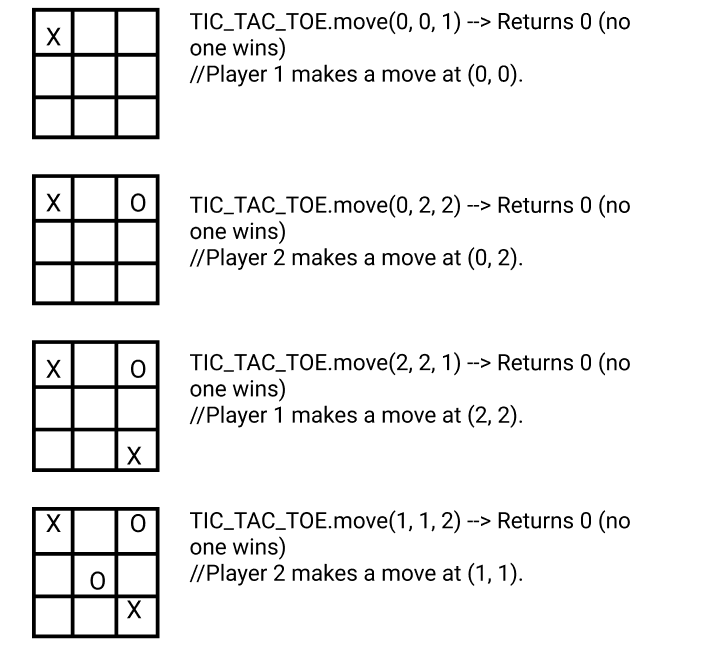
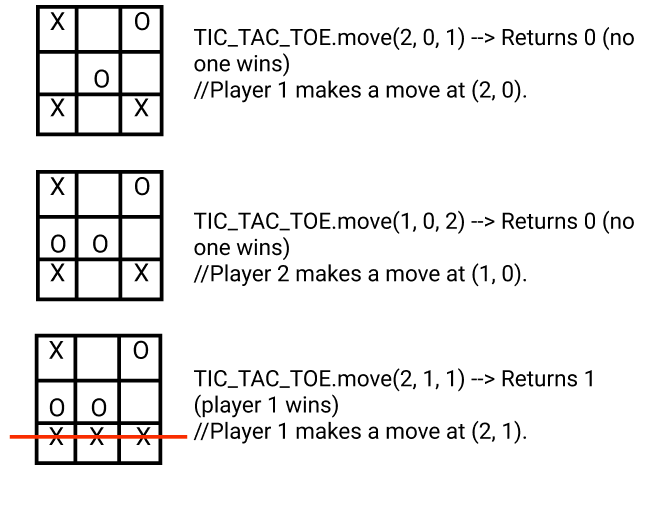
The first line of input contains an integer ‘T’ which denotes the number of test cases.

The first line of each test case contains an integer ‘N’ that represents the size of the ‘N’ * ‘N’ grid.

The next line of each test case contains an integer ‘Q’ that represents the number of queries.

The next ‘Q’ lines of each test case contain three single space-separated integers ‘ROW’, ‘COL’, and ‘PLAYER’ representing the current row and column of the grid and the current player (1 or 2).
For each test case, Ninja has to complete the function ‘move’ and return either 0, 1, and 2.

Print the output of each test case in a separate line.
You do not need to print anything; it has already been taken care of. Just implement the given function.
1 <= ‘T’ <= 100
1 <= ‘N’ <= 100
5 <= ‘Q’ <= ‘N*N’
0 <= ‘ROW’ , ‘COL’ < ‘N’
‘PLAYER’ = {1, 2}

Where ‘ROW’ and ‘COL’ represent the current row and column of the grid and ‘PLAYER’ represents the current player.

Time Limit: 1 sec
In this approach first, we make a move or place an ‘X’ or ‘O’ with respect to the player on the ‘TIC_TAC_TOE’ grid and then check if the current player wins or not.
The steps are as follows:
We can optimise our above approach. We know all moves are guaranteed to be valid. So we do not need to keep track of an entire ‘TIC_TAC_TOE’ grid. We declare two arrays/lists ‘ROWS’ and ‘COLS’ in which we store count of moves of both players in each row and column of the ‘TIC_TAC_TOE’ grid. If at any time the count of the current player is equal to ‘N’ then that player has won.
The steps are as follows:

