











1. You are not required to print the output explicitly, it has already been taken care of. Just implement the function and return the ‘K-th’ smallest element of BST.
2. You don’t need to return ‘K-th’ smallest node, return just value of that node.
3. If ‘K-th’ smallest element is not present in BST then return -1.
The first line of input contains an integer ‘T’ denoting the number of test cases.
The next ‘T’ lines represent the ‘T’ test cases.

The first line of input contains a single integer ‘K’.
The second line of input contains the elements of the tree in the level order form separated by a single space.
If any node does not have a left or right child, take -1 in its place. Refer to the example below.

Example:

Elements are in the level order form. The input consists of values of nodes separated by a single space in a single line. In case a node is null, we take -1 in its place.

For example, the input for the tree depicted in the below image would be :
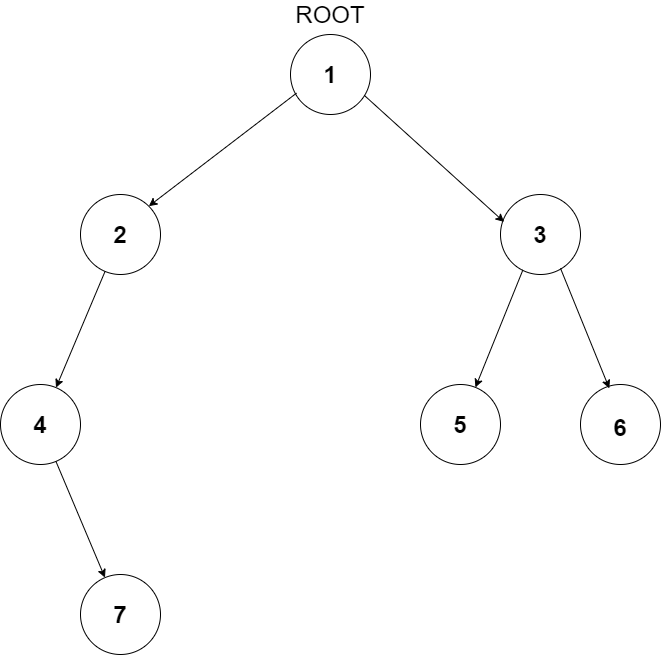
1
2 3
4 -1 5 6
-1 7 -1 -1 -1 -1
-1 -1

Explanation :
Level 1 :
The root node of the tree is 1

Level 2 :
Left child of 1 = 2
Right child of 1 = 3

Level 3 :
Left child of 2 = 4
Right child of 2 = null (-1)
Left child of 3 = 5
Right child of 3 = 6

Level 4 :
Left child of 4 = null (-1)
Right child of 4 = 7
Left child of 5 = null (-1)
Right child of 5 = null (-1)
Left child of 6 = null (-1)
Right child of 6 = null (-1)

Level 5 :
Left child of 7 = null (-1)
Right child of 7 = null (-1)

The first not-null node (of the previous level) is treated as the parent of the first two nodes of the current level. The second not-null node (of the previous level) is treated as the parent node for the next two nodes of the current level and so on.

The input ends when all nodes at the last level are null (-1).
The above format was just to provide clarity on how the input is formed for a given tree.

The sequence will be put together in a single line separated by a single space. Hence, for the above-depicted tree, the input will be given as:

1 2 3 4 -1 5 6 -1 7 -1 -1 -1 -1 -1 -1
For every test case, return the ‘K-th’ smallest element.
1 <= T <= 100
1 <= N, K <= 3000
-10^9 <= data <= 10^9

Where ‘T’ represents the number of test cases, ‘N’ is the number of nodes in the tree, ‘K’ denotes given integer and ‘data’ denotes data contained in the node of a binary tree.

Time Limit: 1 sec
The basic idea is that traversal the whole tree in an inorder manner and adds the node values in an array and at the end return the ‘k-1’th element of the array. Due to BST property, inorder traversal of BST will in a sorted order( ascending ).
The basic idea is that traversal the tree in an inorder manner with help of iteration, so we don’t need a size ‘n’ call stack( call stack required to store all the calls from a function that is currently executing). But in an iterative manner, we can optimize it in O(H) space.
Code -
In this approach, we will use the Morris traversal algorithm, which is the space optimization of approach-2.
    5
   / \
  3   7
 / \   \
2   4   9
       /
      8
  3
 / \
2   4
     \
      5
       \
        7
         \
         9
        /
       8
2
 \
  3
   \
    4
     \
      5
       \
        7
         \
         9
        /
       8
Guess Price
Unique BSTs
Unique BSTs
Unique BSTs
Kth Largest Element in BST
Two Sum IV - Input is a BST
Icarus and BSTCOUNT

