





Last Updated: 9 Jan, 2021

Find Kth row of Pascal's Triangle

Easy
Asked in companies
OlaMAQ SoftwareGoogle inc

Problem statement

You are given a non-negative integer 'K'. Your task is to find out the Kth row of Pascal’s Triangle.

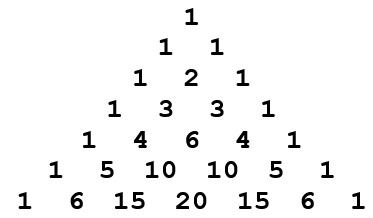
In Mathematics, Pascal's triangle is a triangular array where each entry of a line is a value of a binomial coefficient. An example of Pascal’s triangle is given below.

example

Example :-

INPUT : K = 2
OUTPUT: 1 1

In the above example, K = 2, Hence the 2nd row from the top of pascal’s triangle, as shown in the above example is 1 1.

INPUT   : K = 4
OUTPUT  : 1 4 6 4 1

In the above example, K = 4, Hence the 4th row from the top of pascal’s triangle, as shown in the above example is 1 3 3 1.
Input Format
The first line of input contains an integer 'T' representing the number of the test case. Then the test case follows.

The first and the only line of each test case contains a single integer “K”.
Output Format:
For every test case, print a single line containing 'R' space-separated integers showing the Kth row of pascal’s triangle, where 'R' is the number of elements in a particular row.

The output of each test case will be printed in a separate line.
Note
You don’t have to print anything, it has already been taken care of. Just implement the given function. 
Constraints:
1 <= T <= 50
1 <= K <= 50

Where ‘T’ is the number of test cases, ‘K’ is the input row number.

Time limit: 1 sec.

Approaches

01 Approach

In this approach, we find the row elements of the previous row using recursion, and based on the values of previous row elements, we will evaluate the current row elements.

  1. We are given a function kthRow() which takes an integer ‘K’ as the only parameter and returns an integer vector. This is the definition of our recursive function too.
  2. As the base condition of our recursive function, we will check if ‘K’ is equal to 1 or not. If ‘K’ is 1, we will return the vector containing 1.
  3. Now we will call our recursive function kthRow() with K - 1 as our new parameter to store the previous row elements.
  4. Now by adding the previous row elements, we will find the current row elements and then return the current row.

02 Approach

In this approach, we will build our solution in the bottom-up manner storing the results in a 2D array “DP”.


  1. We are given a function kthRow() which takes an integer ‘K’ as the only parameter and returns an integer vector.
  2. Initialize a vector “RESULT” to store the final result.
  3. Initialize a 2D integer array “DP” with both rows and columns equal to ‘K’.
  4. Now in a nested loop, we will build our array “DP” using the bottom-up approach, forming the current element by adding values just above it.
  5. Finally, add the final row elements of “DP” in the array “RESULT” and return it as our final answer.

03 Approach

  1. We are given a function kthRow() which takes an integer ‘K’ as the only parameter and returns an integer vector.
  2. Initialize a vector “RESULT” to store the final result.
  3. Initialize two arrays of size K, as “PREVROW” and “CURRROW” to store previous row and current row of the triangle.
  4. Now in a nested loop, we will build our array “CURRROW” using the bottom-up approach, forming the current element by adding values of “PREVROW”.
  5. Finally, add the final row elements of “CURRROW” in the array “RESULT” and return it as our final answer.

04 Approach

In this approach, we will try to observe the pattern and make the sequence for the current row elements. We can clearly see that the Kth row of pascal’s triangle has the sequence : C(K, 0), C(K, 1), ..., C(K, K - 1), C(K, K), where C(N, R) is the binomial coefficient or Combination function. As C(K, 0) = 1, we can evaluate other values of the sequence by the formula, C(N, R) = (C(N, R - 1) * (N - R )) / R .

  1. We are given a function kthRow() which takes an integer ‘K’ as the only parameter and returns an integer vector.
  2. We will store the value of the first coefficient, i.e C(K, 0) or 1 in a variable “PREV”. This variable will be used to store all the previous coefficient values
  3. Then in the loop, until we reach K, we will evaluate the value of each element of the Kth row and store it in the vector “ROWVECTOR”, simultaneously storing the current value in “PREV” for further use.
  4. Finally, we will return “ROWVECTOR” as our answer.