










If K is 4 and the tree is depicted by the following image then,
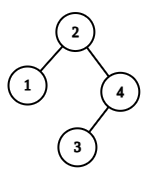
The 4th largest element in the given BST is 1. So the output will be 1.
Try to do it in O(1) space without using recursion.
The first line contains an Integer 'T' which denotes the number of test cases or queries to be run. Then the test cases follow.

The first line of each test case contains the elements of the tree in the level order form separated by a single space.
If any node does not have a left or right child, take -1 in its place. Refer to the example below.

The second line of each test case contains a single integer ‘K’, denoting ‘K’ as explained in the problem statement.
Elements are in the level order form. The input consists of values of nodes separated by a single space in a single line. In case a node is null, we take -1 in its place.

For example, the input for the tree depicted in the below image would be :
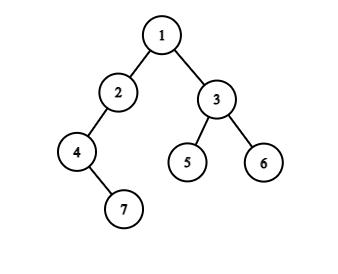
1
2 3
4 -1 5 6
-1 7 -1 -1 -1 -1
-1 -1

Explanation :
Level 1 :
The root node of the tree is 1

Level 2 :
Left child of 1 = 2
Right child of 1 = 3

Level 3 :
Left child of 2 = 4
Right child of 2 = null (-1)
Left child of 3 = 5
Right child of 3 = 6

Level 4 :
Left child of 4 = null (-1)
Right child of 4 = 7
Left child of 5 = null (-1)
Right child of 5 = null (-1)
Left child of 6 = null (-1)
Right child of 6 = null (-1)

Level 5 :
Left child of 7 = null (-1)
Right child of 7 = null (-1)

The first not-null node (of the previous level) is treated as the parent of the first two nodes of the current level. The second not-null node (of the previous level) is treated as the parent node for the next two nodes of the current level and so on.

The input ends when all nodes at the last level are null (-1).

Note: The above format was just to provide clarity on how the input is formed for a given tree.

The sequence will be put together in a single line separated by a single space. Hence, for the above-depicted tree, the input will be given as:

1 2 3 4 -1 5 6 -1 7 -1 -1 -1 -1 -1 -1
For each test case, print a single integer value representing the Kth largest value of the given BST.

Output for each test case will be printed in a separate line.
You are not required to print anything, it has already been taken care of. Just implement the function.
1 <= T <= 100
1 <= N <= 5 * 10^3
1 <= K <= N
0 <= X <= 10^9

Where ‘X’ is the value at the node and ‘N’ is the no. of nodes in given BST.

Time Limit: 1 sec.
The main idea is to use inorder traversal and get elements of the BST in sorted order. Then return the (n-k)th element. as it will be the Kth largest element. The implementation details are as per the following algorithm.
Inorder Function
Function arguments - Node * root, depicting the pointer to the node to which we are traversing, integer array order to store the elements in sorted order.
Saves the elements of given BST in sorted order in the order array.
Given Function
The idea is to use Reverse Morris Traversal which is based on Threaded Binary Trees. Threaded binary trees use the NULL pointers to store the successor and predecessor information which helps us to utilize the wasted memory by those NULL pointers.
The special thing about Morris traversal is that we can do Inorder traversal without using stack or recursion which saves us memory consumed by stack or recursion call stack.
Reverse Morris traversal is just the reverse of Morris traversal which is majorly used to do Reverse Inorder traversal with constant O(1) extra memory consumed as it does not use any Stack or Recursion.
To find Kth largest element in a Binary search tree, the simplest logic is to do reverse inorder traversal and while doing reverse inorder traversal simply keep a count of the number of Nodes visited. When the count becomes equal to k, we stop the traversal and print the data. It uses the fact that reverse inorder traversal will give us a list sorted in descending order. Implementation details are as per the following algorithm.
Given Function

