








Consider the Binary Tree below :
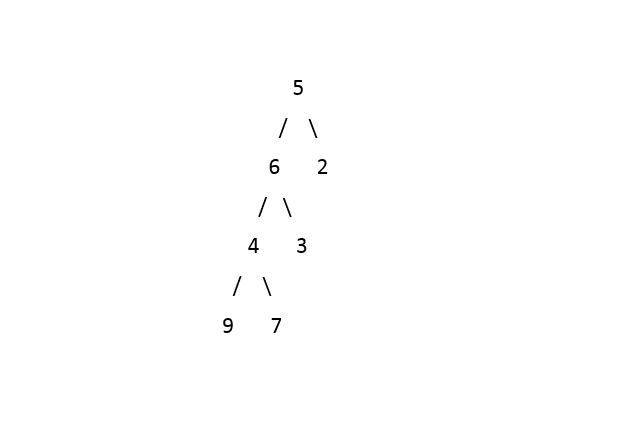
The number of nodes on the left side of node 6 is 3 while on the right side it is 1. Hence the answer for the above binary tree is false.
The first line contains a single integer ‘T’ denoting the number of test cases.

The first line of each test case contains the elements of the binary tree in the level order form separated by a single space.

If any node does not have a left or right child, take -1 in its place. Refer to the example below.
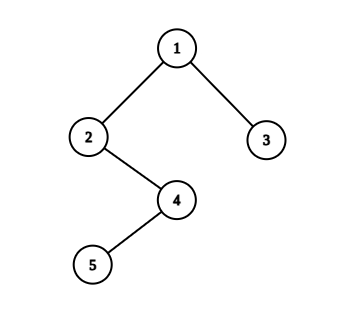
1
2 3
-1 4 -1 -1
5 -1
-1 -1

Explanation :
Level 1 :
The root node of the tree is 1

Level 2 :
Left child of 1 = 2
Right child of 1 = 3

Level 3 :
Left child of 2 = null (-1)
Right child of 2 = 4
Left child of 3 = null (-1)
Right child of 3 = null (-1)

Level 4 :
Left child of 4 = 5
Right child of 4 = null (-1)

Level 5 :
Left child of 5 = null (-1)
Right child of 5 = null (-1)

The first not-null node (of the previous level) is treated as the parent of the first two nodes of the current level. The second not-null node (of the previous level) is treated as the parent node for the next two nodes of the current level and so on.

The input ends when all nodes at the last level are null (-1).

Note: The above format was just to provide clarity on how the input is formed for a given tree.

The sequence will be put together in a single line separated by a single space. Hence, for the above-depicted tree, the input will be given as:

1 2 3 -1 4 -1 -1 5 -1 -1 -1
For each test case, return True or False denoting whether the given binary tree satisfies the above condition.
Output for each test case will be printed in a separate line.
You are not required to print anything; it has already been taken care of. Just implement the function.
1 <= T <= 100
1 <= number of nodes <= 1000
1 <= nodeVal <= 10^9

Time Limit: 1 sec
We can try to find the number of nodes in the subtree of a node as the sum of nodes in the left tree and right subtree + 1 (for the current node). We call another function that calculates the number of nodes in the subtree separately for left and right children. If at any node we encounter that the two values are not equal we return false immediately.
We can try to find the number of nodes in the subtree of a node as the sum of nodes in the left tree and right subtree + 1 (for the current node). It at any node we encounter that the two values are not equal we return false immediately. If not, we propagate the number of nodes up towards the parent node.
Sorted Doubly Linked List to Balanced BST
Longest Substring with K-Repeating Characters
Expression Add Operators
Gray Code Transformation
Count of Subsequences with Given Sum

