










The given string st = AABCBDC.
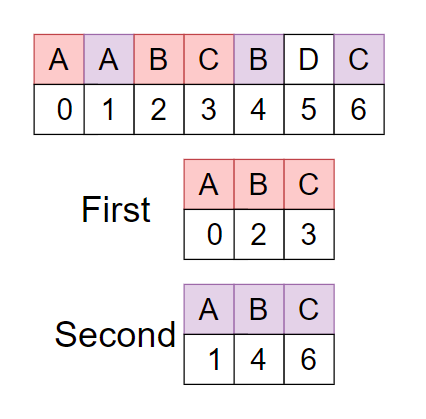
As you can see there are two repeating longest subsequences “ABC” with the same character but different position. Therefore the required answer is ‘3’ as the length of “ABC” is 3.
The first line of input contains an integer ‘T’ denoting the number of test cases.

The first line of each test case contains a single integer ‘N’, where ‘N’ denotes the length of string ‘st’.

The second line of each test case contains a string ‘st’.
For every test case, print the length of the longest repeating subsequence.

Output for each test case will be printed in a separate line.
You do not need to print anything; it has already been taken care of. Just implement the given function.

All the characters of the given string ‘st’ are uppercase letters.
1 <= T <= 50
1 <= N <= 100

Time Limit: 1 sec
The basic idea is the same as the longest common subsequence( LCS), only need to exclude the case when (i==j) because we can’t consider both same characters in both the subsequence.
LRS[i][j] = LRS[i-1][j-1] +1 where ( st[i-1] == st[j-1] and i!=j)
LRS[i][j] = max(LRS[i-1][j], LRS[i][j-1]) where ( st[i-1] != st[j-1)
Consider base case if(i==0 and j==0) then LRS[0][0]=0
Algorithm
There were many overlapping sub-problems in the recursive approach. This can be solved using the memoization technique.
The idea is that compute LRS[i][j] and store the answer of LRS[i][j] in an array and use it for all the other calls of LRS[i][j]
Algorithm
Create a dp table and with the same idea as discussed in approach1.
dp[i][j] = dp[i-1][j-1] +1 where ( st[i-1] == st[j-1] and i!=j)
dp[i][j] = max(dp[i-1][j], dp[i][j-1]) where ( st[i-1] != st[j-1)
Algorithm

