









m = 4, n = 3, mat = {{1, 1, 1}, {2, 1, 2}, {1, 2, 1}, {1, 1, 1}}, val = 5.
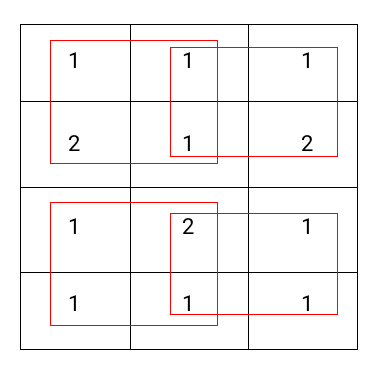
In this example, the maximum value of length of side which can be obtained is 2, Having the starting index: {0, 0} or {0, 1} or {2, 0} or {2, 1}.
The first line contains a single integer ‘T’ denoting the number of test cases, then each test case follows:

The first line of each test case contains two integers ‘n’ and ‘m’ denoting the dimensions of the matrix.

The next ‘n’ lines contain ‘m’ integer where the jth integer of the ith line denotes the value at “mat[i][j]”.

The next line contains a single integer “val” denoting the maximum sum needed.
For each test case, print a single integer “ans” denoting the maximum side of the square.

Output for each test case will be printed in a separate line.
You are not required to print anything; it has already been taken care of. Just implement the function.
1 <= T <= 10
1 <= N, M <= 300
1 <= mat[i][j] <= 5000
1 <= val <= 50000

Time limit: 1 sec
In this approach, we will iterate through all the square matrices and check whether the sum of the matrix is less than “val” and return the value of the side of the matrix having the maximum length.
The steps are as follows:
In this approach, we will iterate through all the square matrices and check whether the sum of the matrix is less than “val” and return the value of the side of the matrix having the maximum length.
The steps are as follows:
Sorted Doubly Linked List to Balanced BST
Largest Plus Sign
Minimum Operations to Form Letter Y
Matrix Block Sum
Minimized Maximum of Products Distributed to Any Store

