










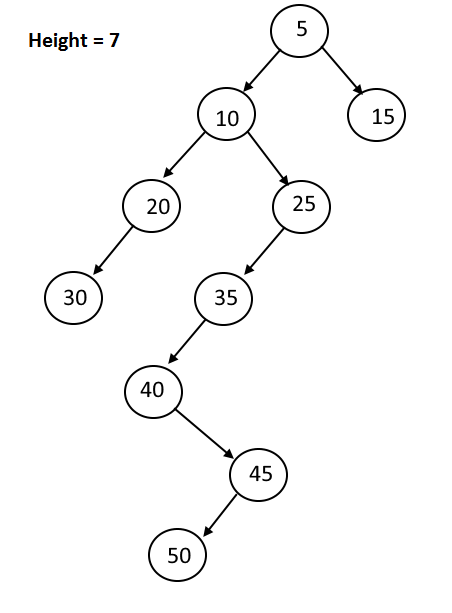
If we are given the above binary tree as input then moving from root node(5) to the farthest leaf node(50), the path formed will be [ 5->10->25->35->40->45->50 ]. The total number of nodes encountered is 7, therefore the maximum depth of the binary tree is 7.
The first line of the input contains a single integer T, representing the number of test cases.

The first and only line of each test case contains the values of the nodes of the tree in the level order form ( -1 for NULL node) Refer to the example for further clarification.
Consider the following binary tree
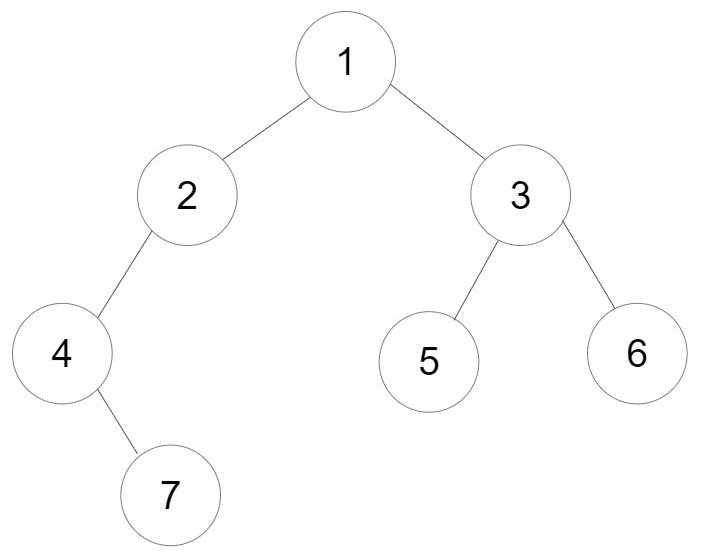
The input of the tree shown in the above image will look like:

1 2 3 4 -1 5 6 -1 7 -1 -1 -1 -1 -1 -1

Explanation :
Level 1 :
The root node of the tree is 1

Level 2 :
Left child of 1 = 2
Right child of 1 = 3

Level 3 :
Left child of 2 = 4
Right child of 2 = null (-1)
Left child of 3 = 5
Right child of 3 = 6

Level 4 :
Left child of 4 = null (-1)
Right child of 4 = 7
Left child of 5 = null (-1)
Right child of 5 = null (-1)
Left child of 6 = null (-1)
Right child of 6 = null (-1)

Level 5 :
Left child of 7 = null (-1)
Right child of 7 = null (-1)

The first not-null node (of the previous level) is treated as the parent of the first two nodes of the current level. The second not-null node (of the previous level) is treated as the parent node for the next two nodes of the current level and so on. The input ends when all nodes at the last level are null (-1).
For each test case, print a single integer “N” representing the maximum depth of the input binary tree.
You do not need to print anything. It has already been taken care of. Just implement the given function.
1 <= T <= 100
1 <= N <= 3000
0 <= data <= 10^9

Time Limit: 1sec
The idea is to use DFS (Depth First Search) traversal and recursively find the maximum depths of the left subtree and right subtree, returning the max of both the values plus 1 (counting the root node) as our answer.
The idea is to traverse the tree using BFS(Breadth-First Search) traversal and iteratively count the number of nodes in the longest path from the root to the farthest leaf node of the binary tree.
Longest Substring with K-Repeating Characters
Expression Add Operators
Gray Code Transformation
Count of Subsequences with Given Sum
Distinct Integers After Zero Removal

