





Last Updated: 8 Jan, 2021

Mike and Mobile

Moderate
Asked in companies
SAP LabsAckoUber

Problem statement

Mike is a little boy who loves solving math problems. One day he was playing with his mom’s mobile. The mobile keypad contains 12 buttons { 10 digits(0-9) and 2 characters(‘*’ and ‘#’) }. Mike wants to know how many different numbers he can generate after pressing exactly the 'N' buttons on the keypad. Mike presses the buttons with the following rules:

1. He always presses the button which has a digit written on it, i.e., he never presses the ‘*’ and ‘#’ button.
2. Once he presses a button, the next button he presses should either be the same button or the button which is adjacent to the previous button.
3. In starting he can press any button except ‘*’ and ‘#’.
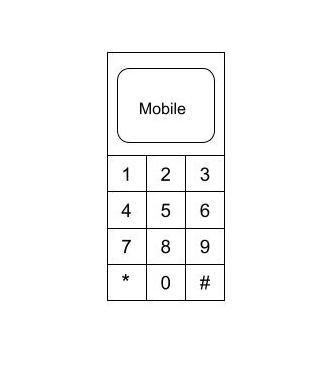
mobile

Mike is too little to solve this problem. Help Mike to solve this problem. As the answer can be large, so find the answer modulo 10^9 + 7.

Input format :
The first line of input contains a single integer 'T', representing the number of test cases or queries to be run. 

Then the 'T' test cases follow.

The first and only line of each test case contains a positive integer N, which represents the number of buttons to press.
Output Format :
For each test case, print the number of numbers that can be generated after pressing exactly the N buttons on the keypad.

The output of each test case is printed in a separate line.
Note:
You do not need to print anything, it has already been taken care of. Just implement the given function.
Constraints :
1 <= T <= 10
1 <= N <= 5 * 10^4

Time Limit: 1 sec

Approaches

01 Approach

We will recursively find the different numbers we can generate after pressing N buttons on the keypad.
 

For simplicity, we will define the keypad with a 2D matrix.

keypad[][] = {{1, 2, 3}, {4, 5, 6}, {7, 8, 9}, {-1, 0, -1}}


Below is the detailed algorithm:


Make a recursive function ‘generateNumbersHelper’ which will return the number of numbers we can generate after pressing ‘N’ buttons on the ‘KEYPAD’.

  1. Call the function: generateNumbersHelper('COUNT', ‘PREV’), where ‘COUNT’ denotes the number of buttons pressed and ‘PREV’ denotes the previous button pressed.
  2. If 'COUNT' is equal to ‘N’, return 1.
  3. Make a variable ‘ANS’ which stores the count of different numbers we can generate after pressing ('N' - 'COUNT') buttons on the ‘KEYPAD’. Initialise ‘ANS’ with 0.
  4. Check every possible button which we can press in the current state.
    • Let ‘R’ denote the row of ‘PREV’ in the ‘KEYPAD’ matrix and ‘C’ denote the column of ‘PREV’ in the ‘KEYPAD’ matrix.
    • There are at most 5 possibilities, { ('R', 'C'), ('R'-1, 'C'), ('R'+1, 'C'), ('R', 'C'-1), ('R', ‘C’+1)}.
    • Let’s say we press the button with index ('X', ‘Y’), then ('X', 'Y') must be inside the ‘KEYPAD’ matrix and ‘KEYPAD[X][Y]’ must not be equal to -1.
    • Update the ‘ANS’, ‘ANS’ += generateNumbersHelper('COUNT'+1, 'KEYPAD[X][Y]').
  5. Return the ‘ANS’.

02 Approach

In the previous approach, we are recalculating the answer. We can optimise it by storing the answers which we have calculated.
 

For example:

Consider the same recursive function, used in the previous approach.

Function: generateNumbersHelper('COUNT', ‘PREV’), where ‘COUNT’ denotes the number of buttons pressed and ‘PREV’ denotes the previous button pressed.

We are recalculating the answer for {(6,1) and (6,5)}.
 

So since there are overlapping solutions, we can store the solution which we have calculated. For this, we will make a 2D array, ‘DP’ to store the answer.
 

‘DP[COUNT][PREV]’ denotes the number of different numbers we can generate after pressing ('N'-count) buttons on the ‘KEYPAD’ and ‘PREV’ is ('COUNT'-1)th button that we have pressed.


Below is the detailed algorithm:


Make a recursive function ‘generateNumbersHelper’ which will return the number of numbers we can generate after pressing ‘N’ buttons on the ‘KEYPAD’.


  1. Make a 2D ‘DP’ array of size ‘N*10', and initialize it with -1.
  2. Call the function: generateNumbersHelper('COUNT', ‘PREV’), where ‘COUNT’ denotes the number of buttons pressed and ‘PREV’ denotes the previous button pressed.
  3. If 'COUNT' is equal to ‘N’, return 1.
  4. If we have visited this state, i.e, ‘DP[COUNT][PREV]’ != -1, then return ‘DP[COUNT][PREV]’.
  5. Make a variable ‘ANS’ which stores the count of different numbers we can generate after pressing ('N' - 'COUNT') buttons on the ‘KEYPAD’. Initialize ‘ANS’ with 0.
  6. Check every possible button which we can press in the current state.
    • Let ‘R’ denote the row of ‘PREV’ in the ‘KEYPAD’ matrix and ‘C’ denote the column of ‘PREV’ in the ‘KEYPAD’ matrix.
    • There are at most 5 possibilities, { ('R', 'C'), ('R'-1, 'C'), ('R'+1, 'C'), ('R', 'C'-1), ('R', ‘C’+1)}.
    • Let’s say we press the button with index ('X', ‘Y’), then ('X', 'Y') must be inside the ‘KEYPAD’ matrix and ‘KEYPAD[X][Y]’ must not be equal to -1.
    • Update the ‘ANS’, ‘ANS’ += generateNumbersHelper('COUNT'+1, 'KEYPAD[X][Y]').
  7. Update  ‘DP[COUNT][PREV]’,  ‘DP[COUNT][PREV]’ = ‘ANS’.
  8. Return the ‘ANS’.

03 Approach

Below is the detailed algorithm:


  1. Create a 2D array ‘DP’ of size (‘N’+1) * 10 to store the answer.
    • Here, ‘DP[COUNT][PREV]’ denotes the number of different numbers we can generate after pressing ‘COUNT’ buttons on the keypad and ‘PREV’ is (‘COUNT’-1)th button that we have pressed.
  2. Run a loop from 0 to 9 (say iterator = ‘i’):
    • Initialize ‘DP[1][i]’ = 1 (Because we will get only 1 number (which will be equal to ‘i’)).
  3. Initialise all other values with 0.
  4. Now, iterate on the indices from 2 to N (say iterator = ‘i’):
  5. Iterate on the digits from 0 to 9 (say iterator = ‘j’):
    • Initialise ‘DP[i][j]’ with 0.
    • Now iterate on the digits that are adjacent to ‘j’.
    • Update ‘DP[i][j]’ :
      • ‘DP[i][j]’ += ‘DP[(i-1)][X]’ (where ‘X’ denotes the digits which are adjacent to ‘j’).
  6. Finally, return sum of { ‘DP[N][0]’ to ‘DP[N][9’] } as the answer.

04 Approach

In the previous approach, we create a 2D array ‘DP’ of size (‘N’+1) * 10 to store the answer.


But, for calculating the answers for ‘DP[i][0 to 9]’, we only need values of ‘DP[i-1][0 to 9]’.


Parity of ‘i’ and (‘i-1’) will always be different i.e. if ‘i’ is odd, (‘i-1’) will be even and vice-versa. So, instead of storing the answer of ‘DP[i][j]’, we can store the answer for ‘DP[parity of i][j]’.

It means we can optimize the space by creating the ‘DP’ array of size 2 * 10.


Below is the detailed algorithm:


  1. Create integer array ‘DP’ of size 2 * 10.
  2. Run a loop from 0 to 9 (say iterator = ‘i’):
    • Initialize ‘DP[1][i]’ = 1 (Because we will get only 1 number (which will be equal to ‘i’)).
  3. Now, iterate on the indices from 2 to N (say iterator = ‘i’):
  4. Iterate on the digits from 0 to 9 (say iterator = ‘j’):
    • Initialise ‘DP[i%2][j]’ with 0.
    • Now iterate on the digits that are adjacent to ‘j’.
    • Update ‘DP[i%2][j]’ :
      • ‘DP[i%2][j]’ += ‘DP[(i-1)%2][X]’ (where ‘X’ denotes the digits which are adjacent to ‘j’).
  5. Finally, return sum of { ‘DP[N%2][0]’ to ‘DP[N%2][9]’ } as the answer.