










Following is the possible movements of the knight from a particular position.
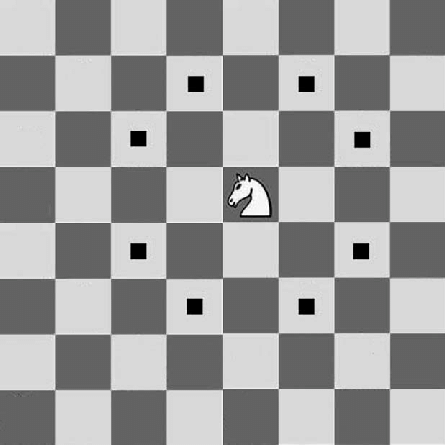
 The first line of input contains an integer 'T' representing the number of the test case. Then the test cases are as follows.

 The first line of each test case contains one integer ‘N’ representing the side of the square chessboard or 2D matrix.

 The second line contains two integers ‘SX’ and ‘SY’ representing the starting position of the knight in the chessboard.

 The third line contains two integers ‘TX’ and ‘TY’ representing the target position in the chessboard.
For each test case, return the minimum number of steps taken by the knight to reach the target position from the given starting position.
You do not need to print anything; It has already been taken care of.
1 ≤ T ≤ 50
1 ≤ N ≤ 100
1 ≤ SX,SY,TX,TY ≤ 100

Where ‘T’ is the number of test cases.
‘N’ is the side of the given chessboard or matrix.
‘SX’, ‘SY’, ‘TX’, ‘TY’ denotes the starting and target positions in the given chessboard.

Time Limit: 1 sec
Our intuition is to think of all the positions knight can reach from the current position. This problem can be seen as the shortest path in an unweighted graph. Hence, we use BFS to solve this problem.
A knight can move to 8 positions from (x,y).
(x, y) ->
(x + 2, y + 1)
(x + 2, y - 1)
(x - 2, y + 1)
(x - 2, y - 1)
(x + 1, y + 2)
(x + 1, y - 2)
(x - 1, y + 2)
(x - 1, y - 2)
(x,y) will have an edge to the 8 neighbors defined above.
Steps are as follows :
This approach considers the implementation of Breadth-First Search for searching through cells, where each cell contains its coordinate and distance from the starting node.
Take a close look at the positions of the knight and the target and how will it get affected in different cases:
First of all, let’s talk about the non-linear positions where the knight and the target cells are along different rows and columns (i.e. sx != tx & sy != ty). For example if (sx,sy) = (3,3) and (tx,ty) = (6,6) then only 2 steps are required to reach the target, which are: (3,3) -> (4,5) and (3,3) -> (5,4). So, using dynamic programming, minSteps{(3,3) to (6,6)} = 1 + [minSteps((4,5) to (6,6)) or minSteps((5,4) to (6,6))].
Secondly, if the positions are linear which means if the knight and the target cell are along either same row or columns. i.e. either kx = tx or ky = ty. For example (sx,ky) = (2,4) and (tx,ty) = (7,4) then there are in total 4 steps move towards the target, which are: (2,4) -> (4,5) and (2,4) -> (4,3), both these steps are equivalent and (2,4) -> (3,6) and (2,4) -> (3,2), both these steps are equivalent. So, using dynamic programming, minSteps((2,4) to (7,4)) = 1 + min[minSteps((2,4) to (4,5)) , minSteps((2,4) to (3,6))].
Corner Cases will be if either of the Knight or the target cell is at the corner position and [abs(sx-tx) , abs(sy-ty)] = [1,1]. Then the minimum steps to reach the target will be 4.
The steps are as follows:
The Dynamic Programming Equation becomes:
Count of Subsequences with Given Sum
Optimal Line Arrangement
Distinct Integers After Zero Removal
Maximize Partition Value
Maximum Value Path in a Graph

