







Let ‘N’ = 5, ‘EDGES’ = [[1, 2], [1, 3], [2, 4], [2, 5]], ‘QUERIES’ = [[1, 2, 3], [2, 1], [1, 3, 2], [2, 1]] and ‘COLOR’ = [1, 1, 1, 1, 1].
The initial tree will be:
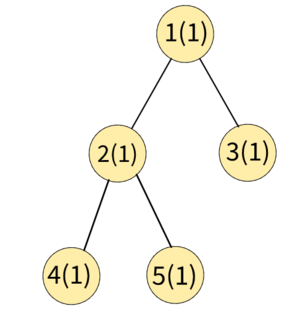
After processing the query [1, 2, 3] i.e. colour all vertices in the subtree of 2 to 3.
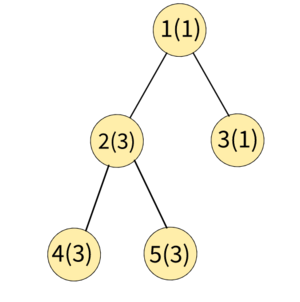
Now the number of different colours in subtree of the vertex 1 is 2.
After processing the query [1, 3, 2] i.e. colour all vertices in the subtree of 3 to 2.
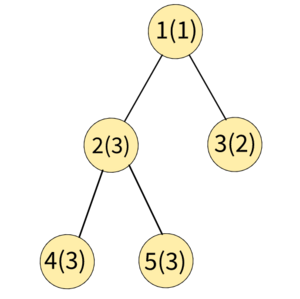
Now the number of different colours in subtree of the vertex 1 are 3.
Hence the answer to this test case is 2 and 3 (print on separate lines).
The first line contains an integer 'T', which denotes the number of test cases.

The next line contains two integers ‘N’ and ‘Q’ denoting the number of vertices and the number of queries respectively.

The next line contains ‘N’ space-separated integers, ‘COLOR[i]’ denoting the initial colour of i-th vertex.

Each of the next N - 1 line contains two integers Uj, Vj (1 ≤ Uj, Vj  ≤ N) - the vertices of j-th edge.

The last ‘Q’ lines contain the description of the queries. Each description starts with the integer Tk (1 ≤ Tk ≤ 2) - the type of k-th query.
For the queries of the first type then follows two integers Vk, Ck (1 ≤ Vk ≤ N, 1 ≤ Ck ≤ 60) - the number of the vertex whose subtree will be recoloured with the colour Ck.
For the queries of the second type then follows integer Vk(1 ≤ Vk ≤ N) - the number of the vertex for which subtree you should find the number of different colours.
For each test case, return an array ‘ANS’, where ‘ANS[i]’ will denote the answer to i-th query of the second type.
You don't need to print anything, it has already been taken care of. Just implement the given function.
1 ≤ T ≤ 10
1 ≤ N ≤ 1000
1 ≤ Q ≤ 1000
1 ≤ COLOR[i] ≤ 60

Time limit: 1 sec
The idea is simple, we process according to the problem statement. Initially we perform a DFS and find the parent of all vertices. This is required later while performing DFS we don’t end in an endless loop.
While processing the first query we perform DFS from given vertex and update colors of all vertices in subtree.
While processing the second query we perform DFS from given vertex and insert colors of all vertices in subtree in set. And finally we will print size of this set.
In this approach, we first compute the startTime and endTime of each vertex and also we flatten the tree( convert it into an array ) using euler tour.
Euler tour is basically a permutation of vertices on the basis of order of visiting by DFS starting from root. Easy to see that subtree of any vertex is a subsegment of that permutation.
After finding Euler tour we can query on this array for our query of type 2. We can get L and R value using startTime and endTime for each node. While generating Euler tour we also record the startTime and endTime for each node. So the L will be startTime and R will be endTime. startTime and endTime are just indices in Euler’s Tour.
After this we update the Euler Tour to store the color of corresponding vertex. Hence we got a permutation of color, according to visiting by DFS.
Thus we just need to find the number of distinct values from L to R. Now this question is converted to a range - query and range - update form. We can think of Segment Tree with Lazy Propagation.
Also note that the number of different colors is 60, so we can store the set of colours just as mask of binary bits in 64-bit type. So for a range we store if a color has appeared in that range or not. So for a particular bit, Bi that represents color, Ci - 0 represents Ci never appeared in the range, 1 represents that it appeared one or more times.
While updating a node in Segment Tree the bit-mask of that node will be bitwise-OR of bit-mask of Right and Left child. So the anwer to our query will be just the number of 1s in binary representation of final mask.
Let us take an example of our Testcase 1 of Sample Input 1.
The Euler tour will be [1, 2, 4, 5, 3]. After we update it to store color it will be [1, 1, 1, 1, 1].
Now we will query on this array. We update color in subtree of 2 to 3. Hence the array will become [1, 3, 3, 3, 1].
Now we need to count the number of distinct values in subtree of 1. Now when we perform a query it will return 10. 10 is bitwise-OR of 2 and 8 (1 << 3). Remember while updating we will update it as (1 << Ci) because at i-th position there will be 1 denoting i-th color has appeared. So finally we will just count the number of 1s in the binary representation of 10. So the answer will be 2.
Now we perform another query and update color in subtree of 3 to 2. Hence the array will become [1, 3, 3, 3, 2].
Now when we perform query from [1, 5] it will return 14, which is bitwise-OR of 2, 8 and 4. So finally we will just count the number of 1s in binary representation of 14. So the answer will be 3.

