










If the given list is (1 -> -2 -> 0 -> 4) and N=2:
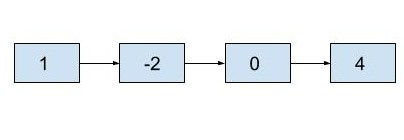
Then the 2nd node from the end is 0.
The first line of input contains a single integer T, representing the number of test cases or queries to be run.

The first line of each test case contains the elements of the linked list separated by a single space and terminated by -1. Hence, -1 would never be a list element.

The second line contains an integer ‘N’, the position of the node from the end which you have to find.
For each test case, print the value of the N-th node from the end.

Print the output of each test case in a separate line.
You do not need to print anything. Just implement the given function and return a pointer pointing to the node which is at the N-th position from the last of the linked list.
1 <= T <= 10
1 <= L <= 10^4
-10^9 <= data <= 10^9
1<= N <= L
data != -1
Where 'L' is the number of nodes in the linked list, ‘data’ represents the value of the nodes of the list.

Time Limit:  sec
Nth node from the end will be (L - N + 1)th node from the start.
(Note: ‘L’ denotes the length of the list.)
Algorithm
The idea is to have 2 pointers: ‘ptr1’ and ‘ptr2’. Initially, both point to the head node.
Algorithm
Why does this work?
As discussed in ‘Approach 1’ Nth node from the end is (L - N + 1)th from the start.
We are moving ‘ptr2’ to the Nth node from the start, which is also (L - N + 1)th from the end. After this, we are moving both pointers until ‘ptr2’ reaches the end of the list. It means ‘ptr1’ will be at (L - N + 1)th from the start.

