










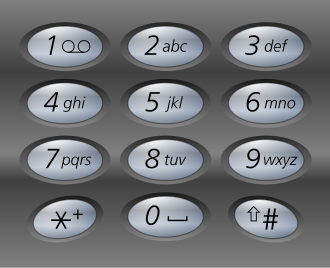
If S = “34”, then all the possible letters that can be formed from string S are {“dg”, “dh”, “di”, “eg”, “eh”, “ei”, “fg”, “fh”, “fi”}.
The first line contains an integer 'T' which denotes the number of test cases or queries to be run. Then, the 'T' test cases follow.

The first line of each test case contains a string S.
For each test case, print all the possible strings separated by a single space in lexicographically sorted order, that can be formed from the input string by mapping the digits to the letters as in a T9 keypad.

The output of each test case will be printed in a separate line.
You do not need to print anything, it has already been taken care of. Just implement the given function.
1 <= T <= 10
1 <= |S| <= 7
where |S| denotes the length of the string S.

Time limit: 1 sec.
The idea is to use a backtracking algorithm. So, we traverse each digit of the string S, we have 3 options to choose if the digit belongs to {2,3,4,5,6,8} or 4 options if it belongs to {7,9}. So, go through all possible options and add a letter in the keypad that map to the current digit and add it to the current string. If there are no more digits to be checked, then add this string to the result array.
void possibleWordsUtil(S, res, curr, index, mp):

