









If the binary search trees look like the ones below:
.png)
The only common values are 6 and 7, therefore we return the list [6, 7].
The first line contains an integer 'T' which denotes the number of test cases or queries to be run. Then the test cases are as follows.

The first line of each test case contains elements of the first tree in the level order form. The line consists of values of nodes separated by a single space. In case a node is null, we take -1 in its place.

The second line of each test case contains elements of the second tree in the level order form. The line consists of values of nodes separated by a single space. In case a node is null, we take -1 in its place.
The input for the tree depicted in the below image would be :
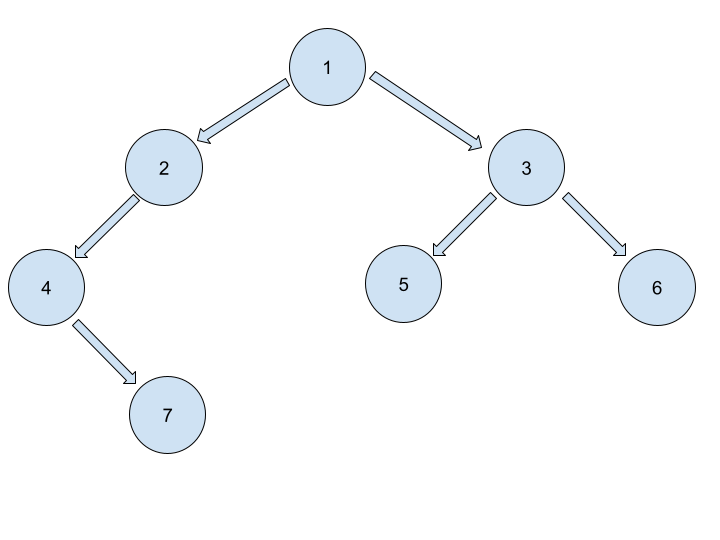
Input Format:
1
2 3
4 -1 5 6
-1 7 -1 -1 -1 -1
-1 -1


 #### Explanation :
Level 1 :
The root node of the tree is 1

Level 2 :
Left child of 1 = 2
Right child of 1 = 3

Level 3 :
Left child of 2 = 4
Right child of 2 = null (-1)
Left child of 3 = 5
Right child of 3 = 6

Level 4 :
Left child of 4 = null (-1)
Right child of 4 = 7
Left child of 5 = null (-1)
Right child of 5 = null (-1)
Left child of 6 = null (-1)
Right child of 6 = null (-1)

Level 5 :
Left child of 7 = null (-1)
Right child of 7 = null (-1)

The first not-null node(of the previous level) is treated as the parent of the first two nodes of the current level. The second not-null node (of the previous level) is treated as the parent node for the next two nodes of the current level and so on.
The input ends when all nodes at the last level are null(-1).
The above format was just to provide clarity on how the input is formed for a given tree.
The sequence will be put together in a single line separated by a single space. Hence, for the above-depicted tree, the input will be given as:

1 2 3 4 -1 5 6 -1 7 -1 -1 -1 -1 -1 -1
For each test case, return a list containing the common elements.

Output for each test case will be printed in a new line.
You do not need to print anything; it has already been taken care of. Just implement the given functions.
1 <= T <= 100
1 <= N <= 10 ^ 5
-10 ^ 9 <= val <= 10 ^ 9

where “val” represents the values stored in the nodes

Time Limit: 1sec
For each element in the first Binary Search Tree, we can check if it exists in the second tree. Since it is a Binary Search Tree, we can perform the search operation in log(N) time, where ‘N’ is the number of nodes in the Binary Search Tree.
Algorithm:
We can solve the problem by keeping two pointers that traverse both the trees in inorder traversal separately.
In each step, if the values that both pointers are pointing to are the same, we append the node value into our result and increment both the pointers. If they point to different values, increment the pointer pointing to the lesser value.
Algorithm:
Guess Price
Unique BSTs
Unique BSTs
Unique BSTs
Kth Largest Element in BST
Two Sum IV - Input is a BST
Icarus and BSTCOUNT

