










For a (6 x 6) board, the numbers are written as follows:
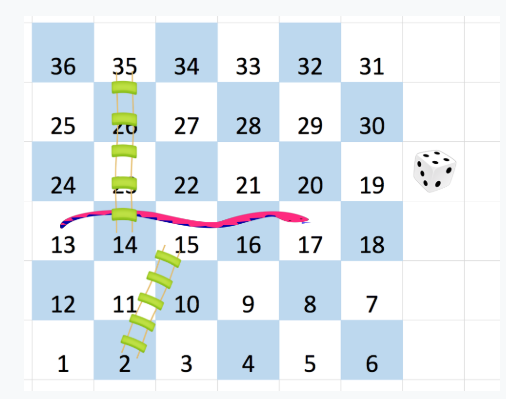
You start from square 1 of the board (which is always in the last row and first column). On each square say 'X', you can throw a dice which can have six outcomes and you have total control over the outcome of dice throw and you want to find out the minimum number of throws required to reach the last cell.
Some of the squares contain Snakes and Ladders, and these are possibilities of a throw at square 'X':
You choose a destination square 'S' with number 'X+1', 'X+2', 'X+3', 'X+4', 'X+5', or 'X+6', provided this number is <= N*N.
If 'S' has a snake or ladder, you move to the destination of that snake or ladder.  Otherwise, you move to S.
A board square on row 'i' and column 'j' has a "Snake or Ladder" if board[i][j] != -1. The destination of that snake or ladder is board[i][j].
You can only take a snake or ladder at most once per move: if the destination to a snake or ladder is the start of another snake or ladder, you do not continue moving - you have to ignore the snake or ladder present on that square.

For example, if the board is:
-1 1 -1
-1 -1 9
-1 4 -1
Let's say on the first move your destination square is 2  [at row 2, column 1], then you finish your first move at 4 [at row 1, column 2] because you do not continue moving to 9 [at row 0, column 0] by taking the ladder from 4.

A square can also have a Snake or Ladder which will end at the same cell.
For example, if the board is:
-1 3 -1
-1 5 -1
-1 -1 9
Here we can see Snake/Ladder on square 5 [at row 1, column 1] will end on the same square 5.
The first line of each test case or query contains a single integer value, 'N' representing the 'rows' and 'columns' for the two-dimensional square matrix.

The Second line onwards, the next 'N' lines or rows represent the ith row values.

Each of the i-th row constitutes 'N' column values separated by a single space.
'-1' denotes the square doesn't contain any Snake or Ladder.
The only line of output prints the minimum number of throws required to reach the last cell of the board. If it is impossible to reach the last cell of the board, then print -1.
1 <= N <= 10 ^ 2
1 <= board[i][j] <= N*N or board[i][j] = -1

Where (NxN) is the size of the board.
We will use Breadth-First Search to find the shortest path from cellNumber 1 to cellNumber N*N.

