










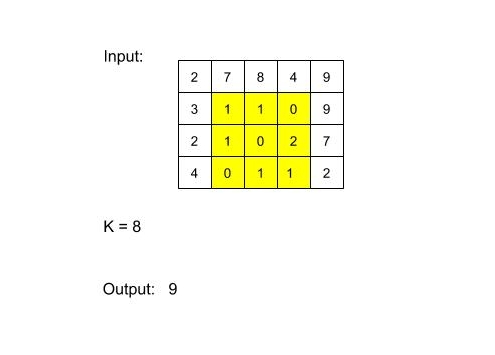
If there is no square sub-matrix with a sum less than or equal to K, then return 0.
The first line of input contains an integer 'T' representing the number of test cases. Then the test cases follow.

The first line of each test case contains three single-spaced integers N, M and K, representing the number of rows, number of columns and the given integer, respectively.

The next N line contains M single-spaced elements.
For each test case, print the size of the largest sub-matrix with sum less than or equal to K.

Print the output for each test case in a separate line.
You do not need to print anything, it has already been taken care of. Just implement the given function.
1 <= T <= 10
1 <= N, M <= 100
0 <= K <= 10^5,
0 <= data <= 10^5,

where ‘data’ is the value of the elements of the matrix.
In this approach, we will find all possible square sub-matrices and check whether it has sum less than or equal to K or not.
We will define a square sub-matrix using 3 variables (R, C, L). (R, C) denotes the top-left corner of the sub-matrix and L denotes the number of rows/column in the square sub-matrix. So, (R+L-1, C+L-1) will be the bottom-right corner of the sub-matrix.
For finding the sum of a sub-matrix, we will iterate on the elements of the sub-matrix using two loops.
In this approach, we will use the prefix sum, so that we don’t have to iterate on the elements of the sub-matrix for finding the sum of a sub-matrix.
Let pref[][] store the prefix sum of the given matrix.
pref[i][j] is the sum of the sub-matrix whose top-left corner is at (0, 0) and bottom right corner is at (i, j).
For finding the prefix matrix, first, we will do the row-wise sum and then we will do the column-wise sum.
For example:
Sum of a sub-matrix (R1, C1, R2, C2) {where (R1, C1) denotes the top-left corner of the sub-matrix and (R2, C2) denotes the bottom-right corner of the sub-matrix} is:
SUM = pref[R2][C2] - pref[R2][C1-1] - pref[R1-1][C2] + pref[R1-1][C1-1].
If S is the sum of a square submatrix whose top-left corner is (R, C) and contains L number of rows/columns, then the sum of the square submatrix with same top-left corner, containing (L+1) number of rows/columns is always greater than or equal to S (since the matrix contains non-negative integers).
It means using binary search we can find the largest square submatrix whose top-left corner is (R, C).
We will iterate on the top-left index of the sub-matrix and, using binary search, we will find the largest submatrix from this index.
If (R, C) denotes the top-left corner of the sub-matrix, then we have to find the largest L such that the sum of the submatrix (R, C, R+L-1, C+L-1) is less than or equal to K.
Algorithm
For finding the sum of a sub-matrix, we will use the prefix sum.

