










Given ‘N’ = 2, The total number of BST’s is 2.
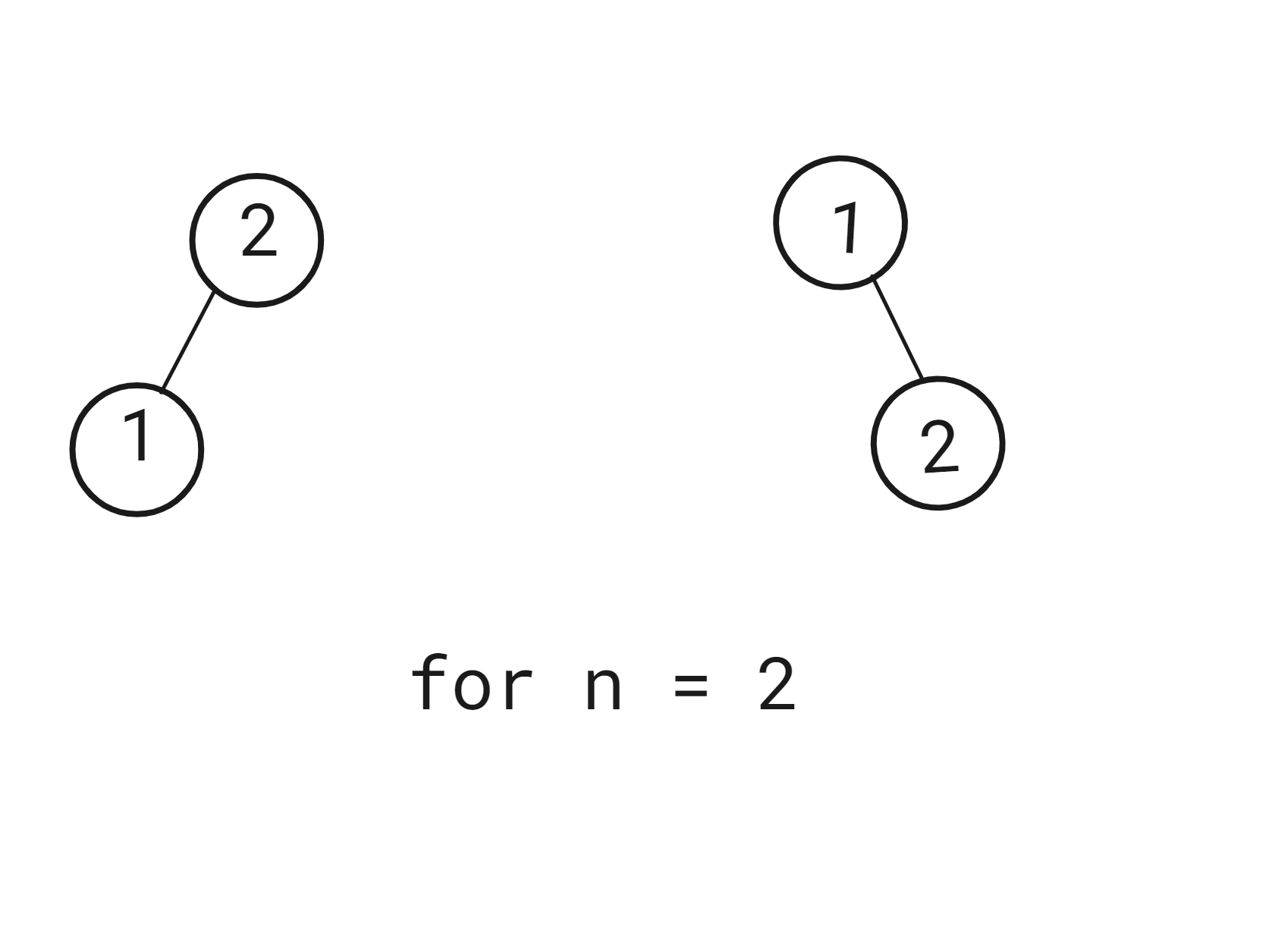
1. A binary search tree is a rooted binary tree whose internal nodes each store a key greater than all the keys in the node's left subtree and less than those in its right subtree.

2. A structurally unique binary search tree is a tree that has at least 1 node at a different position or with a different value compared to another binary search tree.
The first line of input contains an integer T denoting the number of test cases.

The first and the only line of each test case contains an integer 'N', the number of ‘nodes’.
For each test case, print a single line containing a single integer denoting the total number of BST’s that can be formed. The output of each test case will be printed in a different line.

The output of each test case will be printed in a separate line.
You don't have to print anything. It's been already taken care of. Just implement the given function.
1 <= T <= 25
1 <= N <= 30

Where ‘T’ is the total number of test cases, and N is the number of nodes.

Time limit: 1 sec.
The main idea is to calculate all possible configurations using recursion.
The main idea is to use Catalan numbers. In combinatorial mathematics, the Catalan numbers form a sequence of natural numbers that occur in various counting problems, often involving recursively defined objects.
Count of Subsequences with Given Sum
Optimal Line Arrangement
Distinct Integers After Zero Removal
Maximize Partition Value
Maximum Value Path in a Graph

