








Input: Let the binary tree be:

Output: [2, 7, 5, 2, 6, 5, 4, 11, 9]

Explanation: The nodes having the same 'x' coordinates are:

'x' = -2 : [2]
'x' = -1 : [7, 5]
'x' = 0 : [2, 6]
'x' = 1 : [5, 4, 11]
'x' = 2 : [9]

Here 4 and 11 have the same 'x' and 'y' coordinates. So they are considered in non-decreasing order.
The first line contains elements in the level order form. The line consists of values of nodes separated by a single space. In case a node is null, we take -1 in its place. So -1 would not be a part of the tree nodes.
The level order input for the tree depicted in the below image would be
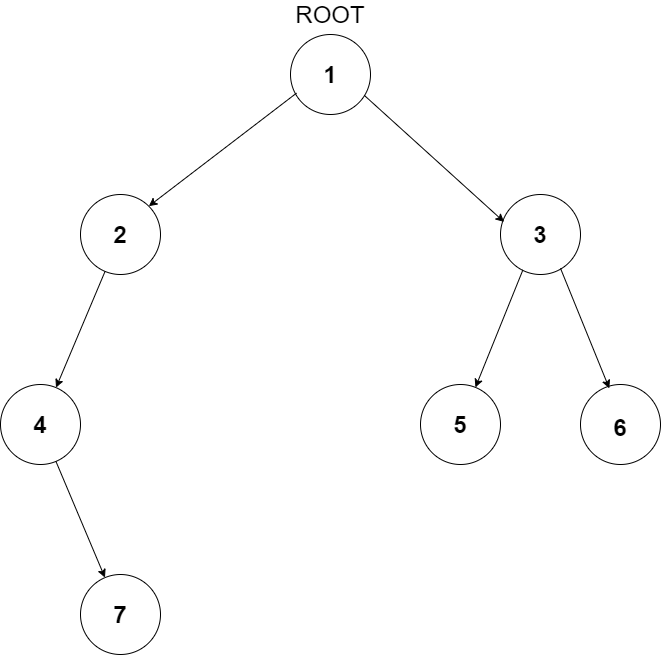
1
2 3
4 -1 5 6
-1 7 -1 -1 -1 -1
-1 -1

The sequence will be put together in a single line separated by a single space. Hence, for the above-depicted tree, the input will be given as:

1 2 3 4 -1 5 6 -1 7 -1 -1 -1 -1 -1 -1

Explanation :
Level 1 :
The root node of the tree is 1

Level 2 :
Left child of 1 = 2
Right child of 1 = 3

Level 3 :
Left child of 2 = 4
Right child of 2 = null (-1)
Left child of 3 = 5
Right child of 3 = 6

Level 4 :
Left child of 4 = null (-1)
Right child of 4 = 7
Left child of 5 = null (-1)
Right child of 5 = null (-1)
Left child of 6 = null (-1)
Right child of 6 = null (-1)

Level 5 :
Left child of 7 = null (-1)
Right child of 7 = null (-1)

The first not-null node (of the previous level) is treated as the parent of the first two nodes of the current level. The second not-null node (of the previous level) is treated as the parent node for the next two nodes of the current level, and so on.
The input ends when all nodes at the last level are null (-1).
Print the vertical order traversal of the given binary tree.
You do not need to print anything; it has already been taken care of. Just implement the given function.
We have to store the values at each coordinate (x, y). So we can use an ordered map for the same. We can use a map of map of container to store the values at each coordinate.
Since we need the values in non-decreasing order, we can use a min heap(priority queue). Please note that there are other ways to implement this.

