

A standout LinkedIn profile as a college student combines a professional photo, a keyword-rich headline that goes beyond your default student title, a first-person summary highlighting your projects and coursework,…


Roles and Responsibilities of a Business Analyst – Complete Overview
4 min read
10,352 views
2 likes

In today’s dynamic job market, the role of a business analyst (BA) has gained immense popularity, especially among college graduates and freshers in India. This comprehensive guide delves into the intricacies of a business analyst’s job, highlighting roles and responsibilities across various sectors.
Whether you’re aiming for a position in IT, banking, or agile environments, this article will provide you with a clear understanding of what it takes to excel in this field.
Who is a Business Analyst?
A business analyst is a professional responsible for bridging the gap between business needs and technical solutions. They analyze business processes, identify improvement opportunities, and implement solutions that align with organizational goals.
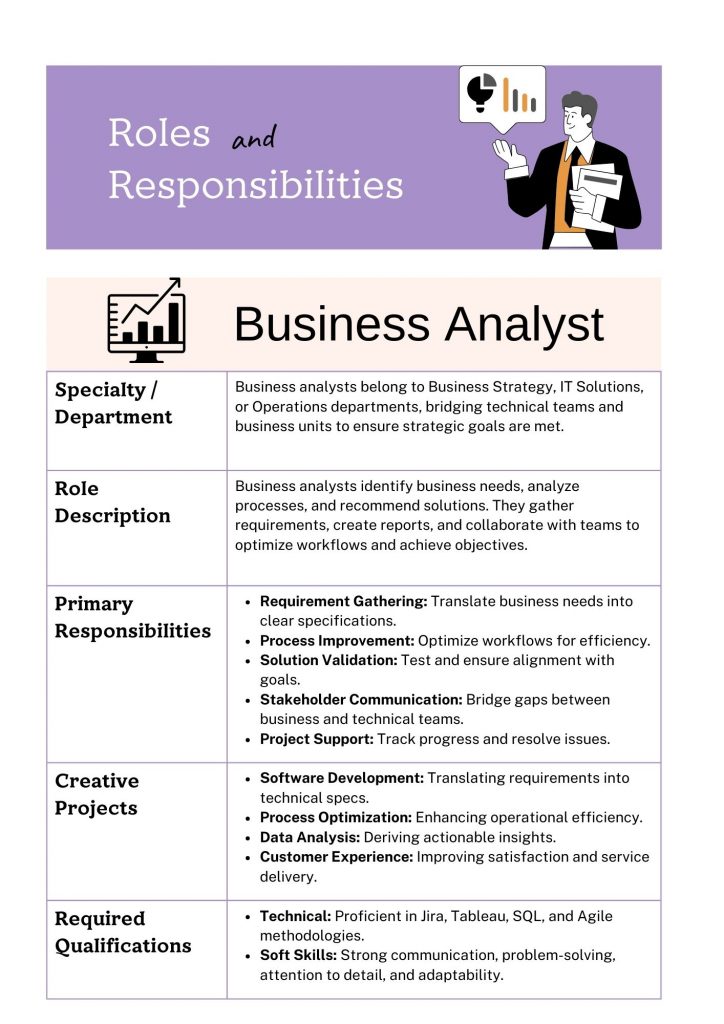
By acting as a liaison between stakeholders and technical teams, business analysts play a crucial role in ensuring projects are delivered successfully and meet business objectives.
Business Analyst Job Description
The job description of a business analyst can vary depending on the industry and company size. However, some core responsibilities include:
- Collaborating with stakeholders to gather and document requirements.
- Analyzing business processes and identifying inefficiencies.
- Recommending solutions to enhance productivity and profitability.
- Facilitating communication between business teams and IT departments.
- Preparing detailed reports, presentations, and business proposals.
- Conducting market research and competitor analysis to inform decision-making.
- Ensuring projects stay on track by managing deadlines, resources, and deliverables.
Business Analyst Roles and Responsibilities
To provide a holistic view, let’s break down the primary roles and responsibilities of a business analyst:
- Requirement Analysis: Gathering and documenting functional and non-functional requirements from stakeholders.
- Process Mapping: Creating visual representations of workflows to identify areas for improvement.
- Data Analysis: Interpreting data to generate actionable insights that inform business strategies.
- Solution Design: Collaborating with technical teams to design systems or solutions that meet business needs.
- Stakeholder Communication: Acting as a mediator to ensure clear communication between technical teams and business units.
- Testing and Validation: Ensuring that proposed solutions are thoroughly tested and meet organizational requirements.
Business Analyst Roles and Responsibilities in an IT Company
In IT companies, business analysts play a pivotal role in software development and project management. The responsibilities of an IT Business Analyst include:
- Understanding Client Requirements: Liaising with clients to gather specific needs and translating them into technical specifications.
- Creating User Stories: Documenting detailed user stories and scenarios to guide the development team.
- Collaborating with Developers: Ensuring the technical team understands business requirements.
- System Testing: Participating in user acceptance testing (UAT) to validate solutions.
- Change Management: Managing modifications in project scope or objectives as per stakeholder feedback.
Business Analyst Roles and Responsibilities in Banking
In the banking sector, business analysts focus on enhancing operational efficiency and customer experience. Key responsibilities include:
- Analyzing Financial Processes: Assessing and improving processes like loan approvals, risk assessments, and transaction management.
- Compliance Monitoring: Ensuring banking processes comply with regulatory standards.
- Developing Financial Models: Creating models to forecast trends and aid decision-making.
- Technology Implementation: Collaborating on the implementation of core banking systems or fintech solutions.
- Customer Experience Enhancement: Identifying opportunities to improve services such as mobile banking or customer support.
Business Analyst Roles and Responsibilities in Agile
Agile methodologies emphasize flexibility and collaboration, and a business analyst in such environments often wears multiple hats. Responsibilities include:
- Participating in Scrum Meetings: Attending daily stand-ups, sprint planning, and retrospective meetings.
- Writing Epics and Stories: Breaking down complex requirements into manageable tasks for development teams.
- Prioritizing Backlogs: Working with product owners to prioritize features and functionalities.
- Continuous Feedback: Gathering and integrating stakeholder feedback into project iterations.
- Facilitating Collaboration: Ensuring seamless communication between cross-functional agile teams.
The role of a business analyst is both challenging and rewarding. By understanding the roles and responsibilities of a business analyst, whether in IT, banking, or agile environments, freshers can better prepare themselves for this exciting career path.
With a focus on communication skills, analytical thinking, and problem-solving, a business analyst is instrumental in driving organizational success.
Related Reads:
Business Analyst Interview Placement Experience
FAQs on Roles and Responsibilities of a Business Analyst
What does a Business Analyst actually do?
Business analysts bridge technology and business, analyzing organizational processes, identifying improvement opportunities, and recommending solutions that optimize operational efficiency and strategic decision-making.
What are the key skills required for a Business Analyst?
Critical skills include data analysis, communication, problem-solving, strategic thinking, technical proficiency, project management, stakeholder management, and expertise in business intelligence tools.
How is a Business Analyst different from a Data Analyst?
Business analysts focus on strategic business improvements and process optimization, while data analysts concentrate on statistical analysis, data interpretation, and generating insights from complex datasets.
What industries employ Business Analysts?
Business analysts are crucial in IT, finance, healthcare, banking, consulting, e-commerce, telecommunications, manufacturing, and technology sectors, driving strategic decision-making across diverse business environments.
What educational background is needed?
Typically requires a bachelor’s degree in business administration, computer science, economics, or related fields. MBA or specialized certifications can enhance career prospects and professional credibility.
What certifications are valuable for Business Analysts?
Top certifications include CBAP (Certified Business Analysis Professional), PMI-PBA (Professional in Business Analysis), and ECBA (Entry Certificate in Business Analysis).
What tools do Business Analysts use?
Key tools include Microsoft Excel, Power BI, Tableau, JIRA, Visio, SQL, SAP, Salesforce, etc.
What are typical responsibilities in a Business Analyst role?
Conduct requirement gathering, process mapping, data analysis, create business reports, facilitate stakeholder meetings, develop business cases, recommend process improvements, and support project implementation.
How can one become a Business Analyst without prior experience?
Focus on online certifications, develop analytical skills, create a portfolio of projects, network professionally, take internships, and demonstrate problem-solving and communication capabilities.
What career progression exists for Business Analysts?
The career path includes a progression from junior analyst to senior analyst, then to management roles like Senior Business Analyst, Business Analysis Manager, and eventually strategic consulting positions.
What soft skills are crucial for Business Analysts?
Critical soft skills include communication, stakeholder management, adaptability, critical thinking, presentation skills, negotiation, empathy, and the ability to translate technical concepts into business language.
Latest Posts
What is SSC CGL Exam? – Complete Details for 2026
If you’re a college student or a fresh graduate wondering, “Should I appear for SSC CGL?” you’re in the right place. Every year, over 30 lakh students apply for this…
Cracked IBPS PO Prelims 2026? Here’s How to Know
If you sat for IBPS PO Prelims on August 22 or 23, 2026, chances are you’ve already refreshed Google a dozen times searching “IBPS PO prelims analysis” or “IBPS PO…
How Does an ATS Score Your Resume? Everything You Need to Know
An ATS (Applicant Tracking System) scores your resume by comparing its text against the job description, matching keywords, required skills, years of experience, and education level, then assigning a percentage…
IBPS PO 2026 Admit Card: How to Download & Important Instructions
With IBPS PO Prelims scheduled for August 22 and 23, 2026, you’re now inside the final stretch, the week where prep matters less than preparation logistics. Not knowing which documents…
Popular Posts
How to Pass the TCS NQT Aptitude Test?
Every year, lakhs of engineering and graduation students apply to TCS, one of India’s largest IT employers. And almost every single one of them hits the same first wall: the…
What is SSC CGL Exam? – Complete Details for 2026
If you’re a college student or a fresh graduate wondering, “Should I appear for SSC CGL?” you’re in the right place. Every year, over 30 lakh students apply for this…
How to Make a Fresher Resume That Recruiters Notice
If you are a college student or a fresher stepping into the professional world, creating a well-structured resume is your first step to success. A polished and ATS-friendly resume can…
About Me in Resume for Freshers: How to Write, Examples
Fresher resumes often look the same because they begin with a generic objective statement that does not clearly explain your strengths. Recruiters read similar lines every day, which makes it…
Best Fintech Companies for Freshers to Work at in India
India is one of the fastest-growing fintech markets in the world, with over 10,000 registered fintech startups and a market valuation projected to cross $150 billion by 2025. For freshers…