

You’ve just graduated; everyone around you is either starting a job or prepping for another exam, and you’re quietly wondering whether taking a year off is a smart reset or…

How to Become a Digital Marketer: Step-by-Step Career Guide
8 min read
32 views

If you’ve typed “how to become a digital marketer” into Google, you’ve probably landed on a dozen conflicting answers; some say a free YouTube playlist is enough, others insist you need a ₹2 lakh certification course. The truth sits somewhere in between, and it depends entirely on your starting point, budget, and how fast you want to get job-ready.
This guide breaks down exactly what digital marketing skills you need, the best free and paid learning paths available in India right now, realistic salary expectations, and a step-by-step plan to go from complete beginner to job-ready without wasting money on courses you don’t actually need.
Is Digital Marketing Still Worth It in 2026?
Yes, and the demand isn’t slowing down. Every business with an online presence, from D2C startups to traditional companies going digital, needs people who can run campaigns, manage content, and read performance data. This makes digital marketing one of the more accessible tech-adjacent careers for freshers.
The bigger draw for first-time job seekers is the low barrier to entry: you don’t need a specific degree to break in, and many roles value demonstrated skills and a portfolio over formal qualifications. That said, this also means competition is high, so how you learn matters as much as whether you learn.
What Digital Marketing Skills Do You Really Need?
Digital marketing isn’t one skill; it’s a cluster of related disciplines, and most professionals specialize in two or three rather than mastering all of them equally. Understanding this early helps you avoid spreading yourself too thin.
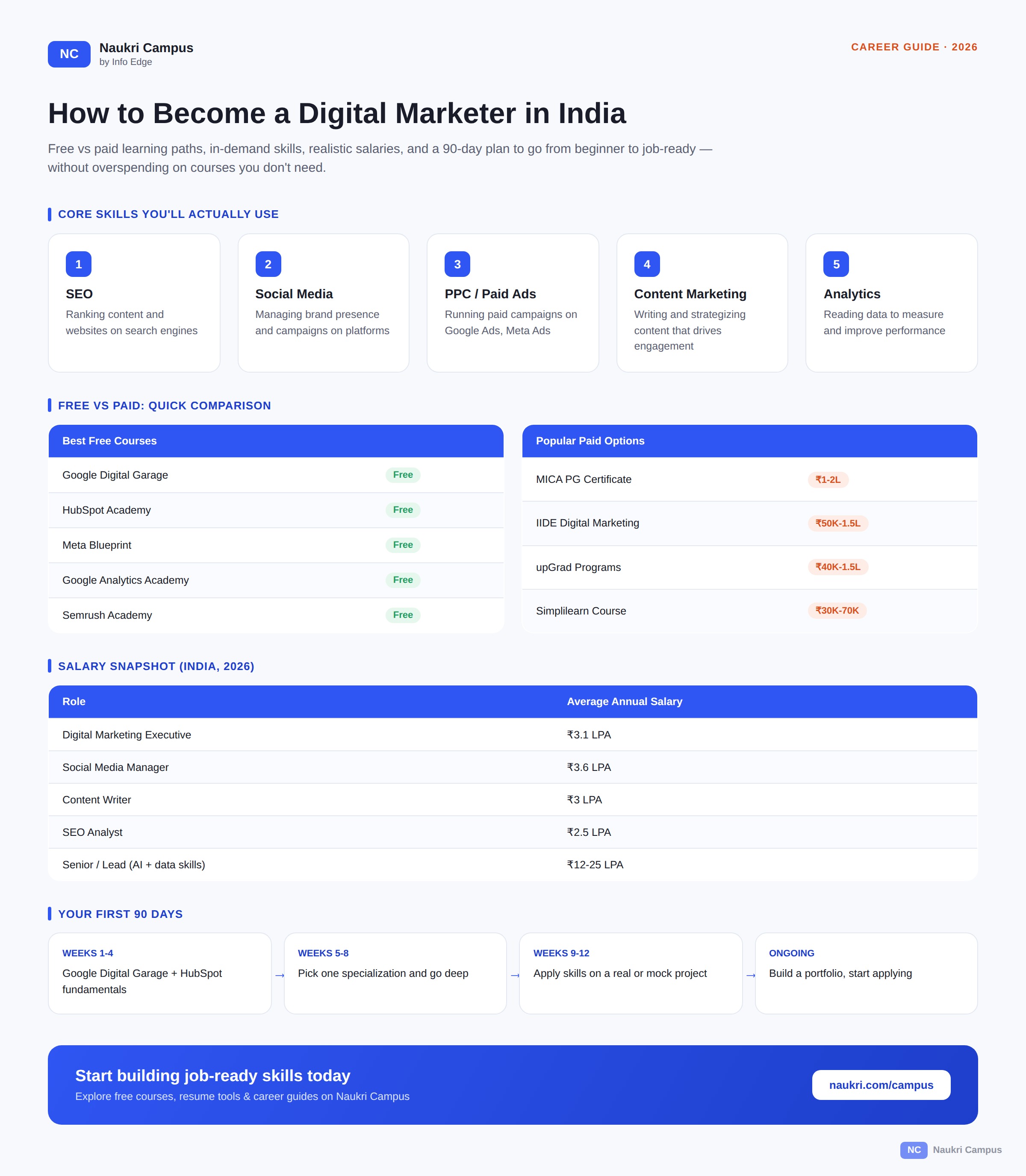
| Skill Area | What It Covers |
| SEO (Search Engine Optimization) | Ranking content and websites on search engines |
| Social Media Marketing | Managing brand presence and campaigns on platforms |
| PPC/Paid Ads | Running paid campaigns on Google Ads, Meta Ads |
| Content Marketing | Writing and strategizing content that drives engagement |
| Analytics | Reading data (Google Analytics) to measure performance |
| Email Marketing | Building and running email campaigns |
Most beginners are better off picking one or two of these to go deep on first; SEO and analytics pair well together, and so do social media and content marketing.
Best Free Digital Marketing Courses For Freshers
There’s no shortage of free content online, but a lot of it is outdated or too generic to actually build job-ready skills. These are the free courses that are genuinely respected by recruiters and consistently updated.
| Course | Provider | Duration | Focus Area |
| Fundamentals of Digital Marketing | Google Digital Garage | ~40 hours | Broad overview, SEO, social, and analytics basics |
| HubSpot Academy Certifications | HubSpot | 4-12 hours per course | Inbound marketing, content, email, SEO |
| Meta Blueprint | Meta (Facebook/Instagram) | Self-paced | Social media & paid ads on Meta platforms |
| Google Analytics Academy | ~15-20 hours | Web analytics and data-driven marketing | |
| Semrush Academy | Semrush | Self-paced | SEO, keyword research, content strategy |
These free courses are strong for building foundational knowledge, and the certificates from Google, HubSpot, and Meta specifically carry real recognition on a resume; they’re not just participation certificates.
Are Paid DM Courses Worth the Money?
This depends heavily on what a paid course offers beyond the free alternatives, namely mentorship, structured projects, placement support, or access to tools you couldn’t otherwise practice with. A paid course is worth it when it fills a genuine gap that free resources can’t.
| What Justifies the Cost | What Doesn’t |
| Live mentorship and doubt-solving | Just repackaged free content |
| Real client projects or internships | Certificates with no practical work |
| Placement assistance or hiring tie-ups | Vague promises without a track record |
| Access to paid tools (Semrush, Ahrefs) | Generic “become an expert” branding |
Before paying for any course, it’s worth checking whether the same curriculum, minus the mentorship, is available for free; often it is, and the paid version’s real value is the structure and accountability around it.
Top Paid Digital Marketing Courses in India
If you’ve decided a paid course fits your situation, here’s how the well-known options in India generally compare in terms of cost and depth. Prices vary by cohort and offers, so treat these as approximate ranges.
| Course/Institute | Approximate Cost | Duration | Best For |
| Google Ads/Skillshop Certifications | Free | Self-paced | Paid search specialization |
| MICA PG Certificate in Digital Marketing | ₹1-2 lakh | 6-12 months | Structured, brand-recognized program |
| IIDE Digital Marketing Course | ₹50,000-1.5 lakh | 3-6 months | Practical, project-based learning |
| upGrad Digital Marketing Programs | ₹40,000-1.5 lakh | 3-11 months | University-affiliated certification |
| Simplilearn Digital Marketing Course | ₹30,000-70,000 | 3-6 months | Self-paced with live sessions |
Notice that the gap between the cheapest and most expensive paid options is large; this is exactly why it’s worth being clear on your specific goal (a certificate for your resume vs. a job guarantee vs. deep specialization) before committing.
Free vs Paid: Which Path Fits You?
For most first-time job seekers, the smartest approach isn’t choosing one path exclusively; it’s starting free to test genuine interest, then investing selectively in paid resources once you know which specialization you want to pursue. This avoids spending money before you’re sure digital marketing is the right fit.
| Your Situation | Recommended Path |
| Complete beginner, unsure of interest | Start entirely free (Google Digital Garage, HubSpot) |
| Know your specialization, want structure | Mix: free foundation + one paid specialized course |
| Need placement support urgently | Paid course with proven hiring tie-ups |
| Already have some projects/portfolio | Free advanced courses (Semrush, Analytics Academy) |
This staged approach also means that if you do end up paying for something, you’re paying to fill a genuine gap in your learning rather than starting from zero with someone else’s syllabus.
How Much Do Digital Marketers Actually Earn?
Salary expectations matter for planning your learning investment, and the numbers in India for 2026 show a fairly wide range depending on role and specialization. Entry-level salaries typically range from ₹2.5 to ₹5 LPA, with clear room to grow as you specialize.
| Role | Average Annual Salary |
| Digital Marketing Executive | ₹3.1 LPA |
| SEO Analyst | ₹2.5 LPA |
| Social Media Manager | ₹3.6 LPA |
| Content Writer | ₹3 LPA |
| Email Marketing Specialist | ₹3 LPA |
As experience builds, the growth curve is meaningful; professionals move from roughly ₹2.7 LPA as freshers to ₹4.2 LPA at the mid-level (4-5 years), and senior/lead roles with strong data and AI-tool expertise can cross ₹12-25 LPA.
Your First 90 Days: A Learning Plan That Works
Rather than jumping between multiple courses at once, the most effective approach is sequential: build foundational knowledge first, then specialize, then prove it with real work. This structure prevents the common mistake of collecting certificates without building anything tangible.
| Phase | Focus |
| Weeks 1-4 | Google Digital Garage + HubSpot fundamentals |
| Weeks 5-8 | Pick one specialization (SEO, social, or paid ads) and go deep |
| Weeks 9-12 | Apply skills on a real or mock project — a blog, a small business’s social page |
| Ongoing | Build a portfolio showcasing results, start applying for internships |
By the end of this window, you should have at least one real project you can discuss confidently in an interview; this matters far more to recruiters than a stack of unused certificates.
No Experience? Here’s How to Build a Portfolio
This is the most common roadblock for first-time job seekers, and the good news is that a portfolio doesn’t require a paying client to start. You can create genuine, demonstrable work through self-initiated projects that show real skill application.
Run a small blog and optimize it for SEO, manage a friend’s or family business’s social media for free in exchange for a testimonial, or run a mock Google Ads campaign using the platform’s own practice tools. Document your process and results for each; that documentation is what turns a project into a portfolio piece.
| Portfolio Idea | Skill It Demonstrates |
| Personal blog with SEO optimization | SEO, content writing |
| Managing a small business’s Instagram | Social media strategy |
| Mock Google Ads campaign | Paid advertising |
| Email newsletter for a project/community | Email marketing |
5 Mistakes That Slow Down Beginners
Watching where others go wrong is often faster than figuring it out yourself, and a few patterns show up repeatedly among beginners who struggle to land their first role. Most of these mistakes come from optimizing for certificates rather than actual capability.
| Mistake | Why It Hurts You |
| Collecting certificates without projects | Recruiters want proof of skill, not just completion badges |
| Trying to learn every specialization at once | Shallow knowledge across too many areas, strong in none |
| Ignoring analytics and data skills | Nearly every role now expects basic comfort with data |
| Ghost-following trends without strategy | Chasing “viral” tactics instead of building fundamentals |
| Ignoring industry updates | Digital marketing platforms and algorithms change constantly |
Avoiding even two or three of these mistakes puts you meaningfully ahead of a large share of beginners competing for the same entry-level roles.
5 Digital Marketing Tools Every Beginner Should Practice With
Beyond courses and certifications, hands-on comfort with the actual tools marketers use daily is what often separates a strong candidate from a merely certified one. Most of these tools have free tiers or trial access, so you don’t need a budget to start practicing.
| Tool | What It’s Used For |
| Google Analytics | Tracking website traffic and user behavior |
| Google Ads / Meta Ads Manager | Running and managing paid campaigns |
| Canva | Creating quick social media and marketing visuals |
| Semrush / Ubersuggest (free tier) | Keyword research and SEO analysis |
| Mailchimp or similar | Building and sending email campaigns |
Getting hands-on with even three or four of these tools during your learning phase gives you concrete, demonstrable experience to reference in interviews, far more convincing than simply naming them on a resume.
Final Thoughts
Becoming a digital marketer in India doesn’t require choosing between free and paid learning; it requires being strategic about which one solves your specific gap at each stage. Start with free, well-recognized certifications to build your foundation, pick one or two specializations to go deep on, and invest in a paid course only when it fills a genuine need like mentorship or placement support.
The recruiters hiring for entry-level digital marketing roles care far more about what you can show them; a portfolio, a project, a real result than which certificate is framed on your resume.
Frequently Asked Questions
Do I need a degree in marketing to become a digital marketer?
No, digital marketing is one of the more accessible careers for career switchers and freshers from any academic background, since employers often prioritize demonstrated skills and portfolio work over a specific degree.
How long does it realistically take to become job-ready in digital marketing?
With focused effort, most beginners can build job-ready foundational skills in 3-6 months, though deeper specialization and stronger portfolios naturally take longer to develop.
Are free certifications like Google Digital Garage actually recognized by employers?
Yes, certifications from Google, HubSpot, and Meta are widely recognized and often specifically mentioned as preferred qualifications in digital marketing job listings.
Is it better to specialize in one area or learn a bit of everything?
Specializing in one or two areas like SEO and analytics or social media and content tends to make you more hireable than a broad but shallow understanding of every discipline.
Can I get a digital marketing job without any paid course at all?
Yes, it’s entirely possible using free resources and self-built projects, though a paid course can help if you specifically need structured mentorship, placement support, or access to premium tools.
Is digital marketing a good fit for someone from a non-technical background?
Yes, digital marketing welcomes people from commerce, arts, and humanities backgrounds just as readily as technical ones, since strong communication, creativity, and analytical thinking matter more than coding ability for most roles.
How do I know which digital marketing specialization suits me best?
Try a bit of each free foundational course first. If you enjoy writing and strategy, content marketing may suit you; if you like numbers and optimization, SEO or paid ads are worth exploring further before committing to a paid specialization.
Latest Posts
AI Jobs Are Booming in India: Here’s How to Land One in 2026
If you’ve been scrolling job portals wondering whether “AI jobs” are actually real career options or just buzzword listings, here’s the short answer: they’re very real, and they’re growing faster…
How to Optimize Your LinkedIn Profile as a Fresher
A standout LinkedIn profile as a college student combines a professional photo, a keyword-rich headline that goes beyond your default student title, a first-person summary highlighting your projects and coursework,…
What is SSC CGL Exam? – Complete Details for 2026
If you’re a college student or a fresh graduate wondering, “Should I appear for SSC CGL?” you’re in the right place. Every year, over 30 lakh students apply for this…
Cracked IBPS PO Prelims 2026? Here’s How to Know
If you sat for IBPS PO Prelims on August 22 or 23, 2026, chances are you’ve already refreshed Google a dozen times searching “IBPS PO prelims analysis” or “IBPS PO…
Popular Posts
How to Pass the TCS NQT Aptitude Test?
Every year, lakhs of engineering and graduation students apply to TCS, one of India’s largest IT employers. And almost every single one of them hits the same first wall: the…
What is SSC CGL Exam? – Complete Details for 2026
If you’re a college student or a fresh graduate wondering, “Should I appear for SSC CGL?” you’re in the right place. Every year, over 30 lakh students apply for this…
How to Make a Fresher Resume That Recruiters Notice
If you are a college student or a fresher stepping into the professional world, creating a well-structured resume is your first step to success. A polished and ATS-friendly resume can…
Engineering Student Resume: A Complete Guide for BTech Freshers
Engineering is a highly competitive field, with more than 1.5 lakh students graduating every year in India. That is why a strong engineering student resume is essential to secure a…
Best Fintech Companies for Freshers to Work at in India
India is one of the fastest-growing fintech markets in the world, with over 10,000 registered fintech startups and a market valuation projected to cross $150 billion by 2025. For freshers…