

Engineering is a highly competitive field, with more than 1.5 lakh students graduating every year in India. That is why a strong engineering student resume is essential to secure a…


Data Science Resume for Freshers: Format, Tips and Cover Letter
7 min read
10,498 views

As the field of data science continues to evolve, the demand for skilled professionals in this domain is soaring. For freshers looking to break into this competitive industry, a well-crafted resume is crucial. A resume is often your first impression on potential employers, and it needs to showcase your skills, knowledge, and potential effectively.
This guide will walk you through creating a data science resume that stands out.
Understanding the Importance of a Data Science Resume
Your resume is more than just a document; it’s a reflection of your academic background, technical skills, and professional aspirations. In the competitive field of data science, a well-structured resume can significantly increase your chances of landing an interview.
Here’s why a strong resume is essential:
- First Impression: A resume often forms the first impression for recruiters.
- Showcases Skills: Highlights your technical skills, projects, and relevant coursework.
- Demonstrates Fit: Shows how you align with the job role and company requirements.
Key Sections of a Data Science Resume
A standard data science resume should include the following sections:
Contact Information
Ensure your contact information is accurate and up-to-date. This section should include:
- Full Name
- Phone Number
- Email Address
- LinkedIn Profile
- GitHub Profile (if applicable)
Professional Summary
The professional resume summary is a brief statement that outlines your career objectives and what you bring to the table. Tailor this section to the job you are applying for.
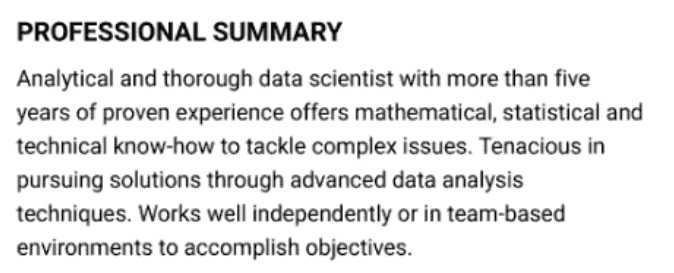
Example:
“Motivated and detail-oriented Data Science graduate with a strong foundation in statistics, machine learning, and programming. Proven ability to leverage analytical skills to solve complex problems. Seeking an entry-level data scientist position to apply my expertise in data analysis and predictive modeling.”
Education
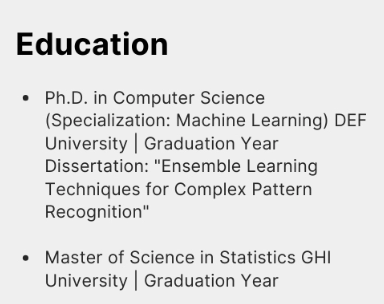
List your educational background, starting with the most recent degree. Include relevant coursework, especially those related to data science. Example:
Master of Science in Data Science
University of XYZ, City, State
Graduation Date: Month Year
Technical Skills
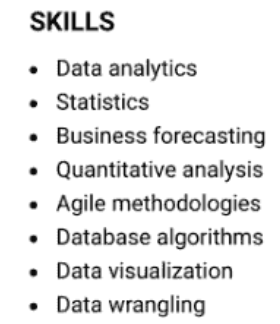
This section should highlight your proficiency in various tools and technologies. Be honest about your skill levels.
Example:
Programming Languages: Python, R, SQL
Data Analysis: Pandas, NumPy, Scikit-learn
Data Visualization: Matplotlib, Seaborn, Tableau
Big Data Technologies: Hadoop, Spark
Databases: MySQL, MongoDB
Machine Learning: TensorFlow, Keras
Version Control: Git
Projects
Showcase your practical experience by listing relevant projects. Include the project title, a brief description, and the technologies used.
Example:
Project Title: Predictive Analytics for Sales Forecasting
Description: Developed a predictive model using machine learning techniques to forecast sales for a retail company. Achieved a 90% accuracy rate using Random Forest and XGBoost.
Technologies Used: Python, Scikit-learn, Pandas, Matplotlib
Work Experience (if applicable)
If you have relevant work experience, list your positions in reverse chronological order. Highlight your achievements and responsibilities.
Example:
Data Science Intern
ABC Corporation, City, State
Dates of Employment: Month Year – Month Year
Assisted in data collection, cleaning, and preprocessing.
Developed and implemented machine learning models to analyze customer behavior.
Created visualizations to present findings to the management team.
Certifications
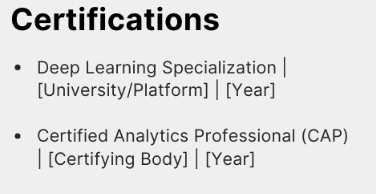
Certifications can add value to your resume by demonstrating your commitment to learning and your proficiency in specific areas.
Example:
Certified Data Scientist – DataCamp
Machine Learning Specialization – Coursera (by Stanford University)
Awards and Achievements
Highlight any awards or recognitions that demonstrate your excellence in the field of data science.
Example:
Winner of the XYZ Hackathon – Developed an innovative data solution for real-time traffic prediction.
Dean’s List – University of XYZ for academic excellence.
Tips for Creating an Effective Data Science Resume
Here are a few additional tips for creating a Data Science Resume for Freshers
- Tailor Your Resume to the Job: Customize your resume for each job application. Highlight the skills and experiences most relevant to the job description.
- Use Action Words: Start bullet points with action verbs to make your responsibilities and achievements stand out. Words like “developed,” “analyzed,” “implemented,” and “created” are powerful.
- Quantify Your Achievements: Whenever possible, use numbers to quantify your achievements. This adds credibility and demonstrates your impact. For Example – Improved model accuracy by 15% through feature engineering and hyperparameter tuning.
- Keep It Concise: Ideally, a resume should be one page long, but two pages are acceptable if you have extensive experience or numerous projects.
- Proofread: Ensure your resume is free from spelling and grammatical errors. Consider asking a mentor or peer to review it.
- Use a Clean and Professional Layout: Choose a simple, professional layout. Avoid overly complex designs and ensure the text is easy to read.
- Include Keywords: Incorporate relevant keywords from the job description. This can help your resume pass through Applicant Tracking Systems (ATS).
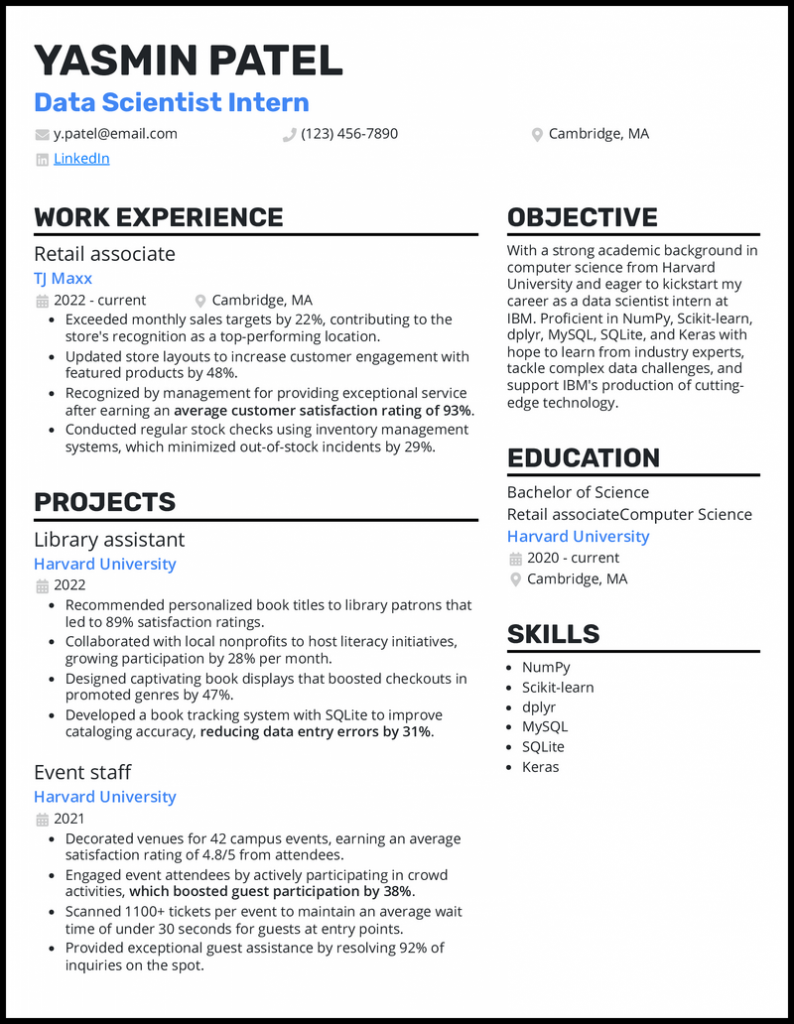
Sample Data Science Resume For Freshers
Below is a sample resume to give you a better understanding of how to structure your own.
Data Science Resume Cover Letter: How to Write?
Creating a compelling cover letter for a data science resume is crucial to making a strong first impression on potential employers. Here’s a template to help you get started:
[Your Name]
[Your Address]
[City, State, ZIP Code]
[Email Address]
[Phone Number]
[Date]
[Employer’s Name]
[Company Name]
[Company Address]
[City, State, ZIP Code]
Dear [Employer’s Name],
I am writing to express my interest in the Data Scientist position at [Company Name], as advertised on [where you found the job posting]. With a strong foundation in data analysis, statistical modeling, and programming, coupled with a genuine passion for uncovering actionable insights from complex data sets, I am confident in my ability to contribute effectively to your team.
During my academic career at [Your University], I honed my skills in data science through various projects and coursework. My experience includes:
- Developing predictive models to forecast sales trends using Python and R, which resulted in a 15% improvement in accuracy over existing models.
- Conducting data cleaning and preprocessing to prepare large datasets for analysis, ensuring data quality and reliability.
- Utilizing machine learning algorithms to identify patterns and insights in customer behavior, contributing to the development of targeted marketing strategies.
In my internship at [Previous Company], I had the opportunity to work on real-world data projects, where I:
- Collaborated with cross-functional teams to identify key business questions and design data-driven solutions.
- Implemented data visualization techniques using tools like Tableau and Power BI to present findings to stakeholders, facilitating data-informed decision-making.
- Leveraged SQL to query and manage large databases, optimizing data retrieval and analysis processes.
I am particularly drawn to [Company Name] due to [specific reason related to the company or its projects, values, etc.]. I admire your commitment to [specific aspect of the company’s mission or work], and I am excited about the possibility of contributing to your innovative projects and helping to drive your data strategy forward.
I am eager to bring my technical expertise, analytical mindset, and enthusiasm for data science to [Company Name]. I look forward to the opportunity to discuss how my background, skills, and certifications align with the needs of your team. Thank you for considering my application. I am available at your earliest convenience for an interview and can be reached at [Your Phone Number] or via email at [Your Email Address].
Sincerely,
[Your Name]
Conclusion
Creating a standout data science resume requires careful planning and attention to detail. By following this step-by-step guide, you can craft a resume that effectively showcases your skills, experiences, and potential to prospective employers. Remember to tailor your resume for each job application, use action words, quantify your achievements, and proofread meticulously.
FAQs on Data Science Resume for Freshers
What should a fresher include in their data science resume?
Focus on projects, skills (programming languages, machine learning frameworks), coursework, and any internships. Showcase your ability to solve problems with data.
Should freshers include an objective statement?
Yes, an objective statement can be a great way to highlight your passion for data science and career goals. Briefly mention your skills and eagerness to learn.
How can freshers with no experience showcase their skills?
Personal projects! Use open-source datasets to build projects demonstrating your data wrangling, analysis, and visualization skills.
What are the best skills to list on a data science resume?
Programming (Python, R), statistics, data analysis tools (Excel, SQL), machine learning libraries (Scikit-learn, TensorFlow), and data visualization tools (Tableau, Power BI).
Can certifications help freshers land a job?
While not essential, relevant certifications in data science or machine learning can showcase your commitment and foundational knowledge.
How important is a strong academic background?
A strong GPA in a relevant field (statistics, computer science) demonstrates your academic ability. Highlight relevant coursework and projects.
Should freshers include soft skills on their resume?
Yes! Data science involves teamwork and communication. Mention soft skills like problem-solving, critical thinking, and communication.
How long should a fresher’s data science resume be?
Keep it concise, ideally one page. Focus on the most relevant skills and experiences.

Latest Posts
What Is a Good ATS Score? Full Benchmarks Guide
A good ATS score is generally 80 or above out of 100; this range typically indicates your resume is well-formatted for automated parsing, relevant to the role you’re applying for,…
How to Improve Your Resume Score to 90+ (Step-by-Step)
To improve your resume score to 90+, you need to fix issues in a specific order — ATS parsing and formatting first, then keyword relevance, then content quality — because…
Job Profile vs Job Description: Which One Should You Read First?
Entering the job market as a fresher can be daunting. Your resume is the first impression you make on potential employers, so it’s essential to craft it meticulously. Understanding the…
How to Write an ATS-Friendly Resume? – Best Tips and Samples
In today’s competitive job market, fresh graduates often face significant challenges in landing their first job. A major hurdle is getting past the initial resume screening, usually handled by Applicant…
Popular Posts
What is SSC CGL Exam? – Complete Details for 2026
If you’re a college student or a fresh graduate wondering, “Should I appear for SSC CGL?” you’re in the right place. Every year, over 30 lakh students apply for this…
How to Make a Fresher Resume That Recruiters Notice
If you are a college student or a fresher stepping into the professional world, creating a well-structured resume is your first step to success. A polished and ATS-friendly resume can…
Engineering Student Resume: A Complete Guide for BTech Freshers
Engineering is a highly competitive field, with more than 1.5 lakh students graduating every year in India. That is why a strong engineering student resume is essential to secure a…
Best Fintech Companies for Freshers to Work at in India
India is one of the fastest-growing fintech markets in the world, with over 10,000 registered fintech startups and a market valuation projected to cross $150 billion by 2025. For freshers…
How to Find Off Campus Placement in 2026
You’ve just completed your degree, or you’re in your final year, and you realize your college’s placement cell might not be enough. Maybe your college doesn’t have top recruiters visiting,…