

If you’ve been watching AI headlines and wondering how people actually land jobs building these systems, you’re asking the right question at the right time. Machine learning engineering is one…


IBPS PO 2026 Quant Shortcuts: How to Solve Faster and Score Higher
8 min read
10,173 views

If you’ve started prepping for IBPS PO 2026, you already know the biggest challenge isn’t understanding the math; it’s finishing on time. With Prelims giving you just 20 minutes for 35 quantitative aptitude questions, calculating every answer the textbook way simply won’t work. This is exactly why shortcuts and smart approximation techniques separate candidates who clear the cutoff from those who run out of time mid-section.
This guide breaks down the exact quant shortcuts, time-saving tricks, and topic-wise strategies you need for IBPS PO 2026, along with the latest exam dates, pattern, and marks distribution, so your prep plan is built around the real exam, not guesswork.
When is IBPS PO 2026 and What’s the Latest Update?
IBPS has released the CRP PO/MT-XVI notification, with registration open from July 1 to July 26, 2026. The preliminary exam is scheduled for August 22 and 23, 2026, followed by the main exam on October 4, 2026.
This cycle offers 6,715 vacancies across 11 participating public-sector banks, making it one of the largest recruitment drives in recent years. Interviews are expected in November-December 2026, with the final result and allotment likely by January 2027.
What’s the IBPS PO Exam Pattern for 2026?
Before you can build a shortcut strategy, you need to know exactly what you’re solving for: how many questions, how much time, and how the marks are weighted. IBPS PO has two objective stages: Prelims and Mains, each with a distinct quant-heavy component.
Here’s the prelims pattern, where speed matters most because each section has its own individual timer:
| Section | Questions | Marks | Duration |
| English Language | 30 | 30 | 20 minutes |
| Quantitative Aptitude | 35 | 30 | 20 minutes |
| Reasoning Ability | 35 | 35 | 20 minutes |
| Total | 100 | 100 | 60 minutes |
In Mains, quant is folded into a combined Data Analysis & Interpretation section, which tests both calculation speed and data-reading ability:
| Section | Questions | Marks | Duration |
| Reasoning & Computer Aptitude | 45 | 60 | 60 minutes |
| General/Economy/Banking Awareness | 40 | 40 | 35 minutes |
| English Language | 35 | 40 | 40 minutes |
| Data Analysis & Interpretation | 35 | 60 | 45 minutes |
| English Descriptive Test | 2 | 25 | 30 minutes |
Both stages carry negative marking of 0.25 marks per wrong answer, so shortcuts aren’t just about speed; they’re also about accuracy under pressure.
Why Do You Need Shortcuts for IBPS PO Quant?
With roughly 34-35 seconds per question in Prelims, there’s no time to write out long-form calculations for percentages, ratios, or simplification. Shortcuts let you eliminate wrong options, estimate close enough to the answer, and skip unnecessary steps entirely.
The goal isn’t to memorize tricks blindly; it’s to internalize patterns so your brain recognizes “this is a percentage-to-fraction problem” instantly and jumps straight to the shortcut, the same way you’d recognize a familiar face in a crowd.
Percentage Shortcuts You’ll Use in Almost Every Attempt
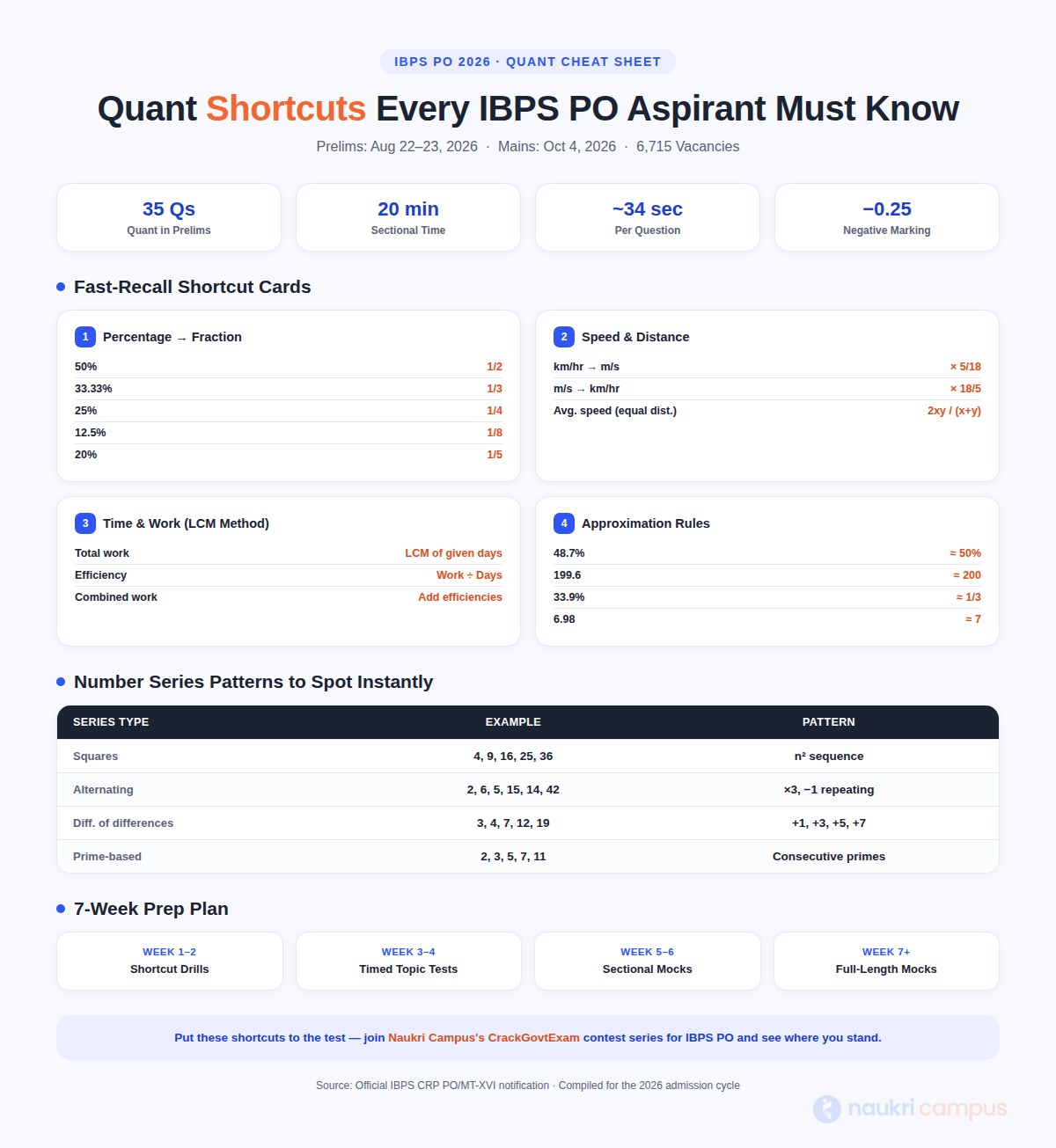
Percentage-based questions appear across simplification, profit & loss, and data interpretation, so mastering this one shortcut set pays off across multiple question types. Memorizing fraction equivalents of common percentages saves you from long division every single time.
| Percentage | Fraction | Percentage | Fraction |
| 50% | 1/2 | 12.5% | 1/8 |
| 33.33% | 1/3 | 16.66% | 1/6 |
| 25% | 1/4 | 20% | 1/5 |
| 10% | 1/10 | 6.25% | 1/16 |
Once these are second nature, a question like “find 33.33% of 450” becomes 450 ÷ 3 = 150 instantly, instead of a slow multiplication and division chain.
Simplification and Approximation Tricks That Save Time
Simplification questions are designed to be solved through approximation, not exact calculation; most answer options are far enough apart that rounding off numbers won’t cost you accuracy. Round decimals to the nearest whole number and convert awkward fractions to their nearest clean equivalent before you start calculating.
BODMAS still applies, but the trick is deciding what precision you actually need. If a question asks you to find an approximate value, don’t calculate 47.98% of 601.2; treat it as roughly 48% of 600 and move on.
| Original Value | Approximated to |
| 48.7% | 50% |
| 199.6 | 200 |
| 33.9% | 33.33% (1/3) |
| 6.98 | 7 |
Ratio and Proportion Shortcuts for Faster Solving
Ratio-based questions test whether you can compare quantities without converting everything into full numbers first. The fastest approach is cross-multiplication for direct proportion problems and componendo-dividendo for questions involving sums and differences of ratio terms.
For example, if a:b = 3:5 and b:c = 2:3, don’t solve them separately; multiply directly to get a:b:c = 6:10:15 by matching the common term (b). This single trick eliminates an entire extra step that most aspirants waste time on.
Number Series and Missing Term Shortcuts
Number series questions reward pattern recognition over calculation, and IBPS PO typically repeats a handful of pattern types: squares, cubes, prime numbers, alternating operations, and difference-of-differences series. Spend your first 5 seconds scanning for the pattern type before attempting any arithmetic.
| Series Type | Example | Pattern |
| Squares | 4, 9, 16, 25, 36 | n² sequence |
| Alternating | 2, 6, 5, 15, 14, 42 | ×3, −1 repeating |
| Difference of differences | 3, 4, 7, 12, 19 | +1, +3, +5, +7 |
| Prime-based | 2, 3, 5, 7, 11 | Consecutive primes |
Practicing 15-20 series patterns until you can spot them within seconds is one of the highest-return prep activities for the Prelims quant section.
Time, Speed, Distance and Work Shortcuts You Shouldn’t Skip
These two topics consistently trip up aspirants because the traditional formula-based approach is too slow for exam conditions. Converting km/hr to m/s using the shortcut multiplier of 5/18 (and the reverse using 18/5) alone can save you 15-20 seconds per question.
For Time and Work problems, the LCM method beats fraction-based equations almost every time: take the LCM of the given days as the total work, calculate individual efficiencies, and combine them directly instead of setting up equations from scratch.
| Shortcut | Formula/Rule |
| km/hr to m/s | Multiply by 5/18 |
| m/s to km/hr | Multiply by 18/5 |
| Time & Work (LCM method) | Total work = LCM of given days |
| Average speed (equal distance) | 2xy / (x+y) |
Data Interpretation Tricks That Actually Work in Mains
Since Mains combines data analysis and interpretation into a single high-weightage section, DI-specific shortcuts matter as much as pure quant tricks. The biggest time saver is learning to eyeball bar graphs and pie charts for approximate comparisons instead of calculating every individual value before answering.
When a question asks you to compare two values or find the one with the highest percentage change, you often don’t need the exact numbers; visually estimating which bar is taller or which pie slice is bigger gets you to the answer faster and just as accurately.
How Should You Practice These Shortcuts?
Shortcuts only work under exam pressure if you’ve drilled them enough times that they become automatic, not something you consciously recall mid-test. The most effective method is timed, topic-wise practice; solve 20 questions from one topic against a strict clock, then review which shortcuts you missed using.
Once you’re comfortable topic-wise, move to full-length sectional mocks that simulate the actual 20-minute quant window, and track your accuracy alongside your speed; a fast wrong answer costs you more than a slow right one, thanks to negative marking.
| Practice Stage | Focus | Duration |
| Week 1-2 | Topic-wise shortcut drills | 20-25 min/day |
| Week 3-4 | Timed topic tests | 20 min/test |
| Week 5-6 | Full sectional mocks | 20 min/section |
| Week 7 onward | Full-length mock tests | 60 min/mock |
Which Mistakes Cost Aspirants the Most Marks?
Even candidates who know their shortcuts well often lose marks to avoidable habits rather than lack of knowledge. The most common one is attempting questions in the order they appear instead of scanning the full set first and picking off the easiest ones, simplification and approximation questions first, and lengthy DI sets last.
Another frequent mistake is over-relying on shortcuts for questions that actually need the exact answer, especially when options are close together (like 24.6 vs. 24.8). Learn to tell apart questions where rounding is safe from ones where it isn’t; that judgment call alone can save you several marks.
| Common Mistake | Fix |
| Solving questions in printed order | Scan and attempt easiest first. |
| Rounding when options are close | Check option gaps before approximating. |
| Skipping negative marking math | Attempt only when 70%+ confident. |
| No revision of shortcut list | Revise shortcuts weekly, not once. |
What Resources Should You Use for Quant Prep?
You don’t need a dozen books; a focused set of resources used consistently will take you further than switching materials every few weeks. A standard arithmetic and data interpretation practice book, combined with a reliable mock test platform that mirrors the actual IBPS interface, covers most of what you need.
Beyond books, previous years’ IBPS PO Prelims and Mains papers are invaluable because they show you exactly how shortcuts apply to real exam-level questions rather than generic practice sets. Set aside at least one full previous-year paper per week as you get closer to your exam date.
If you’d rather practice in a more exam-like, competitive setting than solo mock tests, keep an eye on Naukri Campus’s CrackGovtExam contest series for IBPS PO; it’s a good way to test your shortcuts against a clock and see where you stand against other aspirants prepping for the same exam.
How Should You Plan Your Last Two Weeks Before Prelims?
The final two weeks before August 22 aren’t the time to learn new shortcuts; they’re for tightening what you already know and building exam-day stamina. Shift your practice almost entirely to full-length, timed mocks that replicate the real test window, including the individual 20-minute sectional locks.
Review every mock immediately after attempting it, focusing specifically on questions where a shortcut existed, but you didn’t use it, since that gap is the fastest one to close before exam day. Keep a small revision sheet of your percentage fractions, series patterns, and key formulas to glance through the night before, rather than starting anything new.
Final Thoughts
Clearing IBPS PO 2026’s Quantitative Aptitude section isn’t about knowing more formulas; it’s about knowing which shortcut to reach for the moment you read a question, so your time goes into solving rather than deciding how to solve. Percentage-to-fraction conversions, approximation in simplification, the LCM method for time and work, and pattern recognition in number series form the backbone of a fast, accurate quant attempt.
And if you want a fun, low-pressure way to track your progress along the way, Naukri Campus’s CrackGovtExam contests are worth bookmarking: a quick weekly gut-check that’s a lot more engaging than another solo mock test.
Frequently Asked Questions
How many questions come from quantitative aptitude in IBPS PO Prelims?
Quantitative Aptitude carries 35 questions worth 30 marks in Prelims, to be solved within a strict 20-minute sectional time limit.
Are shortcuts enough to clear the IBPS PO quant cutoff, or do I need conceptual clarity too?
Shortcuts speed up calculation, but they only work reliably when your underlying concepts are solid; think of shortcuts as an accelerator on a foundation you’ve already built through practice.
What is the negative marking scheme for IBPS PO 2026?
Both Prelims and Mains carry a penalty of 0.25 marks for every wrong answer, so accuracy matters just as much as speed when applying shortcuts.
Which quant topics should I prioritize first for IBPS PO 2026?
Start with simplification, percentages, and number series since they appear most frequently and respond best to shortcut-based solving, then move to ratio, time-speed-distance, and data interpretation.
Can I use these shortcuts for other banking exams like SBI PO or RRB PO too?
Yes, most of these shortcuts are foundational to all major bank PO exams since the quant syllabus and question style overlap heavily across IBPS, SBI, and RRB recruitment exams.
How much time should I spend daily on quant shortcut practice?
Most successful aspirants dedicate 45-60 minutes daily specifically to quant, split between learning new shortcuts early in prep and timed practice as the exam approaches, alongside regular practice in reasoning and English.
Is calculator use allowed in IBPS PO exams?
No, calculators aren’t permitted in either Prelims or Mains, which is exactly why shortcuts and mental math techniques matter so much for finishing the quant section on time.
Latest Posts
How to Become a Digital Marketer: Step-by-Step Career Guide
If you’ve typed “how to become a digital marketer” into Google, you’ve probably landed on a dozen conflicting answers; some say a free YouTube playlist is enough, others insist you…
Graduated. Taking a Gap Year. Now What?
You’ve just graduated; everyone around you is either starting a job or prepping for another exam, and you’re quietly wondering whether taking a year off is a smart reset or…
AI Jobs Are Booming in India: Here’s How to Land One in 2026
If you’ve been scrolling job portals wondering whether “AI jobs” are actually real career options or just buzzword listings, here’s the short answer: they’re very real, and they’re growing faster…
How to Optimize Your LinkedIn Profile as a Fresher
A standout LinkedIn profile as a college student combines a professional photo, a keyword-rich headline that goes beyond your default student title, a first-person summary highlighting your projects and coursework,…
Popular Posts
What is SSC CGL Exam? – Complete Details for 2026
If you’re a college student or a fresh graduate wondering, “Should I appear for SSC CGL?” you’re in the right place. Every year, over 30 lakh students apply for this…
How to Make a Fresher Resume That Recruiters Notice
If you are a college student or a fresher stepping into the professional world, creating a well-structured resume is your first step to success. A polished and ATS-friendly resume can…
Engineering Student Resume: A Complete Guide for BTech Freshers
Engineering is a highly competitive field, with more than 1.5 lakh students graduating every year in India. That is why a strong engineering student resume is essential to secure a…
Best Fintech Companies for Freshers to Work at in India
India is one of the fastest-growing fintech markets in the world, with over 10,000 registered fintech startups and a market valuation projected to cross $150 billion by 2025. For freshers…
How to Find Off Campus Placement in 2026
You’ve just completed your degree, or you’re in your final year, and you realize your college’s placement cell might not be enough. Maybe your college doesn’t have top recruiters visiting,…