How to Write an Academic CV in 2026: Format, Tips & Free Template
By Naukri Team, 29 May, 2026
Copy to clipboard
An academic CV is a detailed document that presents your research and teaching experience, along with publications and academic achievements, in a professional format. It is used for PhD applications, postdoctoral roles, and faculty positions where a full record of scholarly work is expected. This guide explains how to write an academic CV using the right format and sections.
Writing a strong academic curriculum vitae (CV) is essential for PhD applicants and research professionals, as selection committees review these documents closely to assess your research focus and overall academic potential. This guide provides the key resources you need to get started with your academic CV.
Academic CV - Key information at a glance
The length of an academic CV is 2 to 4 pages for early-career researchers and 10+ pages for experienced academics.
Many universities and institutions have their own guidelines for writing an academic CV, so you should always review specific requirements before applying.
Use strong academic action verbs such as designed, managed, implemented, secured funding, or facilitated to describe your work effectively.
Including links to Google Scholar, ORCID, or personal academic profiles is increasingly expected in international academic CVs.
Academic CV sample (PDF version)
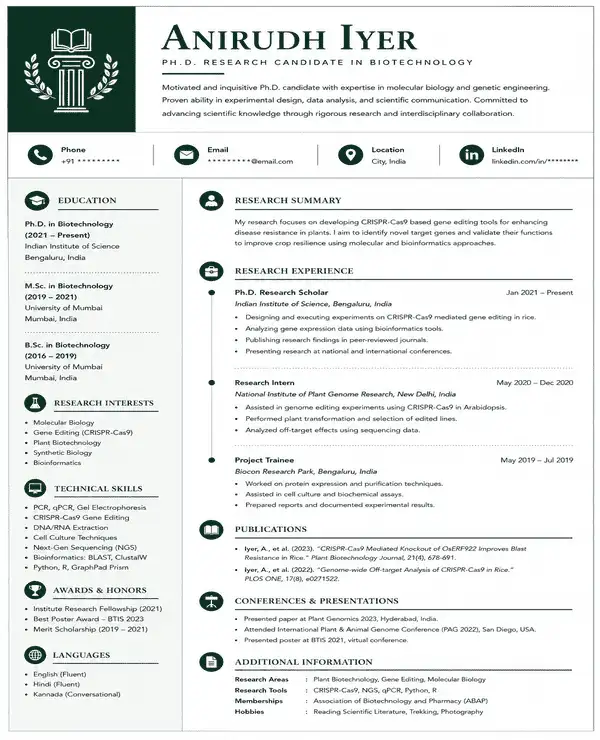
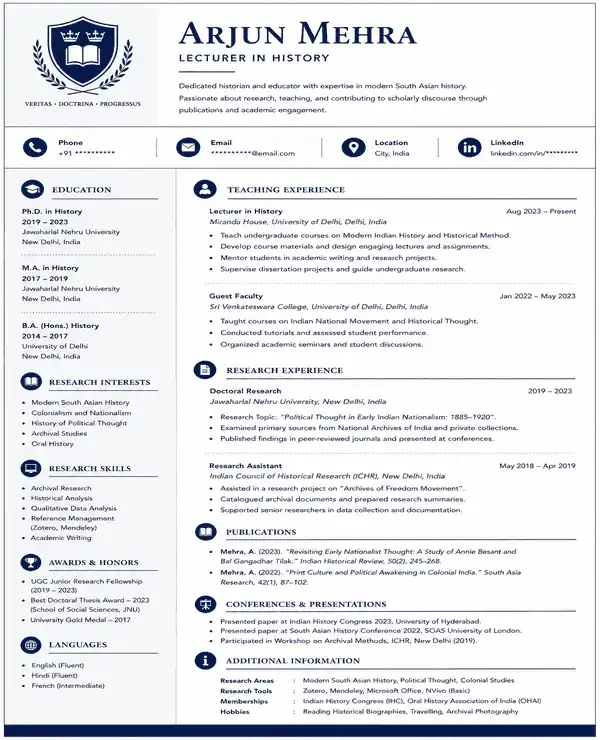
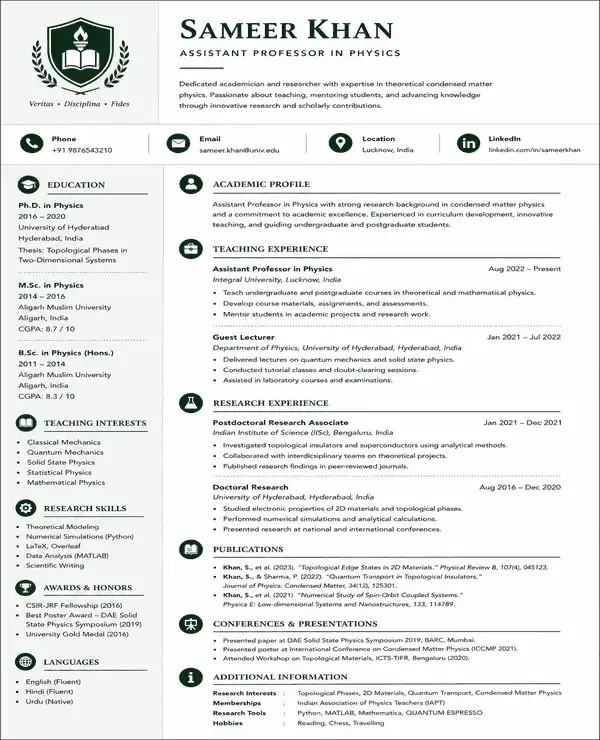
Before we start with the format and key sections, it helps to see how a professionally-written academic CV looks in practice. Below is a sample academic CV to give you a clear understanding of how to present your information.
This academic CV was created using our CV builder. Start building yours now.
Why this academic CV sample works?
Clear section structure makes the CV easy to scan
Most relevant information appears at the top of each section
Strong action verbs highlight contributions and impact
Achievements are supported with specific details and quantitative outcomes
Publications and research work are presented in a the right format
Content is customized to the target academic role
What is an academic CV & how is it different from a resume?
University career centers and top institutions define an academic CV as “a document used by scholars and researchers to present their academic work and apply for roles in higher education and research”. It typically includes research experience, publications, teaching experience, academic achievements, and other scholarly contributions.
Unlike a traditional resume, which is short and job role-specific, an academic CV provides detailed information specific to academia and is sometimes referred to as an academic curriculum vitae or research CV. We will cover academic CV vs resume in detail later in the guide.
You need an academic CV whenever you are applying for opportunities in academia that require a complete record of your academic work. Here are the common situations where an academic CV is required:
PhD applications: A CV for PhD application is used by universities to assess your research interests and potential for advanced study.
Postdoctoral positions: You also need an academic CV for postdoc roles. It should clearly highlight your research experience and publications.
Faculty positions: When applying for teaching or research roles, you are expected to submit a CV that shows your teaching and research experience.
Research grants and fellowships: Academic CVs are often required to evaluate your research contributions and credibility.
Academic job applications: Many roles in universities (such as research assistants, lecturers, or project-based positions) also require an academic CV.
Academic CV format and length
The format and length of an academic CV are not fixed, but they should follow standard academic conventions to present your work effectively. So, let’s look at the key formatting guidelines to follow.
What’s the best format for an academic CV?
The best academic CV format is a section-based format that organizes your work into clear categories such as education, research experience, publications, and teaching experience. Each section should list information in reverse chronological order, with your most recent work first. The order of sections can be adjusted based on the role. For example, research roles may prioritize publications, while teaching roles may highlight teaching experience first.
Ideal length of academic CV by career stage:
The academic CV length depends on your experience and stage of your academic career. Follow this table:
Career Stage
Length
Content
Students / Early-career
2 to 4 pages
Education, research projects, initial publications, teaching experience
Mid-career researchers
4 to 8 pages
Research work, publications, conferences, grants
Senior academics / Professors
10+ pages
Extensive publications, research projects, teaching, awards, academic service
A curriculum vitae for professors is often longer, as it includes a complete record of academic work built over many years.
How to format an academic CV - Font, margins and layout rules
The formatting of your academic CV should make it easy to read. Here are the key formatting rules to follow:
Choose a professional font: Use standard fonts like Times New Roman, Arial, Garamond, or Calibri.
Keep font size readable: 11 to 12 pt for body text and 14 to 16 pt for headings.
Maintain consistent formatting: Use the same font, bullets, spacing, and style throughout.
Set proper margins: Keep margins around 1 inch (2.5 cm) on all sides.
Use clear spacing: Add space between sections to improve readability.
Include your name and page numbers: Add your name and page number in the header or footer.
Use bullet points for descriptions: Keep descriptions concise and easy to read instead of long paragraphs.
Avoid excessive design elements: Do not use colors, graphics, icons, or columns.
Keep it ATS-friendly: Use a clean layout without tables or complex formatting if submitting online.
What are the essential academic CV sections?
Your academic CV should include all the sections that academic recruiters expect. It should clearly answer key questions such as: Do you have any publications? What is the focus of your dissertation or current research? Have you presented your work at recognized conferences in your field? What teaching experience do you have? What are your main research and teaching interests?
Here are the important academic CV sections to include:
1. Contact Information and Header
The header is the first section of your academic CV and should present your basic contact details.
Full name: Use your full name as the main heading.
Phone number: Include a professional and active contact number.
Email address: Use a formal email ID (preferably your name or institutional email).
Location: Mention your city and country (full address is not required).
Professional links (optional): Add links to your Google Scholar, ORCID, LinkedIn, or personal academic website if relevant.
2. Research Interests
This section highlights your core academic focus and helps reviewers quickly understand your areas of specialization. It is a compulsory section in research CVs. List your research interests as clear and specific phrases. Example: “Machine Learning in Healthcare” or “Development Economics”. Include 3 to 6 key research areas that best represent your work.
3. Profile Summary
A professional summary is a brief introduction at the top of your CV that highlights your academic background and key strengths to help reviewers quickly understand your profile. Write a short 2 to 4 line summary explaining your skills and experience. You should also mention 1 or 2 quantitative achievements related to publications or projects. Customize it to the role or program.
Here is an academic CV resume summary example:
“Early-career researcher in environmental economics with over 3 years of experience in quantitative research and policy analysis. Contributed to 5+ research projects and authored 2 peer-reviewed publications, with findings presented at 3 international conferences. Skilled in econometric modeling and data analysis, with a focus on climate policy and sustainable development. Committed to producing research that supports evidence-based decision-making.”
4. Education
The education section of your academic CV should present your academic qualifications in reverse chronological order, starting with the most recent degree.
List your degrees: Include degree name, field of study, university name, and graduation year.
Include dissertation/thesis (if relevant): Mention the title or research focus, especially for Master’s or PhD.
Add academic achievements: Include honors, distinctions, or high grades if applicable.
Include institution details: You may add location if applying internationally.
5. Publications
List your publications in reverse chronological order, starting with the most recent. Include full citation details such as authors, title, journal or publisher, and year of publication. You can organize publications section in CV into categories such as:
Peer-reviewed journal articles
Books or book chapters
Conference papers or proceedings
If you have multiple publications, consider grouping them under clear subheadings. For early-career researchers, you may also include work under review or in progress, but make sure it is clearly labeled.
6. Research Experience
This section shows your involvement in research and is a key part of an academic CV, especially for research-focused roles. It should explain the type of work you have done, your role in each project, and the impact of your contributions.
List roles in reverse chronological order
Include the role/title, institution, and duration for each position
Focus on research objectives, methods, and key outcomes
Highlight contributions to projects, publications, or collaborations
Use strong action verbs (e.g., designed, conducted, analyzed)
When writing an academic CV for faculty position, you must keep the teaching experience section on top. It is essential for positions where your ability to teach, mentor, and engage with students is evaluated.
Start with your most recent experience
Include role, institution, course name, and duration
Mention responsibilities such as lecturing, curriculum design, grading, or mentoring
Add any teaching outcomes or feedback if available
Include experience such as teaching assistantships, guest lectures, or workshops
8. Grants, Fellowships and Awards
Include any funding, scholarships, or recognitions that support your academic work and achievements. List them in the correct order, including the name of the grant, fellowship, or award, along with the awarding body and year. Where relevant, you can also mention the funding amount and briefly describe the purpose or significance. Including grants and fellowships strengthens your research CV, as it shows your ability to secure funding and recognition for your work.
9. Conference Presentations
Include conferences where you have presented your research, as this shows your engagement with the academic community. Mention the title of your presentation, the conference name, and the year. You can also specify the type of presentation, such as oral or poster, and include the location or organizing body if relevant. Focus on recognized or relevant conferences that add value to your profile.
10. Professional Affiliations
Include any academic or professional organizations you are a member of to show your involvement in your field. This section is particularly important in academic CVs for faculty positions and senior roles. Mention the organization name, your role or membership status, and any contributions if relevant.
11. References
Include references who can assess your academic work and experience, particularly for PhD, postdoctoral, and faculty roles. Typically, 2 to 3 referees are expected. Provide their name, designation, institution, and contact details, or simply mention “References available upon request” if not required upfront.
Additional sections you can include in academic CV
Depending on your experience and the role you are applying for, you can include additional sections to strengthen your academic CV.
Technical / Research Skills: Include tools, methods, or techniques relevant to your field (e.g., statistical software, lab techniques).
Certifications and Training: Add relevant courses, workshops, or certifications.
Languages: Useful for international roles or research collaborations.
Professional Development: Include seminars, workshops, or academic training programs.
Volunteer or Academic Service: Committees, peer reviewing, or conference organization.
Academic CV examples by career stages
Here are academic CV examples based on different career stages to show you how the structure and content changes as your academic experience grows.
1. Academic CV for PhD application
Follow this academic CV format for PhD applications. You can use this PhD CV example as a reference to structure your own academic CV.
We are sharing an academic CV template Word and PDF format that you can download and customize for your application.
Academic CV vs resume - Comparison table
Understanding the difference between an academic CV vs resume helps you choose the right document based on your career goals and the type of role you want to secure.
Feature
Academic CV
Resume
Purpose
Used for academic, research, and higher education roles
Used for corporate and non-academic jobs
Length
No strict limit; can be multiple pages
Strictly limited to 1 to 2 pages
Content
Includes publications, research, teaching, grants, and academic service
Includes selected experience, skills, and achievements relevant to the job
Customization
Adjusted by reordering sections based on role (research vs teaching focus)
Customized for each job by modifying content and keywords
What are the common academic CV mistakes to avoid?
Now that you understand how to write an academic CV, let’s look at the common mistakes to avoid.
Including irrelevant information: Avoid adding details that do not contribute to your academic profile.
Poor structure and organization: A cluttered or unstructured CV makes it difficult for reviewers to find key information.
Inconsistent formatting: Mixing fonts, styles, or layouts can make your CV look unprofessional.
Mixing published and unpublished work without clear labels: Listing work in progress or under review without distinguishing it from published work.
Not customizing the CV for the role: Failing to adjust your CV based on the position can reduce its impact.
Ignoring international CV expectations: Using the same format without considering differences in US, UK, or European academic standards.
Using generic section titles: Labels like “Work Experience” instead of more relevant titles such as “Research Experience” or “Teaching Experience.”
Weak or poorly structured publications section: Publications should be clearly formatted and easy to review.
About the Author
Naukri Content Team is the editorial team behind Naukri’s Career Advice platform. The team creates expert-backed content on resumes, interviews, career growth, workplace trends, job search strategies, salary insights, and professional development to help jobseekers make informed career decisions.
Remove outdated or irrelevant details, avoid repetition, and focus on recent and high-impact work. Keep older publications or roles brief.
Is academic CV format different in other countries?
Yes. CV expectations vary by country in terms of length, structure, and detail. Always check the institution’s guidelines before applying
Where should I include the publications section in CV?
Place it after education and research experience, or earlier if publications are a strong part of your profile.
Can I use an academic CV template?
Yes. An academic CV template helps maintain structure and consistency, but you should customize it based on your experience and the role.
Do institutions use application tracking systems to filter academic CVs?
Some institutions use ATS, especially for online applications, but many academic CVs are reviewed directly by committees.
How should I make my academic CV ATS-friendly?
Use a simple layout, standard section headings, and avoid graphics or complex formatting. Include relevant keywords from the job description.
How to write an academic CV for students?
Focus on education, research projects, coursework, and any academic achievements. Include internships, assistantships, or presentations if available.
What are the best skills for an academic CV?
Include technical and research skills such as data analysis, lab techniques, grant writing, literature review, or academic writing. Avoid generic soft skills.
What are the best certifications to add in a research CV?
Include certifications relevant to your field. Some general certifications you can add include: Research Methodology Certification, Academic Writing Certification, Good Clinical Practice (GCP) Certification, and Responsible Conduct of Research (RCR).
Your career deserves the best start. Begin your career journey with Naukri's AI Resume Maker or pick from professionally designed Resume Templates - the smarter way to create a professional resume that stands out. Along with resume maker service, dive into expert Career Advice, and discover career tips, guidance, and growth insights on Naukri's Blog. Explore Naukri Campus for career opportunities for freshers.
Apply on the go
Get real-time job updates on our App
Buy Safely with Naukri.com We support secure payment methods
Disclaimer
While Naukri FastForward services have helped many customers over the years, we do not guarantee any interview calls or assure any job offers with any of our services. The services associated with NaukriFastforward are only provided through the website Naukri.com. You are advised to be cautious of calls/emails asking for payment from other web sites that claim to offer similar services under the name of Naukri.com. We have no associates/agents other than the partner sites that have been specifically named on the homepage of the website Naukri.com. We also recommend that you visit Terms and Conditions and Privacy Policy Naukri FastForward may also contact the User through SMS, internet-based messaging applications like WhatsApp, voice call, e-mail for any pending or failed transactions, to assist user in concluding the purchase of Naukri FastForward services. The User hereby unconditionally consents that such communications via SMS, internet-based messaging applications like WhatsApp, voice call, email or any other mode by Naukri FastForward are: 1) upon the request and authorization of the User; 2) 'transactional' and not an 'unsolicited commercial communication' as per the guidelines of Telecom Regulation Authority of India (TRAI), and 3) in compliance with the relevant guidelines of TRAI or such other authority in India and abroad. The User will indemnify Naukri FastForward against all types of losses and damages incurred by Naukri FastForward due to any action taken by TRAI, Access Providers (as per TRAI regulations) or any other authority due to any erroneous complaint raised by the User on Naukri FastForward with respect to the communications mentioned above or due to a wrong number or email id being provided by the User for any reason whatsoever.
**Relationship manager is not applicable for monthly plans.