Adding Work Experience in Resume – The Basics You Should Know
Before you learn how to write work experience in a resume, you need to understand a few basics. Here’s what most people don’t tell you about a work experience resume:
● Follow a clear structure. Always include your job title, company name, location, and employment dates in a consistent format when listing your job experience in a resume.
● Use 3 to 5 strong bullet points per role. Keep your points concise and focused. Too many can overwhelm the reader.
● Start with action verbs. Begin each bullet point with a strong verb to make your contribution sound active and direct.
● Use numbers: Add numbers or measurable achievements in the work experience bullet points to show impact.
● Choose the right resume format. A work experience resume usually follows reverse chronological order so employers can see your career progression easily.
● Customize for every job application. Align your responsibilities and achievements in the work experience section with the role you are applying for.
● Add only limited work history. In most cases, list the last 10 to 15 years of experience. Do not fill your entire resume with your work history.
● Use alternative experience if needed: If you lack full-time experience, include internships, volunteer work, academic projects, or part-time roles that show relevant skills.
Once you get these basics right, writing your work experience section becomes much simpler.
If you want to skip formatting issues, you can use a resume builder to structure your work experience automatically.
How to Write Work Experience in a Resume (Step-by-Step)
If you are wondering how to write work experience in a resume properly, don’t start typing immediately. Most mistakes happen because people rush this section. Let’s break down exactly how to add work experience in a resume the right way.
Step 1: Collect your work details before writing
The first thing you must do is gather all your information in one place. This makes the entire process of listing your work experience in a resume easier. Here’s what you need to do:
● Open a blank document and list every job role you have held.
● For each position, note the company name, your exact job title, start and end dates, and key responsibilities.
● If you have more than 10 to 15 years of experience, focus on recent and relevant roles.
● If you are a fresher, think beyond - full-time jobs. Include internships, campus leadership roles, freelance tasks, competitions, certifications or projects where you applied real skills.
Do not depend only on memory. Check old performance reviews, emails, LinkedIn updates, and appraisal letters. These often contain measurable achievements you may have forgotten.
Doing this preparation first makes it much easier to add work experience in resume without sounding vague or repetitive.
Read more: How to Write a Resume for Freshers with No Experience
Step 2: Follow reverse chronological order
People with work experience should always follow a reverse chronological order when writing a resume. Here, you list your most recent job first, and then move backward to show a clear work timeline. This format allows recruiters to see:
● Your current level
● Career progression
● Promotions
● Stability
The reverse chronological order is the most widely accepted structure for a work experience resume, and keep your career path easy to follow.
Step 3: Write the job title clearly
Once you collect all the information and decide the structure, it is time to actually start listing your work experience in a resume. The first thing you need to write is your job title. Make sure you use the official title from your employment record. If your company used an unclear title, adjust it slightly to match industry standards.
For example:
Instead of “Business Ninja”
Write “Business Development Executive”
This small change makes your job experience resume easier to understand and more ATS-friendly.
Step 4: Add company name, location, and employment dates
After writing your job title, the next step is to add the company name, location and employment dates. These details may seem simple, but they make your work experience resume complete and credible.
The standard structure should look like this:
Job Title
Company Name | City, State
Month Year – Month Year
Keep this format consistent for every role in your job experience resume. Choose one date format and stick to it throughout your resume.
For example:
“Jan 2021 – Mar 2023” or “January 2021 – March 2023”
If you are still working in a role, write: “Jan 2023 – Present”
Step 5: Write 3 to 5 achievement-based bullet points
This is the most important and most difficult part of your work experience resume. Many candidates list generic responsibilities like “Managed customer queries” and “Handled social media”. These things doesn’t add any value to your work experience section in the resume.
The key is to turn these basic responsibilities into measurable achievements using numbers. Here’s how to do it:
Instead of writing “Worked on sales targets”
Write “Achieved 120% of monthly sales targets for three consecutive quarters”
Here is an example of how your work experience section in a resume should look like:
WORK EXPERIENCE
Marketing Manager
ABC Digital Solutions | Mumbai, India
Jan 2021 – Present
● Led a team of 6 marketing executives, increasing qualified leads by 38% within one year.
● Planned and executed digital campaigns across Google and Meta platforms, reducing cost per lead by 22%.
● Launched a new content strategy that improved website traffic from 18,000 to 27,000 monthly visitors.
● Managed a ₹25 lakh annual marketing budget and optimized spending to improve ROI by 30%.
Choosing the Right Work Experience Resume Format
Before you decide how to structure your work experience in a resume, it is important to understand where this section appears and how different formats present it. Each format highlights your work history differently. The right choice depends on your career stage and situation.
1. Chronological resume format (most common)
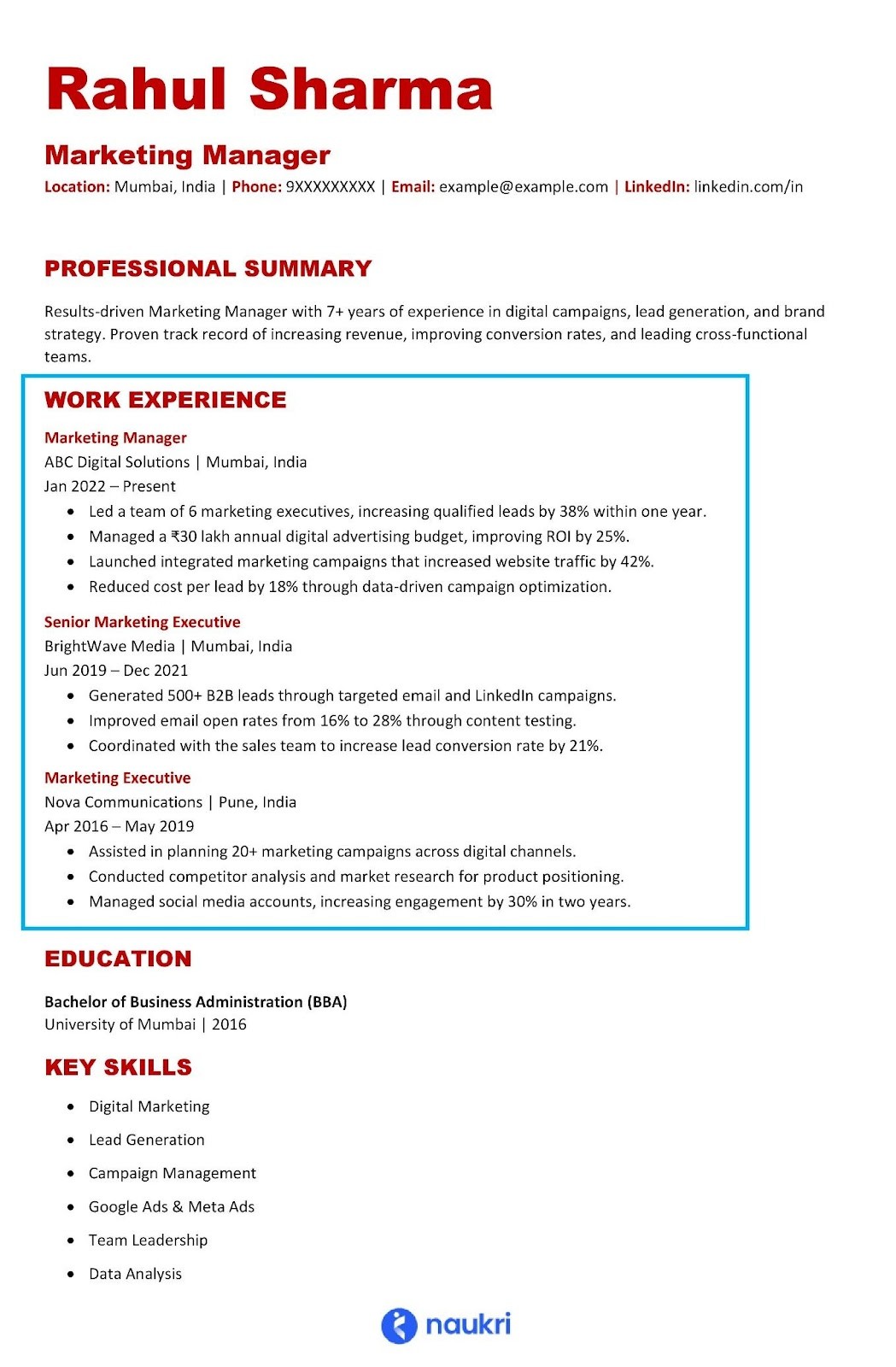
This is the format most professionals use. Your work experience resume section appears near the top of your resume, usually right after your summary. You list your most recent job first, then move backward.
This format works well if you:
● Have steady employment
● Have clear career growth
● Are applying within the same industry
It allows recruiters to quickly see your latest role, responsibilities and progression. If your career path is consistent, this is usually the safest option.
Example of work experience on a chronological resume
2. Functional resume format (skills-focused)
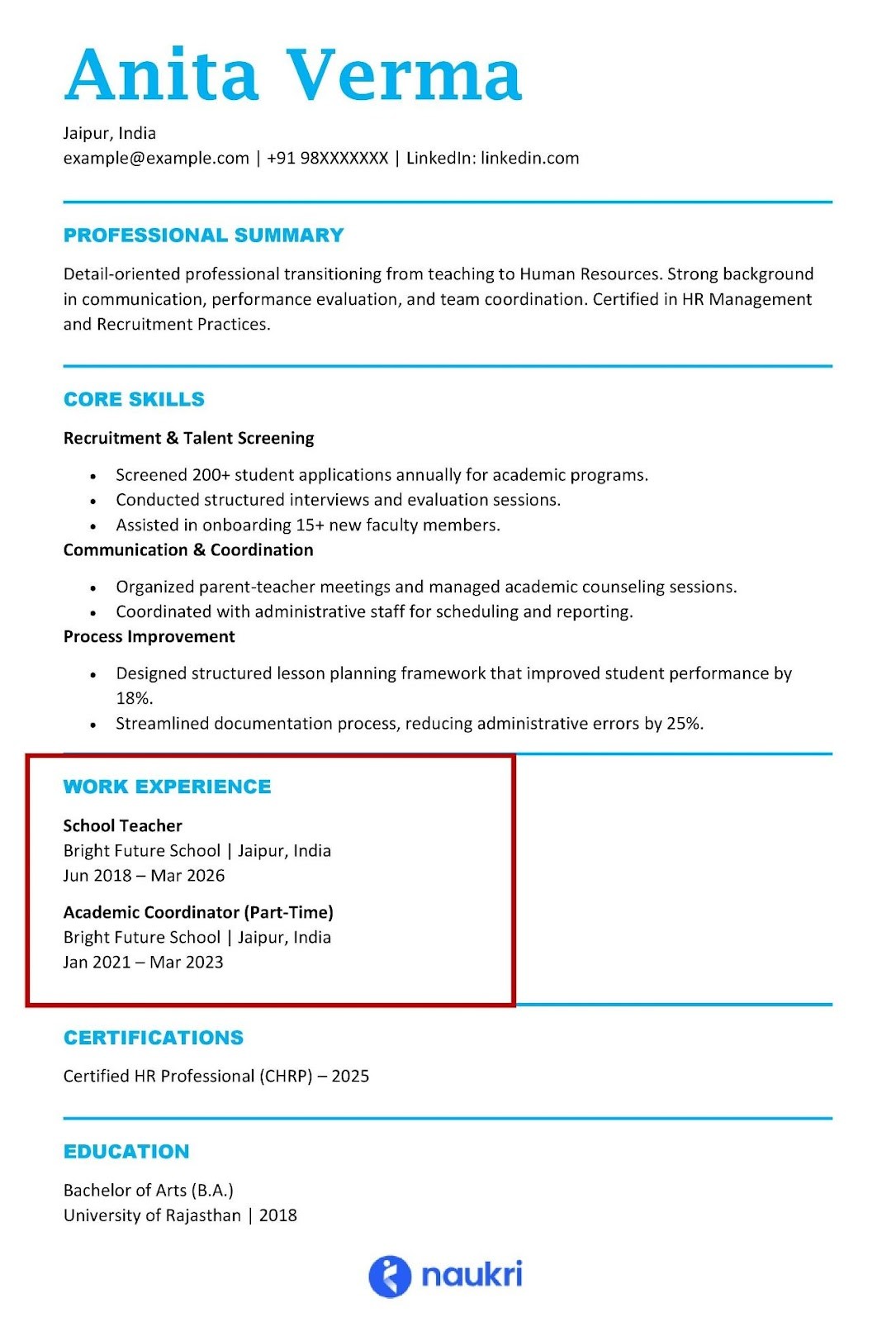
In this format, skills take priority over timeline. Instead of starting with your work history, the resume begins with skill categories. Your work experience section appears later and is shorter.
This format can be useful if you:
● Have employment gaps
● Are switching careers
● Have limited formal past job experience
Read more: Skills for Resume: A Comprehensive Guide with Examples
Example of work experience on a functional resume
Read more: How to write resume summary?
3. Combination (hybrid) resume format
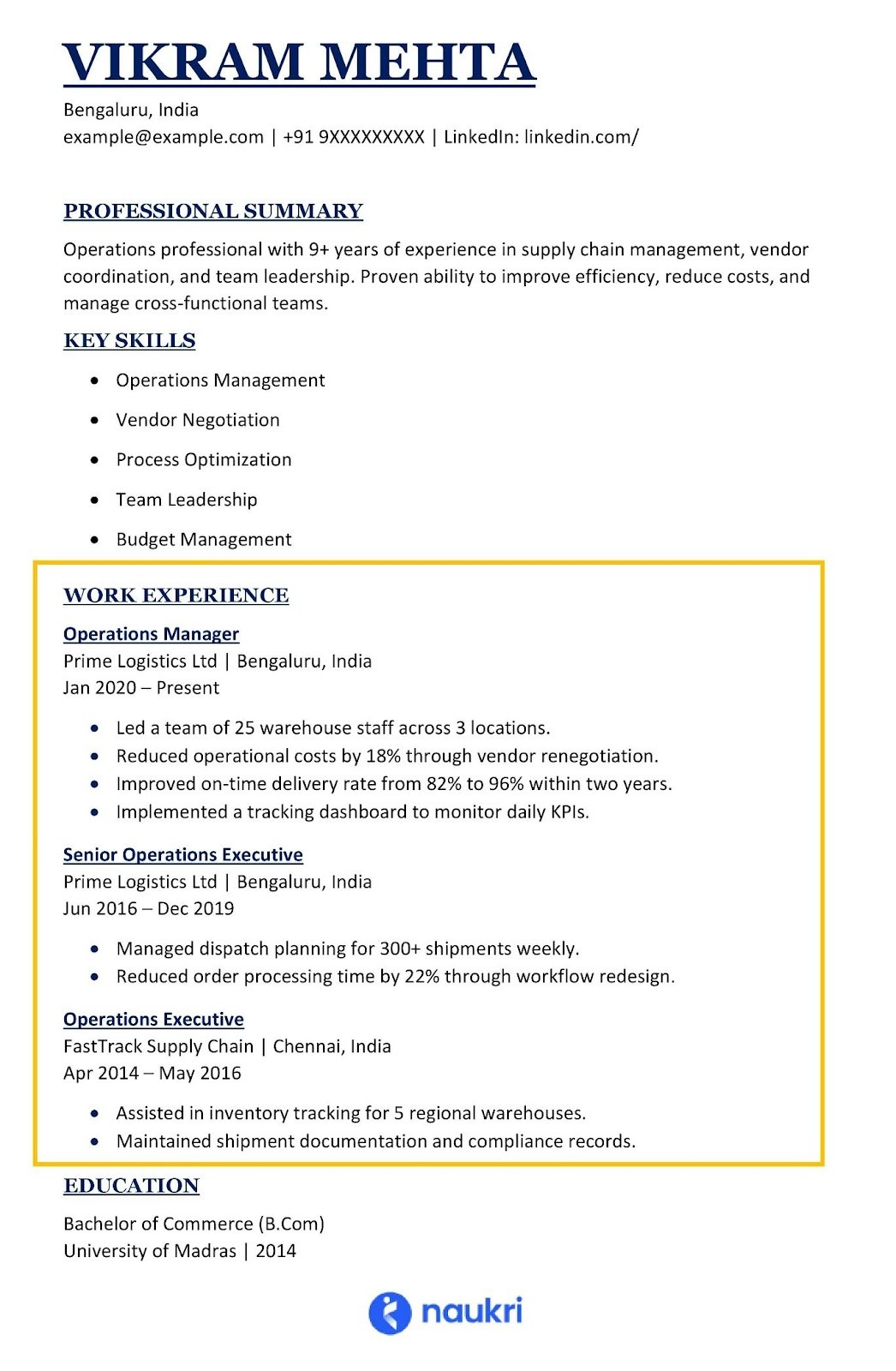
This format blends both approaches, reverse chronological and functional. It begins with a strong summary and skills section, then presents your work history in reverse chronological order. It gives equal importance to what you can do and where you worked.
This works well for:
● Mid-career professionals
● Candidates with diverse experience
● People moving into leadership roles
If you are unsure which work experience resume format to choose, chronological is usually the most straightforward and widely accepted.
Example of work experience on a combination resume
Resume Work Experience Examples for Different Situations and Career Levels
Here are practical resume work experience examples to help you understand how to present your experience clearly, whether you are a fresher, a mid-career professional, or someone changing roles.
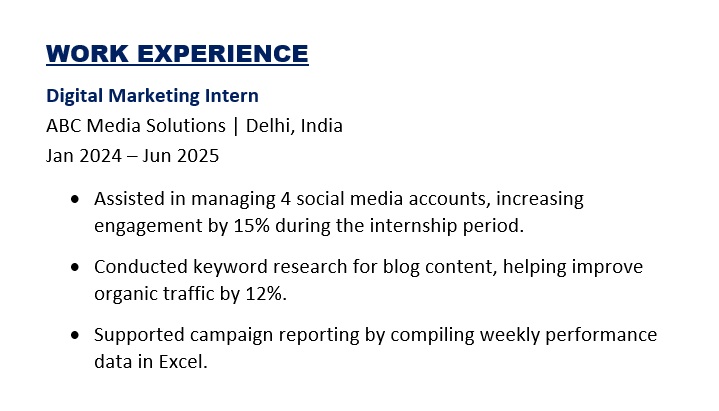
Example 1: Entry-level or fresh graduate
Read more: Resume Formats for Freshers : A Comprehensive Guide
Example 2: Mid-level professional
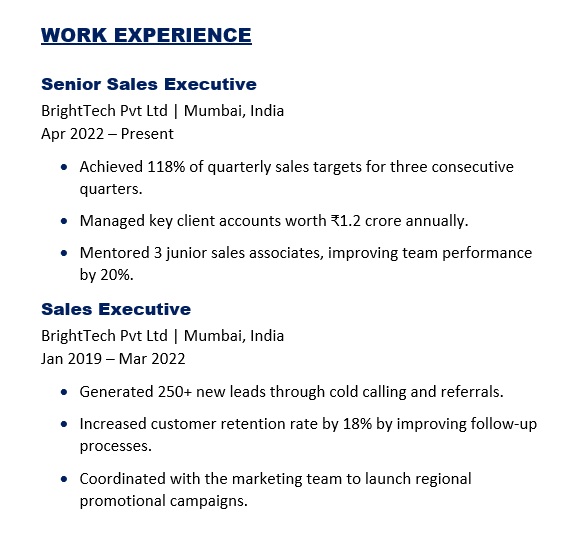
Example 3: Senior-level professional
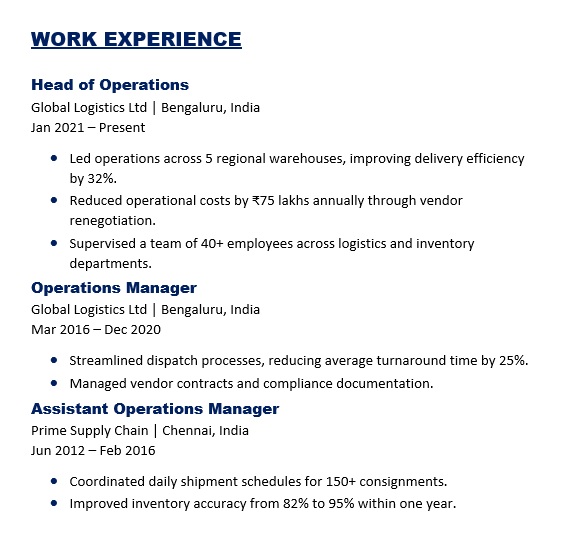
Example 4: Currently working
If you are currently employed, write your end date as - Present and use present tense in your bullet points. This is how to mention currently working in resume clearly:
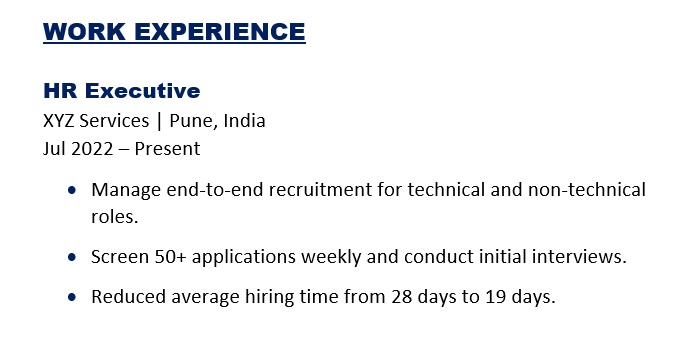
Keep current responsibilities in present tense. Past achievements can still be written in past tense if completed.
Example 5: First job or no experience
If this is your first job experience resume, you can include internships, academic projects, volunteer work, or campus leadership roles.
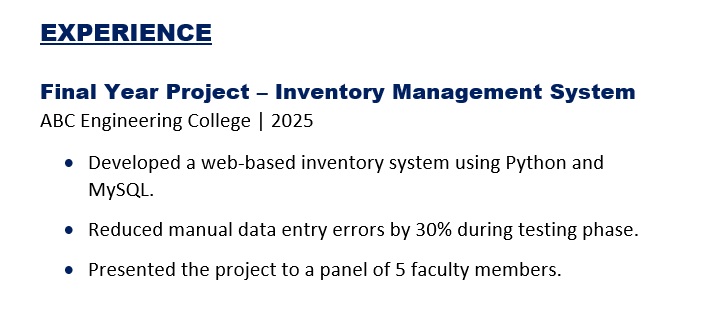
This type of work experience sample still shows skills, responsibility, and measurable output.
Example 6: Employment gap
If you have a career gap, do not try to hide it. Be honest and focus on what you did during that time if it added value.
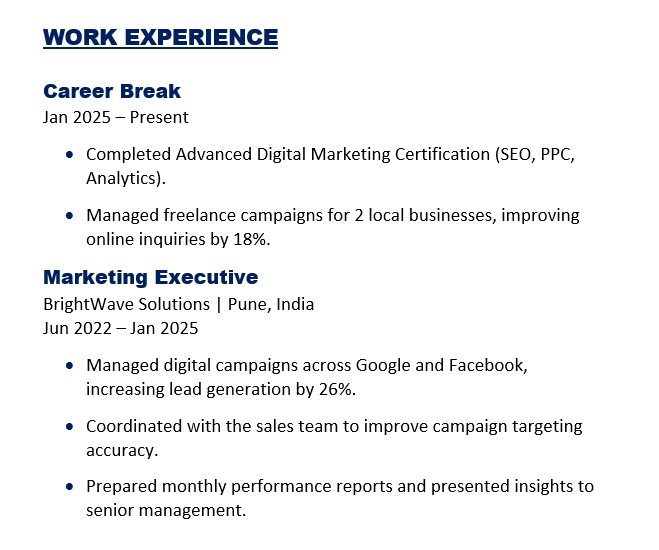
When writing a work experience resume sample with a gap, keep the timeline clear. Recruiters appreciate clarity more than vague dates.
Example 7: Career change
When changing careers, focus on transferable skills. Your job titles may stay the same, but your bullet points should align with the new role.
For example, if moving from Teaching to HR:
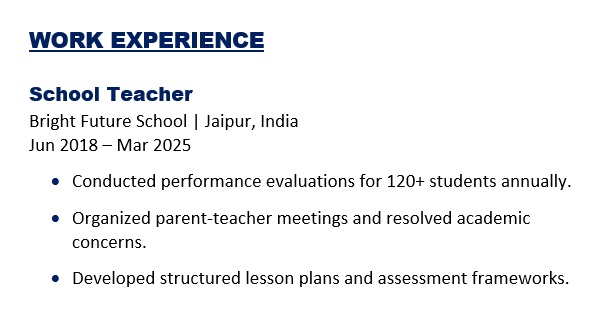
Highlight communication, evaluation, coordination, and planning skills. That’s how to adapt a job experience resume for a career shift.
Example 8: Freelance, contract, or gig work
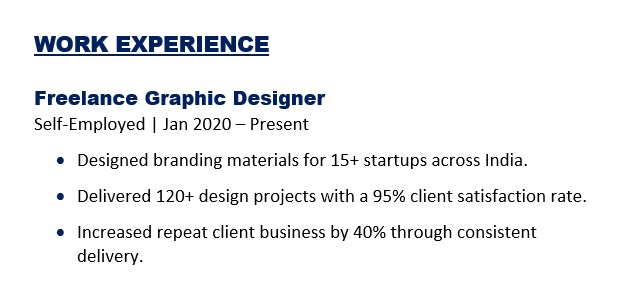
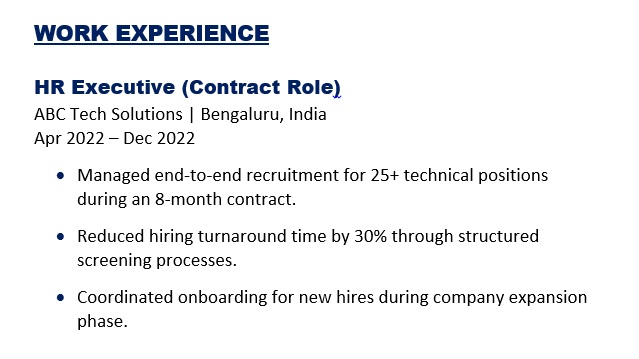
If you have worked as a freelancer or gig worker, list it clearly instead of hiding it. Here’s how to mention work experience in resume for freelancers, contract workers and gig workers.
Freelancers
Contract workers
Gig workers
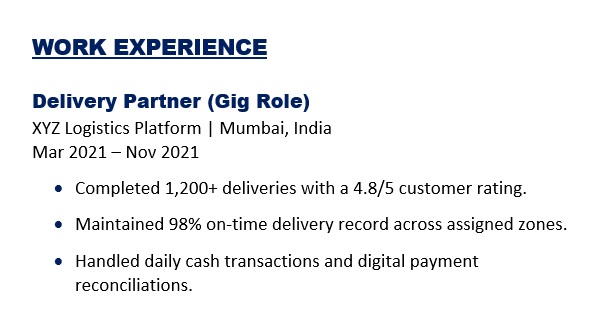
Here’s how to mention work experience in resume for freelancers, contract workers and gig workers:
● Use “Freelance” or “Contract” in the job title.
● Add client impact, not just tasks.
● Include measurable results wherever possible.
This keeps your work history structured and professional.
Resume Work Experience Examples by Job Title
Sometimes the easiest way to understand how to structure your work experience section is by looking at role-specific examples. Below are resume work experience examples by job title.
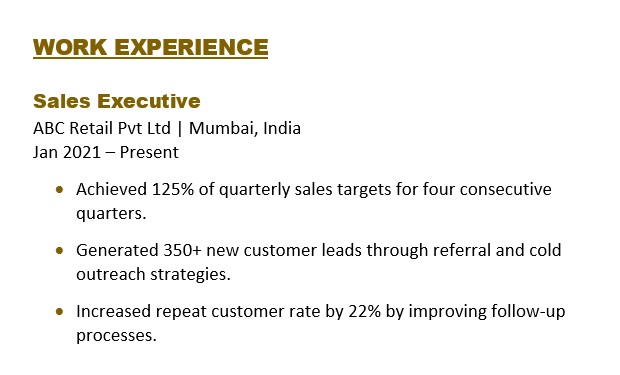
Example 1: Sales Executive
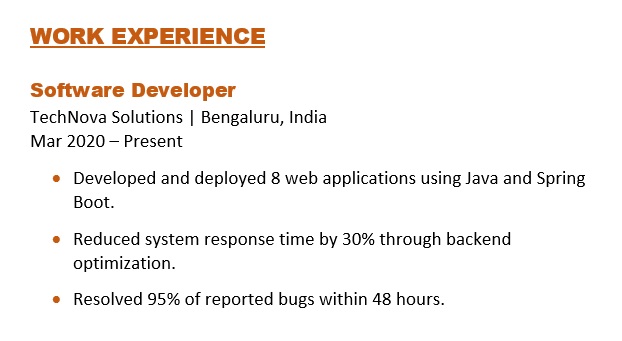
Example 2: Software Developer
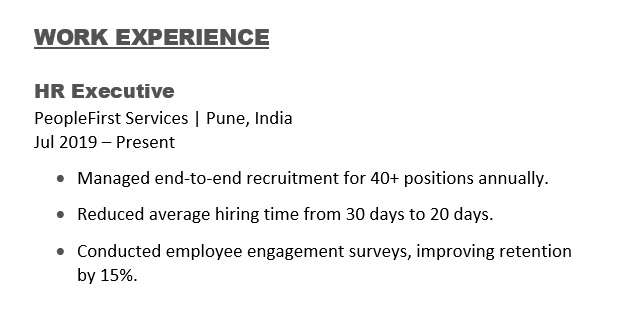
Example 3: HR Executive
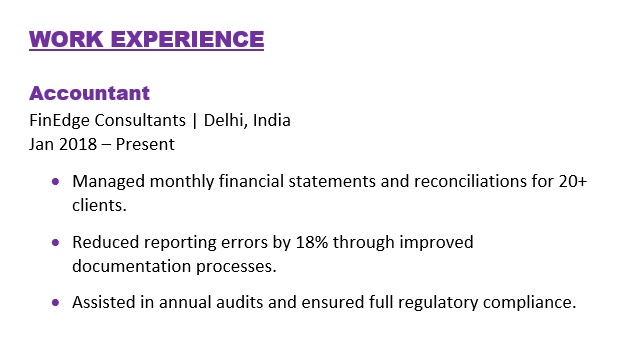
Example 4: Accountant
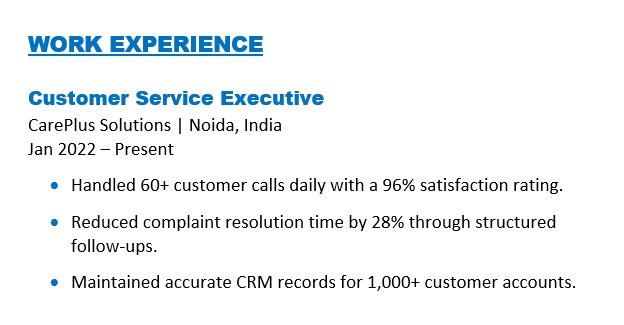
Example 5: Customer Service Representative
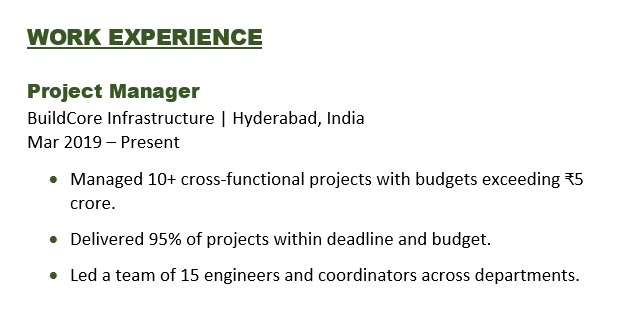
Example 6: Project Manager
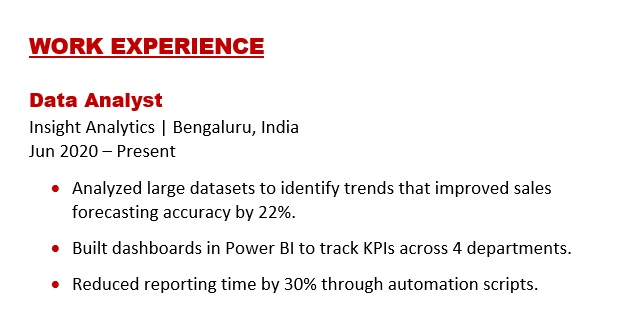
Example 7: Data Analyst
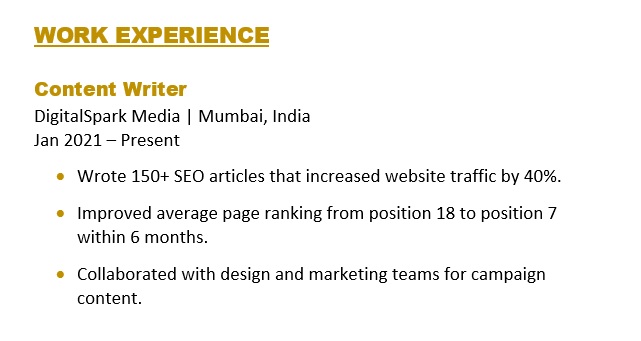
Example 8: Content Writer
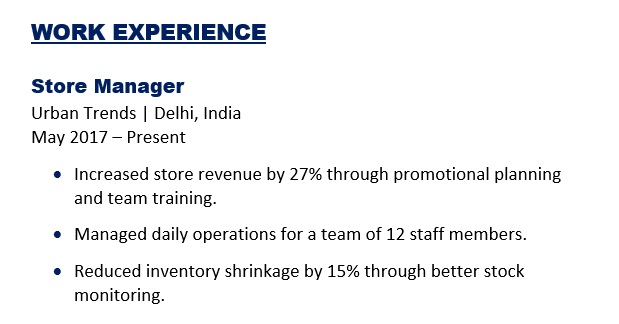
Example 9: Retail Store Manager
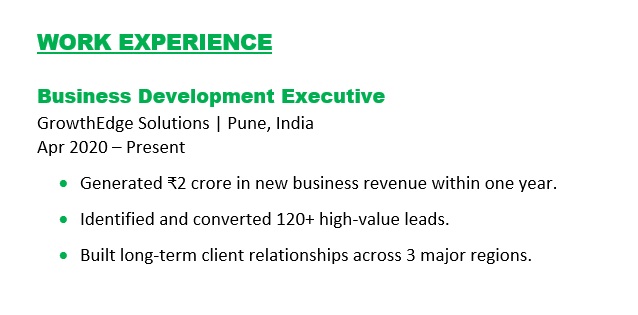
Example 10: Business Development Executive
Work Experience Resume Template (Free Copy Format)
If you need a shortcut to write this section, use this simple work experience resume template. It follows a clean work experience resume format that recruiters are familiar with and easy to scan.
Job Title
Company Name | City, State
Month Year – Month Year (or Present)
● Managed ____________, improving ____________ by ____%.
● Increased/Reduced ____________ by ____% within ____ months.
● Handled ____________ for ____ clients/projects per week.
● Achieved ____% of target or generated ____ results.
You can copy this work experience resume template and adjust it based on your role and industry. This structure works for most roles and can be repeated for every job in your resume.
How to Write Work Experience Bullet Points in a Resume
Bullet points are the most important part of your work experience for a resume. This is where you show what you actually did and how well you did it. Here are the simple tips to write better bullet points:
● Start each line with a strong action verb.
● Avoid phrases like “Responsible for” or “Worked on.”
● Keep each bullet under two lines.
● Add maximum 5 bullet points for each role.
● Add keywords from the job description in your bullet points to make it ATS-friendly resume.
● Add numbers wherever possible.
● Focus on achievements and results, not daily duties.
Use This Simple Formula to Write Work Experience in Bullet Points
When writing bullet points, follow this structure:
Action verb + What you did + Result + Number
Examples of bullet points you can use:
● Increased monthly sales by 22% by improving client follow-up process.
● Reduced operational costs by 15% through vendor renegotiation.
● Managed a team of 5 members to achieve 110% of quarterly targets.
● Processed 50+ client requests daily while maintaining 98% accuracy.
● Generated 300+ new leads through targeted email campaigns.
● Completed 25+ projects within deadlines and allocated budgets.
● Trained 10 new employees, improving onboarding efficiency.
● Resolved recurring system errors, reducing downtime by 20%.
When you review a work experience resume sample, you will notice that the strongest resumes focus on measurable achievements, not routine tasks.
Read more: How to Find and Add the Right Keywords in Your Resume?
Strong Action Verbs for Your Work Experience Resume
Using strong verbs improves the clarity of your professional work experience resume. When learning how to write work experience in resume, starting your bullet points with powerful action words makes your achievements clearer and more professional.
Achievement Verbs | Leadership Verbs | Technical Verbs | Communication Verbs |
● Increased | ● Led | ● Developed | ● Presented |
● Reduced | ● Directed | ● Designed | ● Negotiated |
● Improved | ● Managed | ● Built | ● Trained |
● Optimized | ● Coordinated | ● Implemented | ● Advised |
● Generated | ● Supervised | ● Analyzed | ● Collaborated |
● Boosted | ● Guided | ● Engineered | ● Explained |
● Achieved | ● Oversaw | ● Configured | ● Facilitated |
● Accelerated | ● Headed | ● Programmed | ● Consulted |
● Expanded | ● Mentored | ● Tested | ● Reported |
● Strengthened | ● Delegated | ● Integrated | ● Communicated |
Read more: Action Verbs to Use on Your Resume
Wrapping Up
Your work experience in resume is not just a summary of where you worked. It is proof of what you can deliver. When written clearly, with measurable results and the right format, it helps recruiters understand your value quickly. Focus on relevance, use strong action verbs, and keep your formatting consistent. Small improvements here can significantly improve your chances of getting shortlisted.