










You must sell the stock before you buy it again.
The first line of input contains an integer value N, denoting the size of the input array.

The second line contains N single space-separated integers, denoting the prices on each day.
The only output line contains an integer, denoting the maximum profit.
You are not required to print the output, it has already been taken care of. Just implement the function.
1 <= N <= 5 * 10^4
0 <= PRICES[i] <= 10^4

Time Limit: 1sec
In this approach, we will be using recursion, where we will have a recursive method let's say MAX_PROFIT(PRICES, START) to find the maximum profit that we can make by doing any number of transactions starting from the START index.
To calculate this we will iterate on our prices starting from PRICES[START] till the last price. We will let the current price as the start of a transaction(buy price) and for each START, we will iterate over the next remaining prices and consider them as the end of the transaction(sell price). Let’s say the sell index ends. So the profit for this transaction is profit is PRICES[END] - PRICES[START]. Let it be equal to CURPROFIT (remember we will only choose that END index having price greater than the price of the START index. ).
Now we will calculate the maximum profit possible for the days after the ending day of the current transaction using recursion. So the PROFIT = CURPROFIT + MAX_PROFIT(PRICES, END + 1) and we will find the maximum of all possible profits.
int MAX_PROFIT(PRICES, START):
In this approach, we will be using recursion, where we will have a recursive method let's say MAX_PROFIT(PRICES, START) to find the maximum profit that we can make by doing any number of transactions starting from the START index.
First, we will check whether we have already calculated the results starting from the START index. If calculated, then we will return the results and won’t calculate them again. Otherwise, to calculate this we will iterate on our prices starting from PRICES[START] till the last price. We will let the current price as the start of a transaction(buy price) and for each start, we will iterate over the next remaining prices and consider them as the end of the transaction(sell price). Let’s say the sell index ends. So the profit for this transaction is profit is PRICES[END] - PRICES[START]. Let it be equal to CURPROFIT (remember we will only choose that END index having a price greater than the price of the START index.).
Now we will calculate the maximum profit possible for the days after the ending day of the current transaction using recursion. So the PROFIT = CURPROFIT + MAX_PROFIT(PRICES, END + 1) and we will find the maximum of all possible profits and store these results to be used in future.
int MAX_PROFIT(PRICES, START, DP):
To calculate the maximum profit, we will first plot the graph where the x-axis will denote the indexes and the y-axis will denote the prices. We should buy the stock at the first trough and then sell the stock at the day which is the first peak. In a similar way, the overall profit will be done by doing transactions for each adjacent trough and peak in the graph starting from the first trough and ending at the last peak.
For example, for the given prices [2,4,7,1,3,5] given below is the graph plotted. Transactions will be as follows:
Transaction 1 - Buy at the first trough(price = 2) and sell at first peak(price = 7), making a profit of (7 - 2) = 5
Transaction 2 - Buy at second trough(price = 1) and sell at second peak(price = 5), making a profit of 4
Total profit = 5 + 4 = 9.
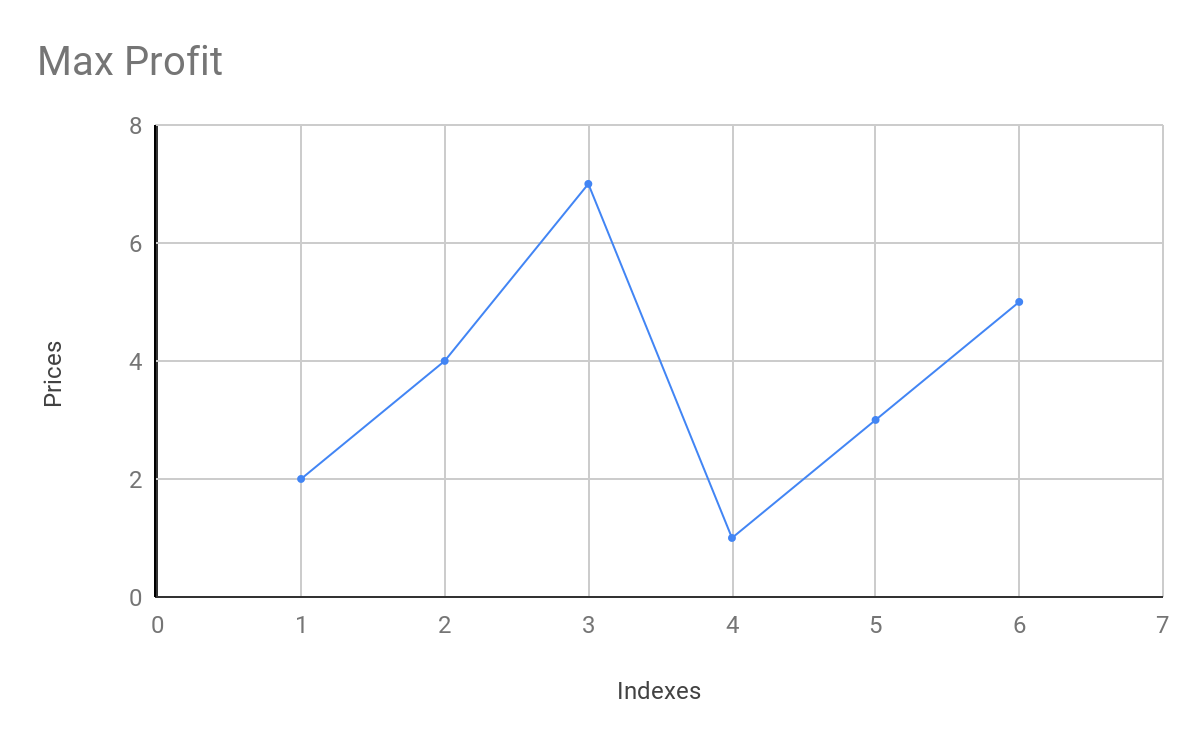
To calculate the maximum profit, we will first plot the graph where the x-axis will denote the indexes and the y-axis will denote the prices. Now if you carefully observe the graph and the solution discussed in approach 3. It can be seen that the maximum profit will equal the sum of differences of all the consecutive price pairs where in each pair the price on an ith day is greater than the prices on (i-1)th day. 1 <= i <= N - 1.

