Given an undirected graph of 'V' vertices and 'E' edges. Return true if the graph contains a cycle or not, else return false.
Note:
There are no self-loops(an edge connecting the vertex to itself) in the given graph.
Example:
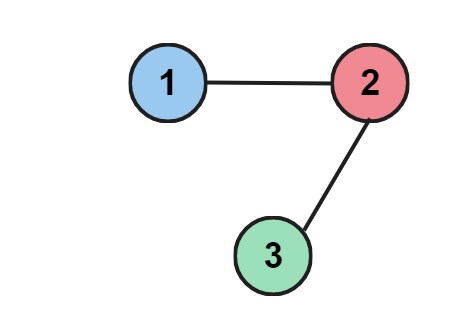
Given N=3, M =2, and edges are (1, 2) and (2, 3), with nodes 1, 2, and 3.

We return false because the given graph does not have any cycle.
Input Format:
The first input line will contain two integers, 'V', and 'E', separated by a single space.

From the second line onwards, the following 'E' lines will denote the edges of the graphs.

Every edge is defined by two single space-separated integers 'a' and 'b', which signifies an edge between vertice 'a' and 'b'.
Output Format:
The single line contains a string, "True" if a cycle exists, else "False".
Sample Input 1:
4 4
0 1
1 2
2 3
3 0
Sample Output 1:
True
Explanation for Sample Input 1:
From node 0, we can reach 0 again by following this sequence of nodes in the path: 0,1,2,3,0.

Similarly, from any of the nodes, we can reach again to that node by following a path. The graph in itself is a cycle.
Sample Input 2:
5 3
0 1
1 2
3 4
Sample Output 2:
False
Constraints:
1 <= V <= 10^5
0 <= E <= 2 * 10^5
0 <= u,v < V

Time Limit: 1sec










