










For the ‘MAT1’ and ‘MAT2’ given below, ‘MAT3’ is the matrix formed by multiplying ‘MAT1’ and ‘MAT2’.
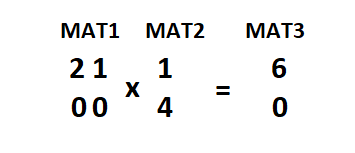
1. MAT3[0][0] = MAT1[0][0] * MAT2[0][0] + MAT1[0][1] * MAT2[1][0]  ie. 2 * 1 + 1 * 4 = 6
2. MAT3[1][0] = MAT1[1][0] * MAT2[1][0] + MAT1[1][1] * MAT2[1][0] ie. 0 * 6 + 0 * 4 = 0
The first line of input contains an integer ‘T’ denoting the number of test cases. Then each test case follows.

The first line of each test case contains four space-separated integers ‘N’, ‘M’, ‘M’, ‘P’ where ‘N’ and ‘M’ representing the number of rows and columns of ‘MAT1’ respectively and ‘M’ and ‘P’ representing the number of rows and columns of ‘MAT2’ respectively.

The next ‘N’ lines of each test case contain ‘M’ single space-separated integers denoting the values of ‘MAT1’. Then the next ‘M’ lines contain ‘P’ single space-separated integers denoting the values of ‘MAT2’
For each test case, return the matrix ‘MAT3’ which will be formed by multiplying ‘MAT1’ and ‘MAT2’.
You are not required to print the expected output; it has already been taken care of. Just implement the function.
1 <= ‘T’ <= 100
1 <= ‘N’, ‘M’ and ‘P’ <= 100
-10^5 <= ‘MAT1[i][j]’ and ‘MAT2[i][j]’ <= 10^5

Time limit: 1 sec
Here is the complete algorithm:
Here is the complete Algorithm:

