




Last Updated: 11 Oct, 2020

Maximum Path Sum Between Two Leaves

Hard
Asked in companies
DirectiMicrosoftMathworks

Problem statement

You are given a non-empty binary tree where each node has a non-negative integer value. Return the maximum possible sum of path between any two leaves of the given tree.

The path is also inclusive of the leaf nodes and the maximum path sum may or may not go through the root of the given tree.

If there is only one leaf node in the tree, then return -1.

Input Format
The first line of input contains an integer 'T' representing the number of test cases. Then the test cases follow.

The only line of each test case contains elements in the level order form. The line consists of values of nodes separated by a single space. In case a node is null, we take -1 on its place.

For example, the input for the tree depicted in the below image would be :
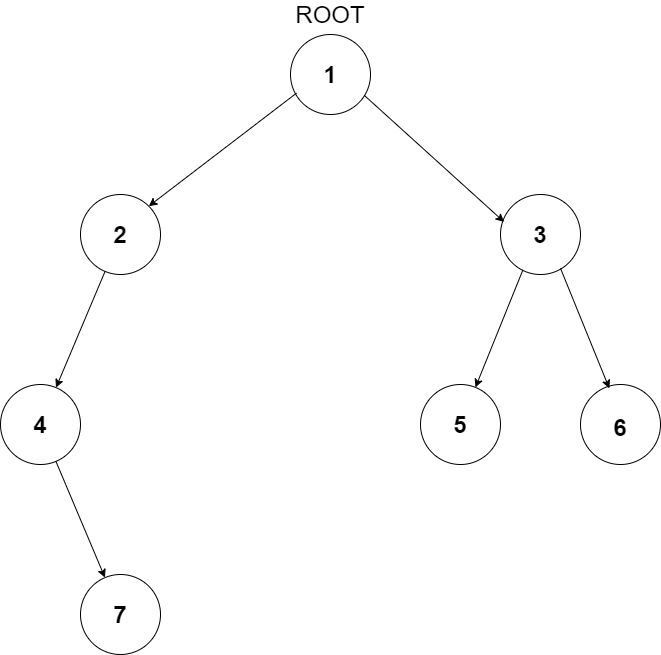
Example Input

1
2 3
4 -1 5 6
-1 7 -1 -1 -1 -1
-1 -1

Explanation :

Level 1 :
The root node of the tree is 1

Level 2 :
Left child of 1 = 2
Right child of 1 = 3

Level 3 :
Left child of 2 = 4
Right child of 2 = null (-1)
Left child of 3 = 5
Right child of 3 = 6

Level 4 :
Left child of 4 = null (-1)
Right child of 4 = 7
Left child of 5 = null (-1)
Right child of 5 = null (-1)
Left child of 6 = null (-1)
Right child of 6 = null (-1)

Level 5 :
Left child of 7 = null (-1)
Right child of 7 = null (-1)

The first not-null node(of the previous level) is treated as the parent of the first two nodes of the current level. The second not-null node (of the previous level) is treated as the parent node for the next two nodes of the current level and so on.
The input ends when all nodes at the last level are null(-1).
Note :
The above format was just to provide clarity on how the input is formed for a given tree. 
The sequence will be put together in a single line separated by a single space. Hence, for the above-depicted tree, the input will be given as:

1 2 3 4 -1 5 6 -1 7 -1 -1 -1 -1 -1 -1
Output Format:
For each test case, print a single integer representing the maximum path sum between two leaf nodes of the given tree.
Note:
You do not need to print anything; it has already been taken care of. Just implement the given function.
Constraints:
1 <= T <= 100
1 <= N <= 5000
0 <= data <= 10^5

Where 'N' is the number of nodes in the tree.

Time limit: 1 sec

Approaches

01 Approach

The main idea behind this approach is to traverse all the nodes in the tree and calculate the maximum sum path between two leaves that passes through a particular node. Now, we have the following functions :


  • ‘FIND_MAX_SUM_PATH()’ : In this function, From this function, we simply make a call to the function ‘FIND_MAX_SUM_PATH_VIA_NODE()’ where we pass the root of the tree as an argument.
     
  • ‘FIND_MAX_SUM_PATH_VIA_NODE()’ :  In this function, we initialize the variable ‘MAX_SUM_PATH’ to -1. This variable will give us the final answer i.e. maximum sum of path between two leaves for the given tree. Then, we calculate the maximum sum path between two leaves that passes through a node (stored in variable ‘MAX_SUM_PATH_VIA_NODE’), which is equal to the maximum sum node-to-leaf path of its left and right child plus the node’s value i.e.
    ‘MAX_SUM_PATH_VIA_NODE’ = ‘FIND_MAX_SUM_NODE_TO_LEAF(node->left)’ + ‘FIND_MAX_SUM_NODE_TO_LEAF(node->right)’ + node->val

    Also, we update ‘MAX_SUM_PATH’ to ‘MAX_SUM_PATH_VIA_NODE’ if we have found a path between two leaves with a greater sum i.e.
    ‘MAX_PATH_SUM’ = max(‘MAX_PATH_SUM’, ‘MAX_PATH_SUM_VIA_NODE’)

    Then, we recursively call the same function for the left and the right subtree.
     
  • ‘FIND_MAX_SUM_NODE_TO_LEAF()' : This function is used to calculate the maximum sum node-to-leaf path starting from the node that is given as an argument to this function i.e.
    max(‘MAX_SUM_LEFT_PATH’, ‘MAX_SUM_RIGHT_PATH’) + node->val.

02 Approach

In this approach, instead of calculating the maximum node-to-leaf path of left child and right child for every node in the tree, we calculate the maximum sum path between two leaves that passes through a node in constant time. The idea is to start from the bottom of the tree and return the maximum sum node-to-leaf path of each node to its parent node. We calculate the maximum sum path rooted at each node and update the max sum during the traversal.

We have the following functions :


  • ‘FIND_MAX_SUM_PATH()’ : In this function, we initialize the variable 'MAX_SUM_PATH' to -1. This variable will give us the final answer i.e. maximum sum of path between two leaves for the given tree. From this function, we simply make a call to the function ‘FIND_MAX_SUM_PATH_HELPER()’ where we pass the variable 'MAX_SUM_PATH' as an argument by reference.
     
  • ‘FIND_MAX_SUM_PATH_HELPER()’ : This is a recursive function with following conditions :

    (1). Base case: If the node is NULL, then return -1

    (2). Recursive case : Call the same function for the left and the right subtree of the node.

    In this function, we recursively find the 'MAX_SUM_LEFT_PATH' (maximum sum of the path from the current node to leaf in the left subtree) and the 'MAX_SUM_RIGHT_PATH' (maximum sum of the path from the current node to leaf in the right subtree). 

    Then, we update the value of 'MAX_SUM_PATH' as follows :
    'MAX_SUM_PATH' = max('MAX_SUM_PATH' , 'MAX_SUM_LEFT_PATH' + 'MAX_SUM_RIGHT_PATH' + node->val)

    This function will return the maximum sum in the subtree starting from the node to leaf i.e.
    max('MAX_SUM_LEFT_PATH', 'MAX_SUM_RIGHT_PATH') + node->val