










Consider following matrix:
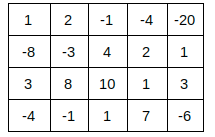
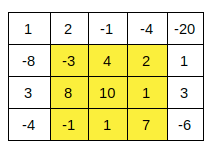
The rectangle (1,1) to (3,3) is the rectangle with the maximum sum, i.e. 29.
The first line of input contains an integer ‘T’ denoting the number of test cases to run. Then the test cases follow.

The first line of each test case contains two space-separated integers ‘N’ and ‘M’ denoting the number of rows and number of columns respectively.

The next ‘N’ lines contain ‘M’ space-separated integers denoting the elements of ARR.
For each test case, print the value of the sum for the maximum sum rectangle.

Print the output of each test case in a separated line.
You do not need to print anything; it has already been taken care of. Just implement the given function.
 1 <= T <= 10
 1 <= M, N <= 75
 -10^5 <= ARR[i][j] <= 10^5

Time Limit: 1 sec
We will iterate through all the rectangles of the matrix with the help of nested loops and return the maximum sum found.
Algorithm
In this approach, we will use the prefix sum, so that we don’t have to iterate on the elements of sub-matrix for finding the sum of a sub-matrix.
Let pref[][] store the prefix sum of the given matrix.
pref[i][j] is the sum of the sub-matrix whose top-left corner is at (0, 0) and bottom right corner is at (i, j).
For finding the prefix matrix, first, we will do the row-wise sum and then we will do the column-wise sum.
For example:
Sum of a sub-matrix (R1, C1, R2, C2) {where (R1, C1) denotes the top-left corner of the sub-matrix and (R2, C2) denotes the bottom-right corner of the sub-matrix} is:
SUM = pref[R2][C2] - pref[R2][C1-1] - pref[R1-1][C2] + pref[R1-1][C1-1].
We can optimize the brute force with the help of the ‘Kadane algorithm’ for a 1-D array which is used to find the maximum subarray sum. We will fix the left and right boundaries for a rectangle. We will then store the sum of elements of the matrix from ‘leftBoundary’ to ‘rightBoundary’, in an auxiliary array ‘temp’ of size ‘N’. We will then use the ‘Kadane algorithm’ to find the maximum subarray sum for ‘temp’.
Algorithm
The function kadaneAlgorithm has two parameters ARR and N and calculates the SUM as follows:

