










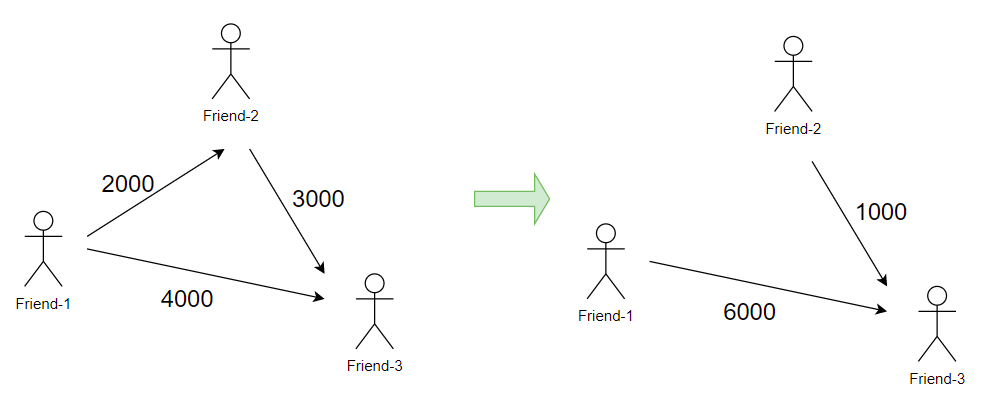
In figure 1 : friend-1 has to pay 2000$ to friend-2, and 4000$ to friend-3 and friend-2 has to pay 3000$ to friend-3.

In figure 2 : so we can minimize the flow between friend-1 to friend-2 by direct pay to friend-1 to friend-3
The first line of input contains a number ‘T’ denoting the number of test cases.

The first line of each test case contains two space-separated integers ‘n’, where ‘n’ denotes the number of friends.

The next ‘n’ line consists of ‘n’ space-separated number, where ‘i’, ‘j’ represents the ‘i-th’ friend to pay ‘arr[i][j]’ to ‘j-th’ friend.
For every test case, return the 2-D matrix.

Output for each test case will be printed in a separate line.
You do not need to print anything; it has already been taken care of. Just implement the given function.
1 <= T <= 5
1 <= N <= 1000
0 <= arr[i][j] <= 10^9

Time Limit: 1 sec
We can calculate the net amount of every person as-
Net amount = sum of all received money - the sum of all sent money.
Find the person with the maximum and the minimum net amount, suppose ‘x’ person has maximum net amount ‘maxAmount’ and ‘y’ person has a minimum amount ‘minAmount’, then ‘y’ person will pay ‘minAmount’ to ‘x’ person after this transaction net amount of ‘x’ person is ‘maxAmount = maxAmount - abs( minAmouny ), and the net amount of ‘y’ person is ‘0’,
Repeat this process until all the amount will not settle or ‘0’.

