









Nodes are numbered from 0 to N - 1.

The graph given is connected.

Print the path[][] in sorted order i.e path[i] is an array containing the path from 0 to n-1, and path[i] is lexicographically smaller than path[i + 1] then path[i] should appear before path[i + 1].

Assume we have two solutions
S1: A1 B1 C1 D1
S2: A2 B2 C2 D2

S1 is lexicographically smaller than S2 iff,
A1 < A2 OR
A1 = A2 AND B1 < B2 OR
A1 = A2 AND B1 = B2 AND C1 < C2 OR
A1 = A2 AND B1 = B2 AND C1 = C2 AND D1 < D2
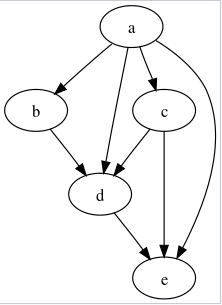
The following is an example of DAG i.e a directed graph with no cycles in it.
The first line contains a single integer ‘T’ denoting the number of test cases. The test cases are as follows.

The first line of each test case contains two integers separated by a single space,‘N’ and ‘M’, where ‘N’  denotes the number of the vertices and ‘M’ denotes the number of edges in the graph.

The next ‘M’ lines of each test case contain two integers ‘X’ and ‘Y’ separated by a single space, here ‘X’ and ’Y’ are the vertices connected by a directed edge from ‘X’ to ‘Y’.
For each test case, print all possible paths from node 0 to N - 1 in sorted order.

Print the output of each test case on a new line.
You don’t need to print anything; It has already been taken care of.
1 <= T <= 5
2 <= N <= 16
N-1 <= M <= N*(N - 1)/2
0 <= X,Y <= N - 1

Time Limit: 1 sec
First of all, we know it is a directed acyclic graph, which means we do NOT need to keep track of previously seen nodes to avoid cycles.
We start our DFS from vertex 0, traverse for all adjacent vertices and push the current adjacent vertex to the path. After that, we call our DFS from the current adjacent vertex. After this, we remove the last added vertex from the path array.
The algorithm is as follows:

