










1. Gray code sequence contains numbers from 0 to 2^'grayNumber'-1 in bit/binary form.
2. Two consecutive gray code sequence numbers only differ by 1 bit.
3. Gray code sequence must start with 0.
Given 'grayNumber' : 2.
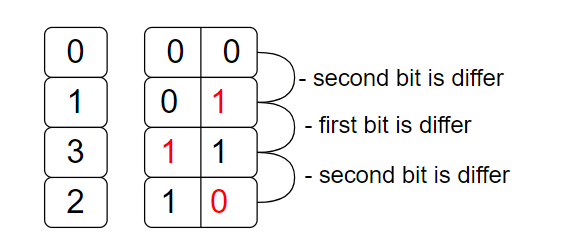
As depicted from above image, the gray code sequence is 0,1,3,2.
1. The output sequence must contain the decimal representation of numbers instead of the binary form.
2. There can be multiple answers print anyone.
The first line of input contains an integer ‘T’ denoting the number of test cases.

The first line of every test case contains an integer ‘grayNumber’.
For each test case, return the ‘list/vector’ of the Gray code sequence.

The output is ‘Valid’ if returned gray code sequence is correct. Else ‘Invalid’.
You do not need to print anything, it has already been taken care of. Just implement the given function.
1 <= T <= 2
0 <= grayNumber <= 15

Time Limit : 1 sec
Suppose are finding an answer for ‘N’ size but we have already the solution for ‘N-1’. then use the previous answer for a new answer. (where ‘N’ is ‘grayNumber’)
The approach is to recursively add the 0 and 1 each time until the number of bits is not ‘N' (where ‘N’ is ‘grayNumber’)
Here is the algorithm :
Suppose the current answer for 'N' : 2 is : {0, 1, 3, 2} (where ‘N’ is ‘grayNumber’ ) then add 2*2 in all the elements in reverse order : { 2+4, 3+4, 1+4, 0+4} then our answer for 'N' : 3 will be : {0, 1, 3, 2, 6, 7, 5, 4}.
Why this is working?
Convert {0, 1, 3, 2} in binary bits form {'00', '01', '11', ‘11’} it is the answer for ‘N’ : 2 if we add '0' as prefix and '1' as a prefix in reverse order of binary representation then we get an answer for 'N' : 3. { ‘0’+‘00’, ‘0’+’01’, ‘0’+‘10’, ‘0’+’11’) by adding '0' as the prefix, (‘1’+‘11’, ‘1’+’10’, ‘1’+‘01’, ‘1’+’00’) by adding '1' as the prefix in reverse order }.
You can observe in adding ‘0’ part we are doing nothing because ‘0’ can’t make any change in the number, and adding ‘1’ part is increasing the value of all the elements in reverse order by 2^'N'.
Here is the algorithm :
Since we need only 1 bit change, we can use XOR with 1 bit shifts. With the use of this property and XOR we can generate numbers which differ by 1 bit. Operation : ‘i’ ^ ( 'i' >> 1 ) gives the gray code for ‘i’th number.
Example :
Given ‘N' : 3 ( where ‘N’ is ‘grayNumber’) and let iterator be ‘i’ which iterates from 0 to 2^3 - 1 (7).
Iteration 0 : ‘i’ = 0, ‘i’ ^ ( ‘i’ >> 1 ) = 0 ^ 0 = 0 {000}
Iteration 1 : ‘i’ = 1, ‘i’ ^ ( 'i' >> 1 ) = 1 ^ 0 = 1 {001}
Iteration 2 : ‘i’ = 2, ‘i’ ^ ( 'i' >> 1 ) = 2 ^ 1 = 3 {011}
Iteration 3 : ‘i’ = 3, ‘i’ ^ ( 'i' >> 1 ) = 3 ^ 1 = 2 {010}
Iteration 4 : ‘i’ = 4, ‘i’ ^ ( 'i' >> 1 ) = 4 ^ 2 = 6 {110}
Iteration 5 : ‘i’ = 5, ‘i’ ^ ( 'i' >> 1 ) = 5 ^ 2 = 7 {111}
Iteration 6 : ‘i’ = 6, ‘i’ ^ ( 'i' >> 1 ) = 6 ^ 3 = 5 {101}
Iteration 7 : ‘i’ = 7, ‘i’ ^ ( 'i' >> 1 ) = 7 ^ 3 = 4 {100}
All the numbers generated differ by 1 bit.
Here is the algorithm :
Count of Subsequences with Given Sum
Optimal Line Arrangement
Distinct Integers After Zero Removal
Maximize Partition Value
Maximum Value Path in a Graph

