










Serialization is the process of translating a data structure or object state into a format that can be stored or transmitted (for example, across a computer network) and reconstructed later. The opposite operation, that is, extracting a data structure from stored information, is deserialization.
The only line of input contains elements in the level order form. The line consists of values of nodes separated by a single space. In case a node is null, we take -1 in its place. So -1 would not be a part of the tree nodes.
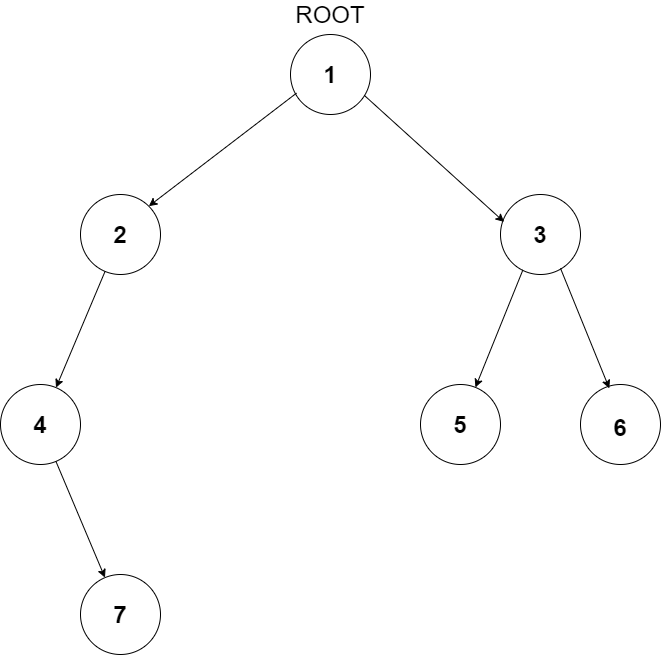
The level order input for the tree depicted in the below image will be:
1
2 3
4 -1 5 6
-1 7 -1 -1 -1 -1
-1 -1

Explanation:
Level 1 :
The root node of the tree is 1

Level 2 :
Left child of 1 = 2
Right child of 1 = 3

Level 3 :
Left child of 2 = 4
Right child of 2 = null (-1)
Left child of 3 = 5
Right child of 3 = 6

Level 4 :
Left child of 4 = null (-1)
Right child of 4 = 7
Left child of 5 = null (-1)
Right child of 5 = null (-1)
Left child of 6 = null (-1)
Right child of 6 = null (-1)

Level 5 :
Left child of 7 = null (-1)
Right child of 7 = null (-1)

The first not-null node(of the previous level) is treated as the parent of the first two nodes of the current level. The second not-null node (of the previous level) is treated as the parent node for the next two nodes of the current level, and so on.
The input ends when all nodes at the last level are null(-1).

The above sequence will be put together in a single line separated by a single space. Hence, for the above-depicted tree, the input will be given as:

1 2 3 4 -1 5 6 -1 7 -1 -1 -1 -1 -1 -1
Print the level order traversal of the deserialized binary tree separated by single spaces. For NULL nodes, print -1.
You don’t need to print anything; It has already been taken care of.
The idea is to store the level order traversal of the given binary tree to serialize the tree. But since only storing the level order traversal cannot uniquely determine the structure of the binary tree, we will insert -1 in place of NULL nodes so that we can determine the structure of the binary tree uniquely when we deserialize the binary tree.
We will store the serialized binary tree in a string, let’s say “serialized”.Also, we will use ‘,’ as a separator to separate the value of different nodes in the string because then we can distinguish that nodes 12 and 1,2 are different.
The steps to serialize the binary tree are as follows:
To deserialize the tree, we will read the values in the “serialized” string one by one and then create the binary tree in a level order manner.
The steps to deserialize the binary tree are as follows:
Inorder Traversal
Inorder Traversal
Inorder Traversal
Inorder Traversal
Inorder Traversal
Postorder Traversal
Postorder Traversal
Height of Binary Tree
Height of Binary Tree
Height of Binary Tree
Height of Binary Tree
Locked Binary Tree
Maximum Island Size in a Binary Tree

