










The first line of input contains an integer ‘T’ representing the number of test cases. Then the test cases follow.

The first line of each test case contains elements of the first tree in the level order form. The line consists of values of nodes separated by a single space. In case a node is null, we take -1 in its place.

The second line of each test case contains elements of the second tree in the level order form. The line consists of values of nodes separated by a single space. In case a node is null, we take -1 in its place.

For example, the input for the tree depicted in the below image would be:
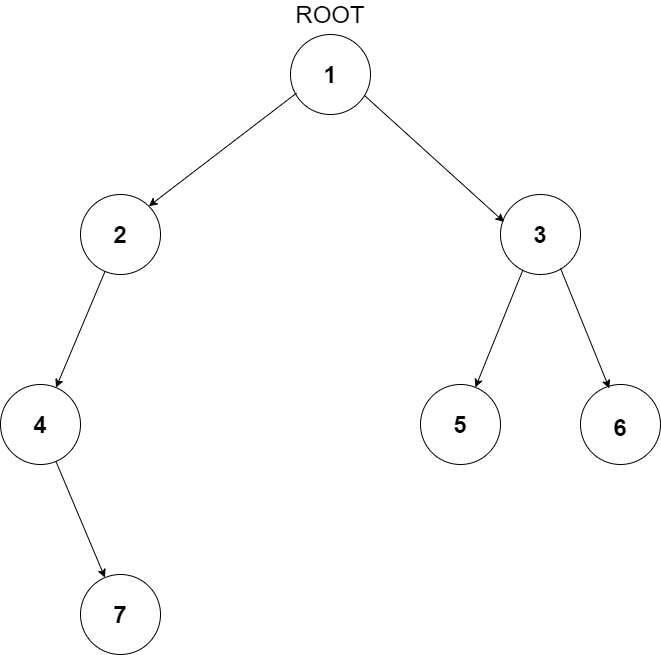
1
2 3
4 -1 5 6
-1 7 -1 -1 -1 -1
-1 -1
Level 1:
The root node of the tree is 1

Level 2:
Left child of 1 = 2
Right child of 1 = 3

Level 3:
Left child of 2 = 4
Right child of 2 = null (-1)
Left child of 3 = 5
Right child of 3 = 6

Level 4:
Left child of 4 = null (-1)
Right child of 4 = 7
Left child of 5 = null (-1)
Right child of 5 = null (-1)
Left child of 6 = null (-1)
Right child of 6 = null (-1)

Level 5:
Left child of 7 = null (-1)
Right child of 7 = null (-1)

The first not-null node(of the previous level) is treated as the parent of the first two nodes of the current level. The second not-null node (of the previous level) is treated as the parent node for the next two nodes of the current level and so on.
The input ends when all nodes at the last level are null(-1).
The above format was just to provide clarity on how the input is formed for a given tree.
The sequence will be put together in a single line separated by a single space. Hence, for the above-depicted tree, the input will be given as:

1 2 3 4 -1 5 6 -1 7 -1 -1 -1 -1 -1 -1
For each test case, the only line of output prints true if tree S is a subtree of the tree T else prints false.

The output for each test case is in a separate line.
You do not need to print anything; it has already been taken care of.
1 <= T <= 100
1 <= N, M <= 1000
0 <= data <= 10^6 and data != -1

Where ‘T’ is the number of test cases, ‘N’ and ‘M’ are the number of nodes in the given binary trees’, and “data” is the value of the binary tree node.

Time Limit: 1 sec.
Traverse the tree T in preorder fashion and treat every node of the given tree T as the root, treat it as a subtree and compare the corresponding subtree with the given subtree S for equality. For checking the equality, we can compare all the nodes of the two subtrees.
So the basic idea is to traverse over the given tree T and treat every node as the root of the subtree currently being considered and compare the corresponding subtree with the given subtree S for equality. To check the equality of the two subtrees, we make use of areIdentical(t,s) function, which takes t and s, which are roots of the two subtrees to be compared as the inputs and returns “true” or “false” depending on whether the two are equal or not. It compares all the nodes of the two subtrees for equality. Firstly, it checks the roots of the two trees for equality and then calls itself recursively for the left subtree and the right subtree.
We know that inorder and preorder/postorder identify a tree uniquely. The idea is to store inorder and postorder traversal of both trees in separate arrays. Then, for a given binary tree S to be a subset of another binary tree T, the inorder traversal of S should be a subset of inorder traversal of T. Similarly, the post-order traversal of S should be a subset of post-order traversal of T. We can also perform pre-order traversal instead of post-order traversal. For example, consider the below trees:

Inorder(T) = {4, 2, 5, 1, 6, 3, 7}
Inorder(S) = {6, 3, 7}
Postorder(T) = {4, 5, 2, 6, 7, 3, 1}
Postorder(S) = {6, 7, 3}
Since inorder(S) is a subset of inorder(T) and postorder(S) is a subset of postorder(T), we can say that S is a subtree of T.
To check whether the inorder(S)/postorder(S) is a subset of inorder(T)/postorder(T) or not, we will use the naive algorithm, i.e., store the inorder and postorder traversal of both the trees in string. Then, use String.contains() function to check if the inorder/postorder of tree ‘S’ is substring of inorder/postorder of tree ‘T’ or not.
We know that inorder and preorder/postorder identify a tree uniquely. The idea is to store inorder and postorder traversal of both trees in separate arrays. Then, for a given binary tree S to be a subset of another binary tree T, the inorder traversal of S should be a subset of inorder traversal of T. Similarly, the post-order traversal of S should be a subset of the post-order traversal of T. We can also perform pre-order traversal instead of post-order traversal. For example, consider the below trees:
Inorder(T) = {4, 2, 5, 1, 6, 3, 7}
Inorder(S) = {6, 3, 7}
Postorder(T) = {4, 5, 2, 6, 7, 3, 1}
Postorder(S) = {6, 7, 3}
Since inorder(S) is a subset of inorder(T) and postorder(S) is a subset of postorder(T), we can say that S is a subtree of T.
To check whether the inorder(S)/postorder(S) is a subset of inorder(T)/postorder(T) or not, we will use the KMP algorithm, which is a pattern searching algorithm that uses degenerating property (pattern having same sub-patterns appearing more than once in the pattern) of the pattern and improves the worst-case complexity to O(n). The basic idea behind KMP’s algorithm is, whenever we detect a mismatch (after some matches), we already know some of the characters in the text of the next window. We take advantage of this information to avoid matching the character that we know will anyway match.
Preprocessing Overview:
Searching Algorithm:
Unlike naive algorithm, where we slide the pattern by one and compare all characters at each shift, we use a value from lps[] to decide the next characters to be matched. The idea is not to match a character that we know will anyway match.
How to use lps[] to decide the next positions (or to know the number of characters to be skipped)?
Inorder Traversal
Inorder Traversal
Inorder Traversal
Inorder Traversal
Inorder Traversal
Postorder Traversal
Postorder Traversal
Height of Binary Tree
Height of Binary Tree
Height of Binary Tree
Height of Binary Tree
Locked Binary Tree
Maximum Island Size in a Binary Tree

