










Input: Let the binary tree be:
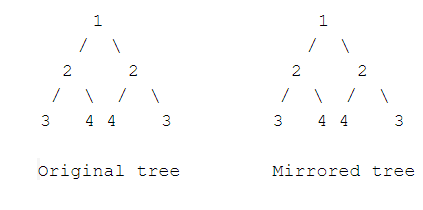
Output: YES

Explanation: As we can see in the image, the original tree is the same as the mirrored tree.
The first line of input contains elements in the level order form for the first binary tree. The line consists of values of nodes separated by a single space. In case a node is null, we take -1 in its place.
The level order input for the tree depicted in the below image would be
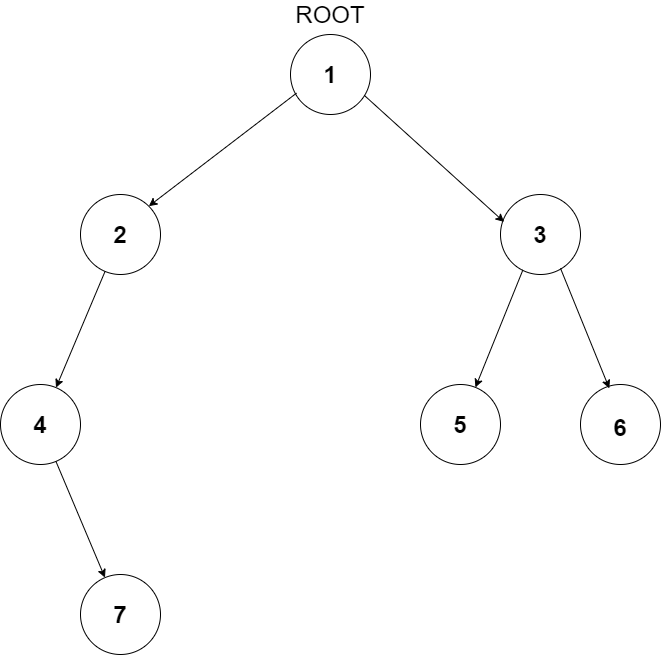
1
2 3
4 -1 5 6
-1 7 -1 -1 -1 -1
-1 -1

The sequence will be put together in a single line separated by a single space. Hence, for the above-depicted tree, the input will be given as:

1 2 3 4 -1 5 6 -1 7 -1 -1 -1 -1 -1 -1

Explanation :
Level 1 :
The root node of the tree is 1

Level 2 :
Left child of 1 = 2
Right child of 1 = 3

Level 3 :
Left child of 2 = 4
Right child of 2 = null (-1)
Left child of 3 = 5
Right child of 3 = 6

Level 4 :
Left child of 4 = null (-1)
Right child of 4 = 7
Left child of 5 = null (-1)
Right child of 5 = null (-1)
Left child of 6 = null (-1)
Right child of 6 = null (-1)

Level 5 :
Left child of 7 = null (-1)
Right child of 7 = null (-1)

The first not-null node (of the previous level) is treated as the parent of the first two nodes of the current level. The second not-null node (of the previous level) is treated as the parent node for the next two nodes of the current level, and so on.
The input ends when all nodes at the last level are null (-1).
The output contains "YES" or "NO" depending on whether the tree is symmetric or not.
You do not need to print anything; it has already been taken care of. Just implement the given function.
Two trees are a mirror reflection of each other if the following condition holds:
Inorder Traversal
Inorder Traversal
Inorder Traversal
Inorder Traversal
Inorder Traversal
Postorder Traversal
Postorder Traversal
Height of Binary Tree
Height of Binary Tree
Height of Binary Tree
Height of Binary Tree
Locked Binary Tree
Maximum Island Size in a Binary Tree

