You are given a matrix 'A' having ‘N’ rows and ‘M’ columns. Each cell of the matrix represents the height of water placed in that cell. Water can flow only in four directions ( up, down, right, and left) but only to a cell having its height less than or equal to the height of the current cell.
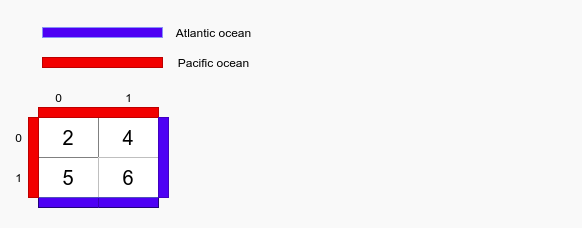
The four boundaries of the matrix represent the oceans- the left and top boundary represent the Pacific ocean, and the right and bottom boundary represent the Atlantic ocean.
You need to find the list of coordinates from which water can flow to both the oceans. The list should be sorted in lexicographical order.
Input Format:
The first line of the input contains an integer ‘T’ denoting the number of test cases.

The first line of each test case contains two space-separated positive integers ‘N’ and ‘M’ denoting the number of the rows and columns in a matrix 'A' respectively.

In the next ‘N’ lines of each test case, the ith line contains ‘M’ space-separated integers denoting the height of water.
Output Format:
The first line of output of each test case should contain positive integer ‘K’ denoting the total number of coordinates.

The next ‘K’ lines contain one coordinate in each line.
Note:
You do not need to print anything, it has already been taken care of. Just implement the given function.
Constraints:
1 <= T <= 50
1 <= N <= 10^4
1 <= M <= 10^4
1 <= N*M <= 10^4
1 <= A[i][j] <= 10^9

Time Limit: 1 sec