










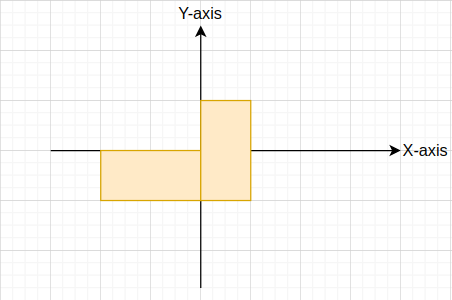
1. For a rectangle, its top left and bottom right coordinates are given.

2. Coordinates of the rectangles are integer values.

3. Edges of the given rectangles will always be parallel to the X and Y coordinate axes of the cartesian plane.

4. It is guaranteed that both the rectangles will have at least a unit area.
The first line of the input contains an integer 'T' denoting the number of test cases.

The first line of each test case contains 4 space-separated integer values 'x1', 'y1', 'x2', 'y2' denoting the top left ('x1', 'y1') and bottom-right ('x2', 'y2') coordinates of the first rectangle.

The second line of each test case contains 4 space-separated integer values 'x3', 'y3', 'x4', 'y4' denoting the top left ('x3', 'y3') and bottom-right ('x4', 'y4') coordinates of the second rectangle.
For each test case, return an integer denoting the net area of two rectangles.
You do not need to print anything, it has already been taken care of. Just implement the given function.
1 <= T <= 10^5
-10^9 <= x1, y1, x2, y2 <= 10^9
x1 < x2, x3 < x4
y1 > y2, y3 > y4

Time Limit: 1sec
Construct The Parameter
Construct The Parameter
Construct The Parameter
Construct The Parameter
Construct The Parameter
Construct The Parameter
Construct The Parameter
Construct The Parameter
Construct The Parameter
Construct The Parameter
Construct The Parameter
Construct The Parameter
Construct The Parameter
Points Visible
Points Visible
Points Visible
Circle Intersection
Circle Intersection
Circle Intersection
Circle Intersection
City Lights
Angler's Race

