








Suppose you rotate ‘d’ degrees counterclockwise.
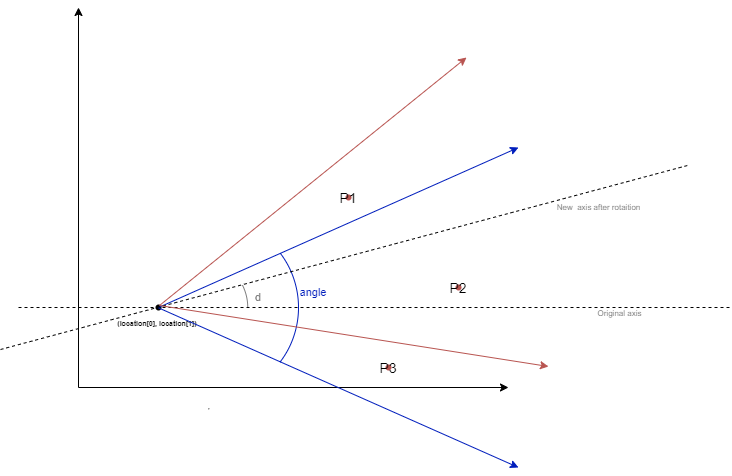
You are given ‘location’ = [2, 2], ‘points’ = [[3,3], [4, 2], [3, 1]], ‘angle’ = 60. Due to the field of view only two, only 2, points [[2, 4], [3, 2]] simultaneously, are visible from the given position hence the answer is 2.
The first line of input contains a single integer ‘T’ representing the number of test cases.

The first line of each test case contains 2 space-separated integers, ‘N’, ‘angle’, where N represents the number of points in the given array and ‘angle’ is the given integer.

The second line of each test case contains two space-separated integers ‘x’ and ‘y’ representing coordinates of the location you are standing on.

The next ‘N’ lines of input contain two space-separated integers ‘a’ and ‘b’ representing ‘X’ and ‘Y’ coordinates of the points in the ‘points’ array.
For each test case, print a single integer representing the maximum number of points visible at a time.

Print a separate line in each test case.
1 <= T <= 10
1 <= N <= 10^5
0 <= angle <= 360
0 <= x, y, a, b <= 1000
You do not need to print anything. It has already been taken care of. Just implement the given function.
In this approach, we will draw a line from where we are standing to each point and find the angle the line makes with the X-axis and store it in the array. Then we sort the array according to the angle.
To find the angle of point(Px, Py) from our standing coordinate(A, B) we use the formula:
We can then start a sliding window of size ‘angle’ from the starting of the array. The maximum number of points in the sliding window will be the answer.
Here we will extend the sorted array with itself, with all the angles in the latter half will be increased by 2*π.
Save Ninja Land
Save Ninja Land
Save Ninja Land
Save Ninja Land
Save Ninja Land
Save Ninja Land
Construct The Parameter
Construct The Parameter
Construct The Parameter
Construct The Parameter
Construct The Parameter
Construct The Parameter
Construct The Parameter
Construct The Parameter
Construct The Parameter
Construct The Parameter
Construct The Parameter
Construct The Parameter
Construct The Parameter
Circle Intersection
Circle Intersection
Circle Intersection
Circle Intersection
City Lights
Angler's Race

