Do you think IIT Guwahati certified course can help you in your career?
Introduction
In this article, we will discuss the basics of building APIs and how to make a Rails Controller action that can output XML and JSON responses and create unique error messages to answer bad requests. Rails application already functions in a similar capacity to an API. Every time you request a new page, the web browser your user uses—which is a program—makes an API request to your Rails app. Since displaying HTML payloads is so frequent, we include it as the default response type in our server-side programs and treat everything else as unique.
But frequently, you want to submit a request without dealing with the hassle of utilizing a web browser. You could just want to get the data without worrying about the HTML structure of the page.
Build API
You must instruct your controller to return JSON rather than HTML if you want your Rails application to do so. The neat part is that the same controller action can yield different results based on whether your user submits a regular request through a browser or an API request through the command line. The extension of the request file—for instance, example.xml or example.json—helps the system identify the type of request being made.
Steps to build api in ruby on rails
To build api in ruby on rails of your own you need to firstly install ruby on rails in your ide and execute the gem install rails in the project terminal.
Creating the directory for project to build the api in ruby
In your terminal, execute rails new [name] –api.
Your Rails directory name will be [name]. We'll work through constructing an example case together in this tutorial. We're planning to provide a fundamental API with information on woods and their trails.
We will therefore executerails new forest-trails --api
Creating resources build api in ruby on rails
Run rails g resource [name] [attribute] [attribute]
You can also try this code with Online Ruby Compiler
We'll create the resources "Forest" and "Trail" for our example. The required database table name should be entered in the [name] field. The characteristics (see them as the columns of a database table) that your resource requires should be entered in the [attribute] spaces.
Running rails g resource Forest name state will be the first command in our example.
Rails g resource Trail name state will be run next.
Note that strings are the characteristics' default data type. If you desire a different data type, you must modify your syntax. A good example is the railways G resource Trail name state miles:integer.
Controller files (found under "app" -> "models") and migration files (found inside "db" -> "migrate") will be generated once your resources have been created.
Populating the seeds
Navigate to the "database" folder and launch "test.rb" to populate your seeds.
The first two commands will be Forest.destroy all and Trail.destroy all. If we restart our software, this will reset our seeds.
In order to use the.create method, we must first set each seed to a variable (for example, forest1 and trail1) and then provide the resource properties. As an illustration,
Running the migration to build api in ruby on rails
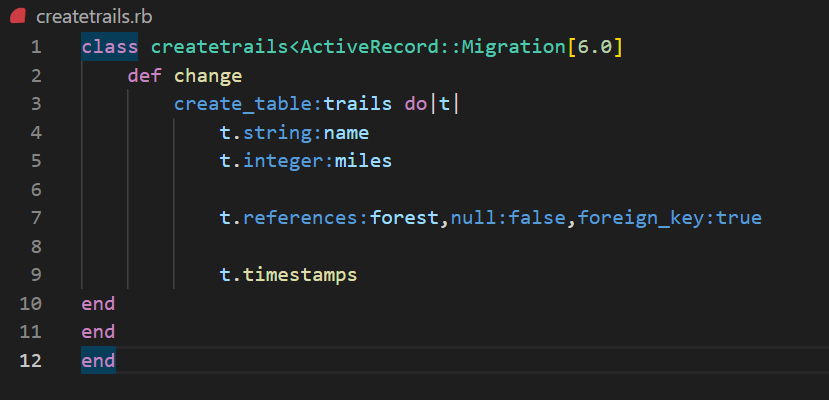
We must make changes to our many migration file because our relationship is one-to-many.
We will add t.references:forest, null: false, and foreign key: true to our trails migration file.
Run DB:migrate in Rails. you can always call rails DB:rollback if you ever need to go backward.
Setting up the associations
In "app" -> "models," we will now create our associations in the files forest.RB and trail.RB.
In this instance, a Forest has many Trails, and a Forest has many Trails. Therefore, we only need to enter many:trails inside the Forest method. belongs to:forest will be entered inside the Trail method.
When you have several resources that are related to one another, take note that this step is applicable. We are in a one-to-many relationship here. In a many-to-many relationship, you could have several resources or just one (thus, no relationship and no associations are needed).
Writing routes to build api in ruby on rails
In the above image, we have seen that we have entirely used the CRUD method to route the instances and showed how to build api in ruby on rails and do the projects with the help of running the seeds
To run the seeds execute rails DB:test and that it will run your project.
Frequently Asked Questions
Which is superior, Ruby on Rails or Django?
Ruby on Rails is shown to be 0.7 percent quicker than Django in performance comparison tests. This is because Rails has the benefit of a vast collection of incredible modules and plugins to increase the speed and ultimately the performance of this framework.
What does Rails' render JSON function do?
In essence, render:JSON calls to JSON and sends the completed document to the browser with the appropriate headers. This is helpful when using JavaScript AJAX calls and needing to return JavaScript objects. Additionally, you can give the name of the callback you want to call via JSONP using the callback option.
In Rails, how do I redirect?
Option and response status are two parameters taken by Rails' redirect to function (optional). The browser is redirected to the destination indicated by the settings. This variable may be: Hash - By executing URL for with the options, the URL will be created.
Conclusion
In this article, we have discussed build api in ruby on rails, how to make a Rails Controller action that can output XML and JSON responses, make a model API that conceals some model characteristics from users of your API, and create unique error messages to answer bad requests. We have started with the basics of API in the introduction and then the basics of build api in ruby on rails.
After reading about Building your own API in Ruby on Rails, are you not feeling excited to read/explore more articles on the topic of file systems? Don't worry; Coding Ninjas has you covered. If you want to check out articles related to ruby, refer to these links, everything you wish to know about ruby on rails, ruby, and ruby on rails ,opportunity after mastering ruby on rails, ruby on rails for web development project.








 5+ registered