Do you think IIT Guwahati certified course can help you in your career?
Introduction
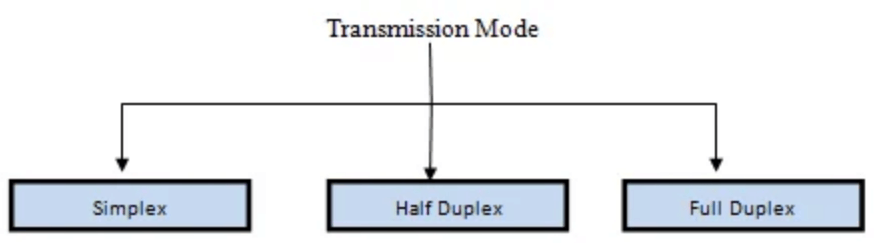
Transferring information between two devices connected over a network is called transmission mode or communication mode. These transmission modes direct the direction of the flow of information. The three types of transmission modes are simplex, half-duplex, and full-duplex transmission modes.
Simplex, Half-Duplex, and Full-Duplex Transmission Modes
In simplex transmission mode, we have unidirectional communication. Only one of the two connecting devices on a link can transmit, and the other device can only receive. It utilizes the entire capacity of the channel to send data in a single direction.
Example: Monitors and keyboards use the simplex transmission mode. In this case, the keyboard can only introduce an input in the system, and the monitor can only generate the output.
In half-duplex transmission mode, every station can receive and transmit data. When one of the devices sends data, the other device can only then receive it. It is two-way directional, i.e., bi-directional communication but one at a time. This mode comes into play in those cases where we don't need the transmission in both directions simultaneously.
Example: In a walkie-talkie, the half-duplex transmission mode is used. We can send messages in both directions, but the transmission of information occurs in one direction at a time.
Full-Duplex Transmission Mode
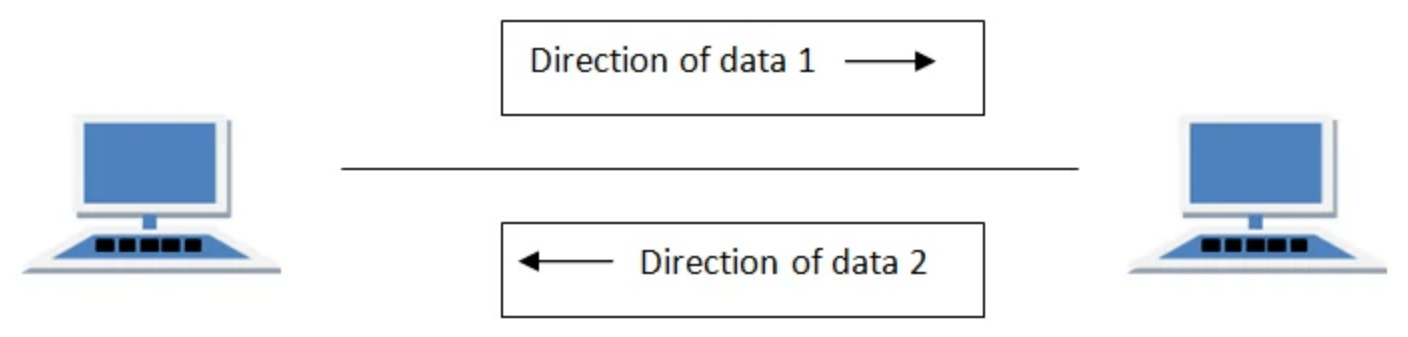
We can simultaneously send data in both directions in the full-duplex transmission mode. This mode comes into play when one requires a continuous connection in both directions all the time.
Example: A telephone Network in which there is communication between two individuals by a telephone line, using which both can talk and listen simultaneously.
Now let's discuss the difference between simplex, half-duplex, and full-duplex transmission modes in detail. You can also read about thenetwork models in computer network.
Difference Between Simplex, Half-Duplex, and Full-Duplex Transmission Modes
The difference between simplex, half-duplex, and full-duplex transmission modes are as follows:-
Simplex Transmission Mode
Half-Duplex Transmission Mode
Full-Duplex Transmission Mode
The communication is unidirectional. The device can do only one task at a time in a single direction.
The communication is bidirectional, but one at a time. The device can receive and send data but can perform only one of these tasks at a time.
The communication is bidirectional, but here, the devices can send and receive data simultaneously at the same time.
The transmission mode involves one station as a sender and the other as a receiver.
The transmission mode connects two systems by a point-to-point link for transmitting and receiving signals.
The transmission mode can have two lines, one for sending the data and receiving data. Or it can divide the capacity between the signals that travel in either of the directions.
One channel to transmit data.
One channel to transmit data.
Two separate channels can also be used to transmit data.
The transmission channel's total capacity goes into sending the data in one direction. Thus, this transmission mode works well when the entire bandwidth is required for the data transmission.
Conserves bandwidth and utilizes one communication channel by sharing it alternatively between both directions. Thus, it works well when we have to send data in both directions alternatively.
The entire communication channel is used by splitting it to allow transmission in both directions simultaneously. It works well when we have to communicate in both directions without delays.
Utilizes the maximum of a single bandwidth.
Lesser utilization of a single bandwidth during the time of transmission.
Doubles the utilization of transmission bandwidth.
It is the worst-performing one because it takes the longest to transmit data.
It has better performance than the simplex transmission mode. But the performance is lower as compared to the full-duplex transmission mode.
It performs the best among as the transmission is continual and bi-directional. So, there is no delay in transmission.
Examples are mouse, keyboard, television, monitor, radio broadcasts, etc.
How is the link's capacity shared in the full-duplex transmission mode? The signals that travel in one direction in full-duplex transmission mode share the link's capacity with those in the other direction. This sharing can occur in two ways: a) The transmission link must have two physically separate transmission paths: one path for sending and the other one for receiving. b) The link can divide the capacity between the signals that travel in either of the directions.
What is the advantage of simplex transmission mode? In the simplex transmission mode, the station can utilize the entire bandwidth of the communication channel, and more data can be transmitted at a time.
What is the disadvantage of half-duplex transmission mode? In the half-duplex transmission mode, another device has to wait until one device sends the data. Due to this, a delay is caused in sending the data at the right time.
What is the disadvantage of full-duplex transmission mode? If there is no dedicated path between the devices, then the capacity of the communication channel has to be divided into two parts.
Which one has the best performance among simplex, half-duplex, and full-duplex transmission modes? The full-duplex transmission mode has better performance as it doubles the utilization of the capacity of the communication channel.
Key Takeaways
In this article, we have extensively discussed the simplex, half-duplex, and full-duplex transmission modes and their differences.
We hope that this blog has helped you enhance your knowledge regarding the differences between simplex, half-duplex, and full-duplex transmission modes and if you would like to learn more, check out our articles on Transmission modes. Do upvote our blog to help other ninjas grow. Happy Coding!
Live masterclass
Amazon-Ready Excel & AI Skills: Ace 20L+ Data Analyst Roles
by Prerita Agarwal
15 Oct, 2026
11:30 AM
Crack GenAI Interviews: Fix AI Hallucinations, Latency & Cost
by Shantanu Shubham
12 Oct, 2026
11:30 AM
PowerBI Dashboard Using T20 World Cup Data
by Sumit Shukla
13 Oct, 2026
11:30 AM
Build a GenAI Copilot: Upgrade from SDE to AI Engineer
by Saurav Prateek
14 Oct, 2026
11:30 AM
Amazon-Ready Excel & AI Skills: Ace 20L+ Data Analyst Roles
by Prerita Agarwal
15 Oct, 2026
11:30 AM
Crack GenAI Interviews: Fix AI Hallucinations, Latency & Cost











 5+ registered

