Do you think IIT Guwahati certified course can help you in your career?
Introduction
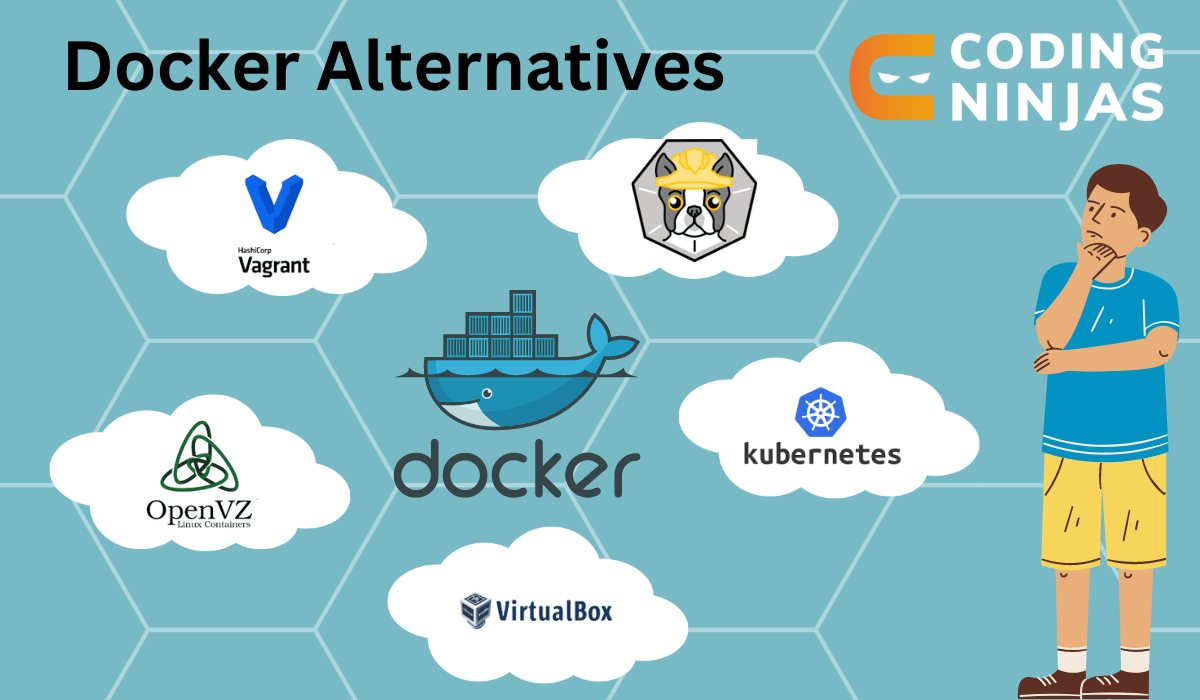
Containerization has become an essential aspect of software development and deployment. Docker is one of the most popular platforms synonymous with Containerization. Docker has played a crucial role in revolutionizing how applications are bundled and deployed on the Internet. However, Docker is not the only popular platform supporting Containerization today. Other platforms have also emerged which are even better than Docker in some scenarios.
In this blog, we will discuss Docker Alternatives in detail. We will discuss Docker and some of its limitations, so we have to search for its alternatives. We will then look at some of the most popular options and conclude with some frequently asked questions. But first, let us learn more about Docker in the next section.
What is Docker?
Docker is one of the most popular systems for application containerization. Containerization is a software method that allows for the packaging, distribution, and deployment of programs via the Internet. Containerization's primary characteristics include:
Isolation - Containerization provides an isolated environment for applications to run such that they can run independently without any conflicts with each other.
Lightweight - Containers share the OS kernel. This helps in reducing the resource consumption of the system.
Portable - Containers enable the applications to consistently run across various environments without any issues with dependencies and configurations.
Scalable - Containers can be replicated and scaled horizontally to meet the system's requirements.
Unlike traditional techniques, Docker uses the host system's kernel, which results in lightweight and efficient containers. All these Containerization features help the applications run consistently across various environments.
Limitations of Docker
Docker has revolutionized the deployment application process but still has some limitations. Some common limitations of Dockerare given below:
Security - Docker Containers share the kernel, which can lead to security issues between each other. These vulnerabilities can be used to compromise the data of the system.
Complexity - Data management in docker containers can prove to be difficult. Containers are stateless and hence can't store data for long-term usage in the application.
Overhead - As the number of containers increases, the overhead increases in the Docker environment. This can be a challenge in scenarios when time optimization is required.
Ease of Learning - Although Docker is easy to learn, scaling multiple containers through Docker can be challenging for beginners.
Real- Time Operations -Docker containers are not built to perform real-time operations. This is due to the scheduling limitations making it difficult for applications requiring high precision.
Alternatives of Docker
Now that we know about the limitations of Docker, we will discuss some of its alternatives.
Buildah
Buildah is a command-line tool for building container images in Linux-based environments. Buildah allows users to create completely new images or modify the existing ones without any container. This allows for better flexibility and security in the application.
OpenVZ
OpenVZ is an open-source container-based runtime that can run multiple virtual environments and private servers on a single Linux system. In OpenVZ the hosts share only a single kernel which leads to less memory usage than other runtimes.
RunC
RunC is an open-source, lightweight, and standardized container runtime. It was first invented as a Docker component, but eventually, it was developed into an independent tool. RunC aims to improve container portability by offering a standardized runtime that works with and with Docker in other container systems.
Vagrant
Vagrant is an open-source tool designed to build portable virtual environments for development. Vagrant aims to maximize development productivity by simplifying virtualization software configuration management.
Virtual Box
Virtual Box is a tool used to create virtual environments so that developers can set up and run their applications on multiple platforms. Virtual Box helps users to create online cloud-based storage. It is a useful tool for developers who work in the field of cloud computing and multiple operating systems.
Kubernetes
Kubernetes is also an open-source container management runtime environment that helps in automating and scaling. Kubernetes has a very large user base and is used by many popular businesses like eBay, Yahoo etc. Kubernetes is also used for hosting cloud-based applications that have rapid scaling requirements.
BuildKit
BuildKit is an image builder tool created by Moby. Moby is a docker framework for assembling specialized container systems. The main purpose of BuildKit is to replace the legacy builder inside Docker. However, Buildkit can also be used alone to create images for docker containers.
An important feature of Buildkit is its ability to build parallelly. Docker is only able to build one image layer at a time. However, BuildKit is capable of working on multiple layers simultaneously, which improves the build speed of the system. Buildkit also improves layer caching in the application.
Frequently Asked Questions
How does Docker help in the application deployment process?
Docker allows us to package our application and its dependencies into a bundle. This ensures that the application shows consistent behavior across multiple environments and machines.
How do Docker Alternatives help beginners in learning?
Docker can prove to be a complex topic for beginners to understand. These docker alternatives can help to simplify the concepts to make it easier for beginners to learn them. Hence these alternatives can be preferred over Docker for beginners.
In what scenarios is Docker better than its alternatives?
Although Docker has some disadvantages, it can be a better choice in some cases than its alternatives. Docker has a broad community of developers and ecosystems, making it faster to get queries resolved. Docker also has multi-platform support making it a better choice in such scenarios.
Conclusion
In this article, we discussed Docker Alternatives. We discussed in detail about Docker and some of its limitations. We also looked at some alternatives to tackle these limitations of Docker. Ultimately, we concluded by discussing frequently asked questions about Docker and its options.
So now that you know about Docker Alternatives, you can refer to similar articles.










 1+ registered

