Do you think IIT Guwahati certified course can help you in your career?
Introduction
Have you ever faced those three dots (...) in Python code and wondered what they are? This article will examine the aspects of Ellipsis in Python.
We'll understand its meaning more straightforwardly, analyze its benefits, and help you reduce the length and improve your code's accuracy. Whether you're a newbie to programming or a skilled coder, join us in learning the secrets behind those dots. Let's begin!!
Ellipsis in Python
In Python, the "..." (three dots) is a remarkable thing that shows missing parts, like when something is removed or not finished. This "..." is also useful in places where code is missing, acting like a signal for programmers to pay attention to certain parts.
Developers use Ellipsis as a placeholder for unimplemented code, allowing them to outline the structure and intent of functions or classes. In multidimensional array slicing (like NumPy arrays), Ellipsis condenses notation by representing multiple colons, simplifying complex indexing. It finds utility in type annotations to omit specific type information and in docstrings to indicate that additional details are available but are condensed.
Python developers may also leverage Ellipsis for custom uses, such as marking incomplete sections or conveying contextual meanings.
Use Cases of Ellipsis in Python
There are many use cases of Ellipsis in Python. Some of them are:
Ellipsis is like a shortcut in computer stuff, especially when dealing with arrays like in NumPy.
It helps make holding certain parts of the arrays easier, especially when they have many dimensions.
In type hinting, an ellipsis (three dots) shows that some information is missing or not fully described.
In comments or documentation strings, three dots (...) are used by programmers to indicate sections of the code that will be addressed later or are temporary.
In code, you can give Ellipsis your special meanings. It helps programmers create their unique rules or actions for how Ellipsis works.
You can add Ellipsis to your methods to enable built-in classes to perform additional tasks.
In Python, the three dots ("...") are like a temporary sign for unfinished code, which is helpful in big and complicated projects. It's like spotlighting parts of the code that need work or finishing touches. It is convenient when dealing with complex programs. You can focus on specific aspects until you can work on them ultimately.
Code
Python
Python
def calculate_average(numbers):

    # Calculate the average of the numbers list
    …

# Input value
numbers = [10, 20, 30, 40, 50]
average = calculate_average(numbers)
print(f"The average is: {average}")
You can also try this code with Online Python Compiler
This code tries to figure out the average when you have a list of numbers. But it requires the part where it calculates the average. It then uses this unfinished part to find the average of some numbers and display it, but since the missing piece isn't there, it won't work perfectly and will exhibit an error.
Using Ellipsis in Slicing
In Python, you can use three dots (...) to refer to multiple dimensions simultaneously when slicing. This special symbol means "take all the rest of the dimensions." It is beneficial when you are working with arrays that have lots of dimensions.
Code
Python
Python
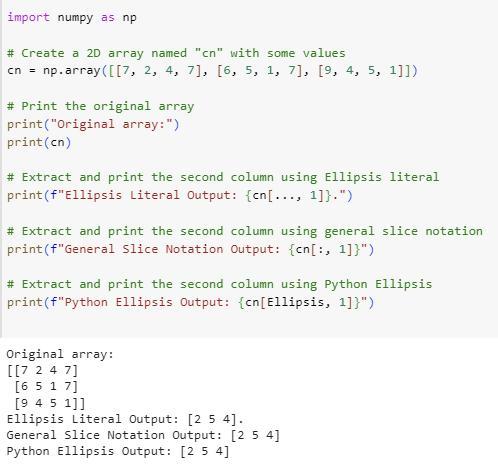
import numpy as np

# Create a 2D array named "cn" with some values
cn = np.array([[7, 2, 4, 7], [6, 5, 1, 7], [9, 4, 5, 1]])

# Print the original array
print("Original array:")
print(cn)

# Extract and print the second column using Ellipsis literal
print(f"Ellipsis Literal Output: {cn[..., 1]}.")

# Extract and print the second column using general slice notation
print(f"General Slice Notation Output: {cn[:, 1]}")

# Extract and print the second column using Python Ellipsis
print(f"Python Ellipsis Output: {cn[Ellipsis, 1]}")
You can also try this code with Online Python Compiler
The code displays three methods to extract and display the values from the second column of the table:
Using three dots (...) indicates that we need all rows and only the second column: cn[..., 1].
Using a colon (:) to specify all rows, followed by the number 1 to access the second column: cn[:, 1].
Using a distinct term, "Ellipsis" and square brackets achieves the same outcome as above: cn[Ellipsis, 1].
Using Ellipsis in Function Arguments
In Python, you can use the ellipsis symbol (...) to show that some function parts can be left out. It is useful when giving steps for a function. It helps the function to handle various amounts of information it requires.
Code
Python
Python
def welcome(name, *args):
    print(f"Hello, {name}! Welcome to Coding Ninjas")

# Calling the function with different names
welcome("Rahul")
welcome("Shaina")
welcome("Kunal")
You can also try this code with Online Python Compiler
The code defines a function named welcome that greets a person by name and adds a standard "Welcome to Coding Ninjas" message. The method can take extra arguments if needed. When called with different names, it prints personalized greetings for each person.
Can Three Dots Always be Considered Ellipses?
In Python, the ellipsis (...) is represented by the Ellipsis object. It is primarily used as a placeholder or to indicate a missing value, particularly in slicing operations on multidimensional arrays or sequences. However, it does not inherently imply an ellipse or have geometric meaning like an ellipse in mathematics. Instead, it serves as a convenient placeholder for certain operations, such as when working with NumPy arrays or indicating an incomplete code snippet.
Frequently Asked Questions
What is the purpose of Ellipsis(...) in Python?
The Ellipsis serves as a placeholder for text or data that is missing. Slices, type hints, and custom classes often employ it when they anticipate completing the implementation later.
How may the Ellipsis be applied to Python slicing?
When working with multidimensional arrays or sequences, the Ellipsis (...) can be used in slicing to represent several colons. For instance, arr[..., 2] and arr[:,:, 2] are equivalent in a three-dimensional array.
Is Python's Ellipsis a standard constant?
Yes, Python includes a built-in constant for the Ellipsis. You can get to it by typing in Ellipsis. It acts as a stand-in for incomplete code or data structures.
Can Ellipsis be used in customized Python classes?
You can use the Ellipsis in custom classes. People often use it as a placeholder in methods intended for future construction. The technique needs to possess the necessary capabilities to make it clear.
What is the ellipsis equivalent in Python?
In Python, the ellipsis equivalent is represented by the Ellipsis object, typically denoted by three dots (...).
Do list comprehensions allow the usage of the Ellipsis?
Certainly, comprehension lists can make use of the Ellipsis. It can serve as a placeholder to say that specific details of the list comprehension have been ignored for clarity or that further code is anticipated to be added later.
Conclusion
In this article, we have learned about Ellipsis in Python. We also see the use cases of Ellipsis in Python. We will even use Ellipsis as a placeholder. We even explore Ellipsis in Slicing. We even learned about Ellipsis in Function Arguments with the help of an example.
Do check out the link to learn more about such topic
You can find more informative articles or blogs on our platform. You can also practice more coding problems and prepare for interview questions from well-known companies on your platform, CodingNinjasStudio.
Live masterclass
Build GenAI Projects that can get you Amazon interview
by Anubhav Sinha
23 Jul, 2026
11:30 AM
Get shortlisted for Amazon data interview: SQL+Python Prep
by Abhishek Soni
20 Jul, 2026
11:30 AM
Top 5 GenAI Projects to Crack 25 LPA+ Roles in 2026
by Shantanu Shubham
21 Jul, 2026
12:30 PM
Interview-Ready Excel & AI Skills for Amazon Analyst Roles
by Prerita Agarwal
22 Jul, 2026
12:30 PM
Build GenAI Projects that can get you Amazon interview
by Anubhav Sinha
23 Jul, 2026
11:30 AM
Get shortlisted for Amazon data interview: SQL+Python Prep









 6+ registered

