Do you think IIT Guwahati certified course can help you in your career?
Introduction
Data science can be challenging to learn in-depth: experts estimate around six to twelve months to master data science fundamentals, but expertise in the field takes years. For that reason, students interested in data science for its own sake often choose immersive bootcamps or certificate programs.
What Is Data Science?
Data Scienceis a multidisciplinary field that uses scientific methods, algorithms, and systems to extract knowledge and insights from structured and unstructured data. It requires knowledge in three major areas: mathematics/statistics, programming, and domain expertise.
How Hard is It to Get into Data Science?
Getting into data science can be challenging due to the technical skills, problem-solving abilities, and industry knowledge it demands. The field requires a strong foundation in mathematics, programming, and statistical analysis, along with proficiency in tools like Python, R, and SQL. In addition to technical expertise, many data science roles emphasize practical experience in data analysis, machine learning, and real-world projects. However, with the right preparation, a clear learning path, and practical projects, aspiring data scientists can steadily build a competitive profile to enter this rewarding field.
Key Points on the Challenges of Entering Data Science:
Technical Skills: Proficiency in programming, statistics, and machine learning is essential, requiring a solid educational background or dedicated self-study.
Tools and Frameworks: Knowledge of tools such as Python, R, SQL, and data science libraries (e.g., pandas, scikit-learn) is essential.
Industry Knowledge: Understanding specific business domains enhances the ability to create actionable insights from data.
Practical Experience: Employers value hands-on project experience and familiarity with real-world data, often gained through internships or personal projects.
Continual Learning: Data science is a fast-evolving field; staying updated with the latest techniques and technologies is crucial for long-term success.
The Hard Parts of Data Science
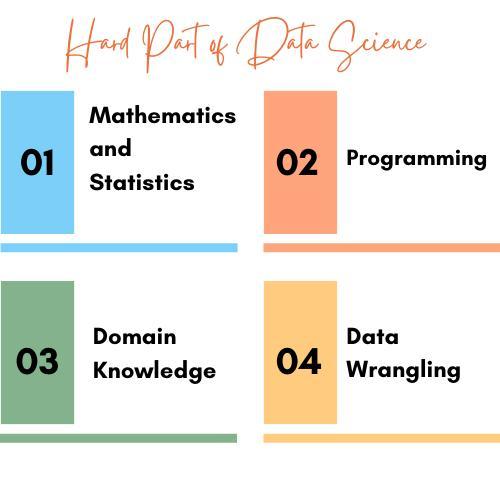
Data Science isn't inherently challenging but requires a particular set of skills and a willingness to learn and adapt. Let's dive into some of the more challenging aspects.
1. Mathematical & Statistical Understanding
Data science involves a lot of math and statistics. You must understand concepts like linear algebra, calculus, probability, and statistics. For some, this might be challenging, especially if you're from a background where math wasn't a significant part of your studies.
2. Programming Skills
Proficiency in at least one programming language, such as Python or R, is essential for data science. You'll use these languages to manipulate data, build models, visualize results, and more.
3. Domain Knowledge
Data Science isn't just about crunching numbers—it's about making sense of those numbers. Without domain knowledge, your conclusions might be misguided or irrelevant. Acquiring this knowledge can be challenging, especially when you're dealing with an unfamiliar industry or topic.
4. Data Wrangling
Real-world data is often messy, incomplete, and unstructured. Cleaning such data to a point where it's usable for analysis can be a tedious and complex task, and it's something many newcomers underestimate.
Making Data Science Less Hard
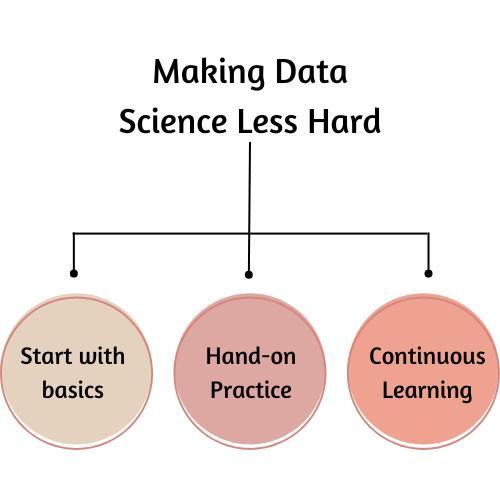
Though data science can be challenging, there are ways to make the learning curve less steep.
1. Start with the Basics
Getting a good grasp of basic statistical and programming concepts can give you a solid foundation. Starting with these basics will allow you to understand more complex concepts later on.
2. Hands-On Practice
Hands-on experience is invaluable in data science. Work on projects, participate in Kaggle competitions or contribute to open-source projects. These activities give you practical experience and can make abstract concepts more concrete.
3. Continuous Learning
Data Science is constantly evolving, with new techniques, tools, and best practices emerging regularly. Staying up-to-date and continually learning is part of the job and can help you adapt to the ever-changing landscape.
Python: Widely used for data analysis, machine learning, and visualization due to its extensive libraries, such as pandas, NumPy, scikit-learn, and Matplotlib.
R: Preferred for statistical analysis and data visualization, offering robust packages like ggplot2 and dplyr for in-depth data exploration.
SQL: Essential for managing and querying large datasets in databases, enabling data extraction and manipulation directly from data sources.
Julia: Known for high-performance computing, it’s gaining popularity for machine learning and numerical analysis tasks.
Scala: Often used with Apache Spark, making it ideal for big data processing and real-time data analytics.
Java: Although not as popular for data science specifically, it’s used in large-scale applications and for integrating data processing into production systems.
Frequently Asked Questions
Can I become a data scientist without a technical background?
Yes, it's possible, but you'll need to acquire the necessary skills in mathematics, programming, and domain knowledge.
Is data science a passing trend?
No, data science is not a passing trend. The need for data-driven decision-making in businesses is increasing, making data science a crucial field in the modern world.
Do I need to be a math genius to excel in Data Science?
No, being a math expertise isn’t required to excel in data science, but a solid understanding of statistics, linear algebra, and calculus is beneficial. Many data science tasks use tools and libraries that simplify complex math operations.
What are the biggest challenges faced by Data Scientists in the workplace?
Data scientists often face challenges like handling unstructured data, ensuring data quality, and communicating complex findings to non-technical teams. Managing high expectations and balancing fast-paced demands with accuracy are also common difficulties.
Is Data Science harder than traditional software engineering?
Data science can be more complex than traditional software engineering due to its reliance on statistics, machine learning, and domain knowledge. However, the level of difficulty often depends on specific roles and individual skill sets.
Conclusion
Data science can be hard, especially if you're starting with minimal background in math, statistics, or programming. However, it's not insurmountable. With the right mindset, a willingness to learn, and plenty of practice, anyone can become a successful data scientist. The journey to becoming a data scientist may be challenging, but it's also incredibly rewarding. You can also consider our online coding courses such as the Data Science Course to give your career an edge over others.







 1+ registered

