Do you think IIT Guwahati certified course can help you in your career?
Introduction
The solutions that are available for hosting JBoss EAP on Azure are described in this article. You may secure and isolate your infrastructure as needed by integrating JBoss EAP with Azure App Service. To adapt an existing JBoss EAP application to run on JBoss EAP on an Azure App Service instance, as described in this tutorial, there are a few things you need to be aware of.
Purpose-built APIs to deploy and run your Java EE applications
Because Red Hat JBoss EAP on App Service is a jointly supported Pay-as-You-Go (PAYG) service, you are not required to buy a Red Hat support subscription in advance. Start deploying your Java EE apps by creating a JBoss EAP web app through the Azure portal or command-line interface (CLI). If you experience a problem or have a question, file a support case with Microsoft or Red Hat, and support engineers from both companies will collaborate to find a solution.
To deploy and run your Java applications, regardless of whether they are contained in an EAR, WAR, or JAR, App Service offers specialised APIs. For a smooth developer experience, these are incorporated into the Azure CLI, Maven plugin, and other tools.
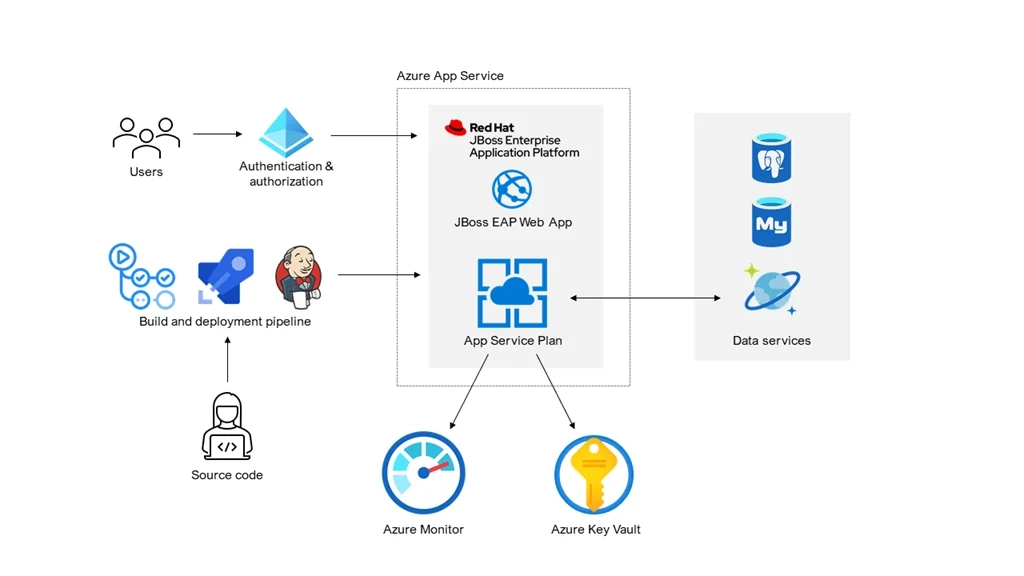
The connection between Red Hat JBoss EAP on App Service and other Azure services and users is shown in Figure 1's high-level architecture diagram.
The Premium V3 and Isolated V2 App Service plan levels have Red Hat JBoss EAP support. To increase security and scale, you can deploy Red Hat JBoss EAP onto the most recent App Service environment or the multi-tenant version of App Service. Reserved Instance (RI) pricing allows you to make a one- or three-year commitment and save up to 35 percent and 55 percent on your hosting costs.
Pre-migration
Before you begin, perform the evaluation and inventory activities outlined in the following sections to ensure a successful migration.
Inventory Server Capacity
Record the current production server(hardware )'s specifications (memory, CPU, disc), average and maximum request counts, and resource use. No matter whatever migration route you take, you'll need this information. It's helpful, for instance, to provide direction when choosing the size of the VMs in your node pool, the amount of RAM the container will take, and the number of CPU shares it will require.
Inventory All Secrets
Search all properties and configuration files on the production server(s) for any secrets or passwords. Verify the jboss-web.xml file in your WARs. Inside your program, you can potentially discover configuration files containing passwords or other login information.
You may use Key Vault secrets in your App Service instance with Key Vault references. Using Key Vault references, you may utilize the unknown in your application while keeping them safe and encrypted at rest.
Inventory External Resources
Through the Java Naming and Directory Interface, external resources, including data sources, JMS message brokers, and others, are inserted (JNDI). Some of these resources might need to be relocated or reconfigured.
Inside Your Application
The WEB-INF/jboss-web.xml and WEB-INF/web.xml files should be examined. Within the Context> element, look for Resource> elements.
Datasources
JNDI resources with the type property set to javax.sql.DataSource is data sources. Make a note of the following details for each data source:
What's the name of the data source?
What is the setup of the connection pool?
What location is the JDBC driver JAR file located?
All Other External Resources
In this lesson, it is not practicable to mention every possible external dependency. Your team is in charge of ensuring you can meet any external dependencies of your application following the move.
Processing
Identify the Use of Session Replication.
If your application relies on session replication, you will need to change it in order to get rid of this need. Direct communication between instances is not possible with App Service.
Check to See if and how the File System is Utilized.
Any use of the application server's file system requires configuration changes or, in rare circumstances, architecture changes. The JBoss EAP modules or the code in your application may use the file system. Any or all of the events listed in the following sections may be recognizable to you.
Read-only Static Content
You'll need a different place for static content if your application presently delivers it. You might want to think about adding Azure CDN for lightning-fast downloads worldwide and migrating inert material to Azure Blob Storage.
Dynamically Published Static Content
Utilize Azure CDN and Azure Blob Storage as described above, together with an Azure Function to manage uploads and CDN refreshes if your application permits inert material that is uploaded or produced by your application but is immutable after it has been created.
Dynamic or Internal Content
You can utilize the local file storage included in your app service plan for files that are often written and read by your application (such as temporary data files) or static files that are only accessible to your application.
Your Application Depends on Scheduled Tasks.
Use of the Azure App Service and scheduled tasks, such as Quartz Scheduler tasks or Unix cron jobs, is NOT advised. You are free to deploy an application with internal scheduled tasks using Azure App Service. The same planned job could execute more than once throughout the specified period if your application is scaled out. There may be unforeseen repercussions in this case.
List any scheduled activities being performed on the production server(s), either inside or outside your application's code.
Check to see if a link to the On-premises is Necessary.
You must set up one of Azure's connection services if your application requires access to any of your on-premises services. Choose an option for connecting an on-premises network to Azure for additional details. As an alternative, you'll need to redesign your application using the open APIs that your on-premises resources offer.
Check whether any JMS (Java Message Service) Queues or Topics are Active.
You must move JMS Queues, and Topics from your application to a JMS server hosted elsewhere. For JMS users, migrating to Azure Service Bus and the Advanced Message Queuing Protocol (AMQP) might be a terrific idea.
If JMS permanent stores have been set up, you must record their settings and use them after the migration.
Check to see if JCA Connectors are being used.
Verify that you can utilize the JCA connector on JBoss EAP if your application supports JCA connectors. If you want to use the JCA connector with JBoss EAP, you must add the JARs to the server classpath and put the appropriate configuration files in the right place in the server directory for JBoss EAP for it to be available.
Check to see if JAAS is being used.
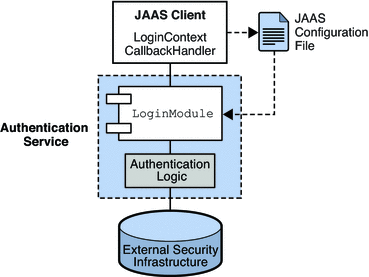
You must record how JAAS is set up if your application uses it. On JBoss EAP, you can change it to a JAAS domain if it uses a database. You must confirm that a custom implementation may be utilized with JBoss EAP if it is.
Check to see if your Application makes use of Resource Adapter
Your application must be compatible with JBoss EAP if it requires a Resource Adapter (RA). Examine the RA's functionality on a solitary JBoss EAP instance by deploying and correctly configuring it on the server. If the RA is functioning successfully, you must add the JARs to the App Service's server classpath and place the required configuration files in the relevant area in the JBoss EAP server directories for them to be accessible.
Check to see if your Application consists of numerous WARs.
If your application consists of several WARs, you should regard each WAR as a unique application and read this guide for each one separately.
Check to see if your Application has an EAR Package
Look through the application.xml file and record the configuration if your application is packaged as an EAR file.
Identify all outside Processes and Daemons running on the Production Servers.
You must terminate or relocate any processes currently operating outside the application server, such as monitoring daemons.
Perform in-place testing
Move your application to the JDK and JBoss EAP versions you wish to utilize on App Service before producing your container images. The program should be extensively tested for performance and compatibility.
Migration
Red Hat Migration Toolkit for Apps
A free add-on for Visual Studio Code is the Red Hat Migration Toolkit for Applications. This plugin examines the setup and application code to suggest moving on-premises applications to the cloud. View the overview of the Migration Toolkit for Applications for additional details.
This tutorial may address the remaining migration process aspects, such as selecting the appropriate App Service Plan type, externalizing session information, and utilizing Azure to manage your EAP instances rather than the JBoss Management interface.
Provision Azure App Service for JBoss EAP Runtime
Use the instructions below to build an Azure App Service Plan and a resource group. The JBoss EAP runtime is used to construct a Linux web app plan after the App Service Plan has been produced. JBoss EAP sites are available only on the PremiumV3 and IsolatedV2 App Service Plan levels.
Make that the environment variables listed have the proper values.
Post-migration
Now that you've migrated your application to Azure App Service, you should verify that it works as expected. After you've done that, we have recommendations for you that can make your application more cloud-native.
Clustering on App Service
JBoss EAP is permanently installed in standalone mode on App Service, and Azure serves as the primary administration plane for delivering code, scaling up or down, changing settings, etc. JBoss EAP will automatically boot with a clustered configuration profile and use the virtual network for node-to-node communication when you build a JBoss EAP site and link it to a virtual network. JBoss EAP uses the FILE PING JGroups discovery protocol on App Service to find instances. The cluster information, including the members of the cluster, their IDs, and their IP addresses, is stored in a standard storage account using FILE PING. The storage account is managed for you on App Service, unlike the virtual machine environment where JBoss EAP is used.
Frequently Asked Questions
Is JBoss supported on Azure?
Since June 2021, JBoss EAP has been a supported runtime for Azure virtual machines (via the Azure Marketplace) and Azure App Service.
What is the difference between JBoss and JBoss EAP?
The JBoss EAP Java EE application server is developed and supported by Red Hat. Version 6 is the most recent version that uses Java EE 6. You may try the open-source JBoss AS/WildFly project. This community endeavor will eventually result in the creation of JBoss EAP.
What is JBoss EAP used for?
JBoss EAP enables the development, management, deployment, and operation of enterprise Java applications across various environments, including on-premises, virtual environments, private, public, and hybrid clouds.
Can I use JBoss EAP for free?
Although Red Hat charges for a maintenance subscription for JBoss Enterprise Middleware, JBoss itself is free and open-source. Red Hat permits the use of JBoss EAP for development. However, modifications are not supported, and a support subscription is necessary to receive support for use in production.
Is JBoss EAP the same as WildFly?
JBoss EAP is only a commercial build of the Wildfly project. When comparing the source code, JBoss and Wildfly resemble one another quite. According to James Falkner, technical product manager for Red Hat Runtimes, Wildfly is the upstream project that serves as the foundation for JBoss EAP.
Conclusion
So that's the end of the article. JBoss EAP to Azure App Service
After reading about the JBoss EAP to Azure App Service, Are you interested in reading/exploring more themes on JBoss? Don't worry; Coding Ninjas has you coveredHowever, if you want to give your work an edge over the competition, you might choose to enroll in one of our premium courses.
With our Coding Ninjas StudioGuided Path, you may learn about Data Structures & Algorithms, Competitive Programming, JavaScript, System Design, and more! If you want to put your coding skills to the test, check out the mock test series on Coding Ninjas Studio and participate in the contests! But if you've only recently started your schooling and are looking for answers to issues presented by digital titans like Amazon, Microsoft, Uber, and others. In this situation, you must consider the obstacles, interview experiences, and interview package as part of your placement preparations. If you find our blogs valuable and fascinating, please vote them up!













 1+ registered

