




Introduction
We will learn about Jelinski & Moranda Model in this blog.
Jelinski and Moranda Model
One of the first software reliability models is the Jelinski-Moranda (J-M) model. This basic concept is the basis for many existing software reliability models.
Characteristics
- It's a model of the Binomial type.
- It is undoubtedly one of the first and most well-known black-box models.
- The J-M model generally makes overly optimistic reliability predictions.
- JM Model performs a perfect debugging phase, in which the observed defect is removed using a certainty simple model.
-
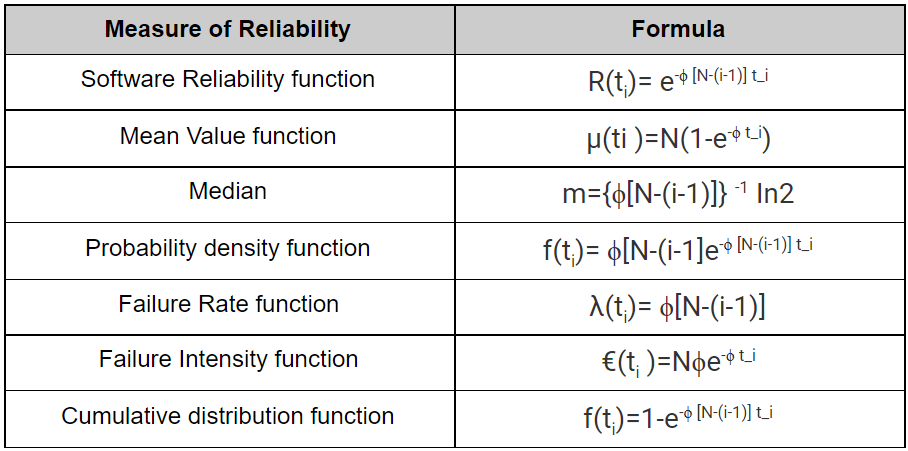
In the JM model, the constant software failure rate at the ith interval is given by:
λ(ti) = ϕ [N-(i-1)]
where,
i = [1, N]
ϕ = a proportionality constant denoting the rate of failure provided by each fault
ti = time interval between i-1th and ith failure
Other characteristics of the JM model are:
Assumptions
Following are the assumptions of the JM Model:
- The exact amount of initial software defects is unknown, but they are constant and fixed.
- Each software error is unique and has an equal chance of causing a test failure.
- The time intervals between failures are random variables with an exponential distribution.
- Over a wide range of fault occurrences, the software failure rate remains constant.
- The number of faults that exist in the software determines the failure rate.
- An identified error is promptly corrected, and no additional errors are introduced during the removal of this detected error.
-
Whenever a failure occurs, the corresponding defect is certainly removed.
Also see, V Model in Software Engineering

 40+ registered

