




Introduction
The Reliability of a software application determines its final outcome. In today's world of intense competition, any product must perform the required functions while also providing added value to its end users. Testing, like software development, is a time-consuming and difficult process. As a result, the ultimate goal of any model employed by a company should be to ensure a reliable software product delivery.
As a result, software reliability can be characterised as a quality attribute that encompasses functionality, usability, performance, capability, maintainability, documentation, and so on.
A software programme will undoubtedly become more sophisticated as it develops. As a result, making estimates such as the cost becomes more difficult. As a result, a variety of models have emerged, each of which provides effective estimating strategies.
This blog will discuss the Jelinski & Moranda Model in software reliability.
Jelinski and Moranda Model
One of the first software reliability models is the Jelinski-Moranda (J-M) model. This basic concept is the basis for many existing software reliability models.
Characteristics
- It's a model of the Binomial type.
- It is undoubtedly one of the first and most well-known black-box models.
- The J-M model generally makes overly optimistic reliability predictions.
- JM Model performs a perfect debugging phase, in which the observed defect is removed using a certainty simple model.
-
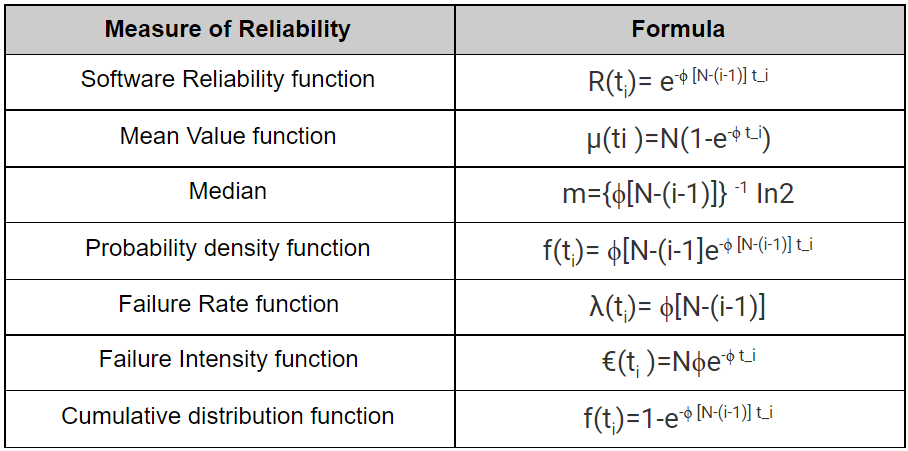
In the JM model, the constant software failure rate at the ith interval is given by:
λ(ti) = ϕ [N-(i-1)]
where,
i = [1, N]
ϕ = a proportionality constant denoting the rate of failure provided by each fault
ti = time interval between i-1th and ith failure
Other characteristics of the JM model are:
Assumptions
Following are the assumptions of the JM Model:
- The exact amount of initial software defects is unknown, but they are constant and fixed.
- Each software error is unique and has an equal chance of causing a test failure.
- The time intervals between failures are random variables with an exponential distribution.
- Over a wide range of fault occurrences, the software failure rate remains constant.
- The number of faults that exist in the software determines the failure rate.
- An identified error is promptly corrected, and no additional errors are introduced during the removal of this detected error.
-
Whenever a failure occurs, the corresponding defect is certainly removed.
Also see, V Model in Software Engineering

 40+ registered

